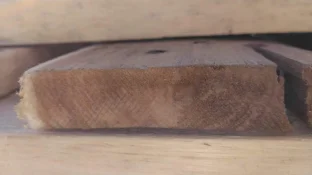
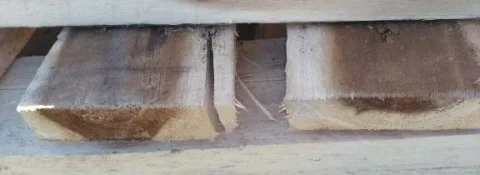
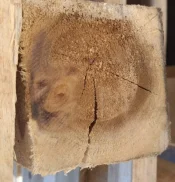
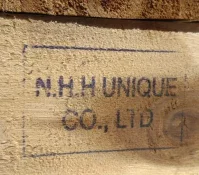
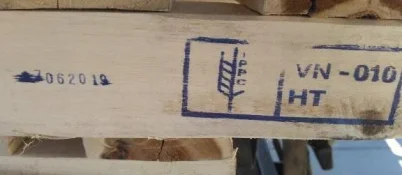
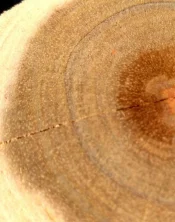
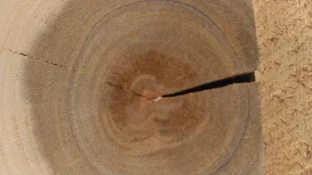
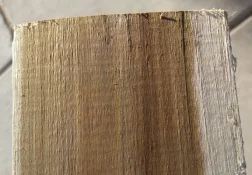
pallet wood nice contrast id help please

End grain pics are not even close to a total loss but I could definitely use a lot more detail. Any chance you can get one of them cleaned up quite a bit?

Mark is better than I am on figuring these things out from such relatively incomplete information.

What's the density?
 
Hey Trev,

I was thinking Chinese tulip, Lirodendron chinense, but those close ups, not sure....
 
Better to send it to me. I'm the one that does the end grain processing for both Mark and myself. I'll PM you my address.
 
Trev, I got the pieces. I've done the preliminary processing but since that doesn't include the fine sanding of the end grain, I haven't attempted any ID so far. My first thought was that the softwood looks like one of those larch-pine-fir pieces that's impossible to ID even down to a genus, BUT ... it doesn't seem to have any resin canals (won't be 100% sure 'til I've done the fine sanding) so that would be impossible. My next off-the-cuff guess was larch, but that ALSO has resin canals which rules it out. I'm going to stop guessing and wait 'til I get the end grain processing done.

The pallet wood is, unfortunately, diffuse porous which is the most common type, so the ID may be difficult but I do note that it has a distinctively triangular pith. That doesn't mean anything to me right now but it might to Mark Peet and it gives me another point to research.

I'll post pics after I've done the final processing.
 
  • Thread Starter Thread Starter
  • #11
Trev, I got the pieces. I've done the preliminary processing but since that doesn't include the fine sanding of the end grain, I haven't attempted any ID so far. My first thought was that the softwood looks like one of those larch-pine-fir pieces that's impossible to ID even down to a genus, BUT ... it doesn't seem to have any resin canals (won't be 100% sure 'til I've done the fine sanding) so that would be impossible. My next off-the-cuff guess was larch, but that ALSO has resin canals which rules it out. I'm going to stop guessing and wait 'til I get the end grain processing done.

The pallet wood is, unfortunately, diffuse porous which is the most common type, so the ID may be difficult but I do note that it has a distinctively triangular pith. That doesn't mean anything to me right now but it might to Mark Peet and it gives me another point to research.

I'll post pics after I've done the final processing.
cool thx
 
I had a pallet that originated from Vietnam some time ago, can’t find it right now but the wood looked similar. From the research I did I thought it was Acacia. (Acacia Mangium or A. Auriculiformis. Or some of many hybrids) seems there are many plantations that grow it.
Not sure if this will help ?

Rob
 
  • Thread Starter Thread Starter
  • #13
this wood is quite a bit softer than acacia, has that nice contrast though. based on the small size appears to be plantation grown as you commented
 
  • Thread Starter Thread Starter
  • #15
"Acacia" encompass about 200 different common wood names spread across 400 species so don't be too quick to judge "acacia" in such a general way.
sorry our acacias here are only very hard wood, but obviously i have a limited scope of knowledge and exposure.

side note on the "fir" one there doesn't appear to be any difference or notable "heartwood" vs new growth. it is whitish yellow all the way to the center
 
Last edited:
  • Thread Starter Thread Starter
  • #16
some pictures that might add to the possible id, under the bark is a stringy layer similar to that on cedar, and a broken qrtr section showing ray flecks and some up close of the little bits of bark i was able to locate,

KIMG1468.webp

KIMG1471.webp

KIMG1474.webp

KIMG1476.webp

KIMG1482.webp

KIMG1484.webp

KIMG1487.webp

KIMG1488.webp

KIMG1489.webp
 
Seeing the new pictures, wonder if the Asiatic balsam group of the Populus genus might have rank...?..
 
Trev, I got the end grain processing done yesterday and since then I've twice poked around my anatomy pages looking for anything close and I've come up dry. Here are some end grain shots --- my standard 1/4" x 1/4". The pores are more distinct in the one dark heartwood area, probably because that area is harder than the lighter softwood areas.

1.webp 2.webp 3.webp 5.webp 6.webp

And here's the triangular pith. I've not made a study of pith shapes and have little information on that. @Mr. Peet might be able to tell something from this. This is a 1/2" x 1/2" area
4.webp
 
Trev, I got the end grain processing done yesterday and since then I've twice poked around my anatomy pages looking for anything close and I've come up dry. Here are some end grain shots --- my standard 1/4" x 1/4". The pores are more distinct in the one dark heartwood area, probably because that area is harder than the lighter softwood areas.

View attachment 172939 View attachment 172940 View attachment 172941 View attachment 172942 View attachment 172943

And here's the triangular pith. I've not made a study of pith shapes and have little information on that. @Mr. Peet might be able to tell something from this. This is a 1/2" x 1/2" area
View attachment 172944

I believe the pith for Lirodendron is chambered (little open pockets like a ladder when bisected). Star sharped are common in the Populus genus, I'm leaning more that direction... Remind me of the density / weight ratio.
 
I believe the pith for Lirodendron is chambered (little open pockets like a ladder when bisected). Star sharped are common in the Populus genus, I'm leaning more that direction... Remind me of the density / weight ratio.
For the density I get about 27lbs/cuft

Doesn't look anything like Populus to me. No distinct growth ring boundaries, pore density way too low, etc.
 
Last edited:
Back
Top