
Buck Grunt Tutorial- The Exhaust and Reed Assm.

BrentWin

Custom sawdust maker
Full Member
Messages
880
Reaction score
1,290
Location
Fulton, MO
First name
Brent
The exhaust half of a grunt is just a tube with a 5/8" hole bored through it, so I will go through it pretty quickly. I mount the 4" blank on the expanding mandrel and round the blank off and taper it down until the top end is just slightly smaller than the bottom of the barrel.
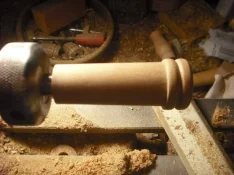
DSCF1785.webp


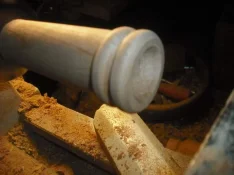
Now it's just a matter of flairing the inside of the exhaust and round off any decoration that you want to put on the end of the tube.
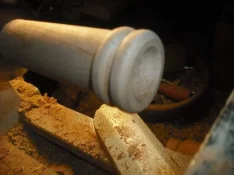
DSCF1784.webp

The next step is to make a part to hold the reed and couple the two halves of the call. I like to use a piece of 5/8" delrin rod. Place an 1-1/2" piece of rod in the collet chuck and drill it out with a 1/2" bit.
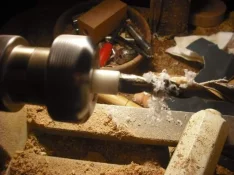
DSCF1789.webp

This is what it will look like when finished.
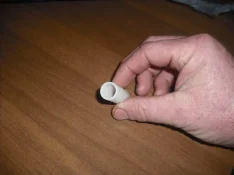
DSCF1798.webp

After the call has been sanded and finished, epoxy the delrin rod about 3/4" into the exhaust and insert the reed. Be sure and set the reed so it stops about 1/8" short of the tip of the tone board.
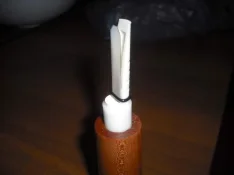
DSCF1799.webp

Here's my call with a quick wipe of BLO and dry fitted. I will post a picture of the completed call in a few days.
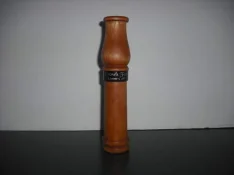
DSCF1802.webp

Hope this helps you get started. Please feel free to ask any questions.
DSCF1784.webp
 
Last edited:
Brent, what is the size of your bands? For this little experiment into calls, I was thinking about just getting a piece of large copper tubing and making them out of that. Do you think this will work? My bro is a plumber and has a bunch of scrap copper pipe.
 
  • Thread Starter Thread Starter
  • #3
1-1/4" OD is standard
 
Last edited:
Where do you get your reed assembly at I would like to try this type of call and I am new to call making.
 
  • Thread Starter Thread Starter
  • #5
Josh, I get mine from the THO Game Call Store or Hut Products. They both have the same guts. You shouldn't have any troubles, but if you do, let me know and I'll help you thru it.

Brent
 
Thanks! I like the two piece wood like this instead of the flex tube. It looks allot nicer.
 
  • Thread Starter Thread Starter
  • #7
Working together, we can stamp out plastic accordion tubes in our lifetime. :rofl:
 
just wondering if you have tried the metal reed assembly w/ bushing they sell or if the style you use on tutorial work better. also is the turning stock 1 1/2"
 
  • Thread Starter Thread Starter
  • #9
I have tried them, but I think that the plastic ones have a richer sound and are more adjustable. Yes, I use 1-1-/2" blanks.
 
Got my first one turned out this am out of tulip wood. I'll post pics when the Poly dries. Ill probably end up making some cosmetic changes later but right now in doing this all with out an expanding mandrel or collet chuck. Overall I'm pretty happy with results.
 
I have another question. What type of expanding mandrel are you using, do you not need a live center on the other end. I made a mandrel for sanding on mine but the chuck has so much run out it doesn't spin true. I am hopefully going to upgrade lathes soon and get a collet chuck also, but for now I am trying to make due. I don't think adding a collet chucking system is even an option on my lathe.
 
  • Thread Starter Thread Starter
  • #13
I currently use a 5/8 expanding mandrel made by Wade over at Webfoot Game calls. I have used the Enco mandrels in the past and they are ok, but for some reason they tend to develope run out over time. That and the screws strip out easily.

You aren't supposed to need a live center with a collet/expanding mandrel set up, but I do for added stability and to prevent run out.

If you are going to get into barrel type calls, a collet/mandrel setup will save you a ton of aggrivation. Most call makers use the PSI collet chuck that you can get on Amazon for about $85 with free shipping. Look on your current lathe. It should be threaded 1"-8 or 3/4"-16. The PSI will fit either.
 
For my calls I use a nova chuck withit the jaws and a pen chuck I had someone machine for me and it works perfect. Cost me nothing as the machinest is a friend
 
Ok thanks, yea I used to be a machinist 10 yrs ago before moving to my present job as a maint. electrician. Kind of aggravating not to have access to a machine shop to make up some jigs now, lol. machining and working with wood is one entirely different animal! I decided back in Feb that I wanted to try to make pot calls for turkey hunting and now I am enjoying more than I thought I would
 
Is there any particular reason you use the little plastic piece to insert the reed assembly and not just make a tenon with the rubber o-ring? Didn't know if it's just because easier that way or some other reason.
 
Is there any particular reason you use the little plastic piece to insert the reed assembly and not just make a tenon with the rubber o-ring? Didn't know if it's just because easier that way or some other reason.
For me it's to save wood as every inch counts :sofa: On an all wood grunt. Plus I don't have to measure the tenon. Take a little off take a little more off. It's 5/8". Drill a hole 5/8" and there you have the perfect fit
 
Yea that's true, the couple calls I have made it is kind of a pain making the tenon just perfect without wasting time and the possibility of messing up the piece all together . How secure does it hold the 2 pieces together?
 
  • Thread Starter Thread Starter
  • #19
Yea that's true, the couple calls I have made it is kind of a pain making the tenon just perfect without wasting time and the possibility of messing up the piece all together . How secure does it hold the 2 pieces together?

The main reason that I use the delrin insert is for strength. The reed assembly that I use is a toneboard and wedge set up. If you force the wedge in too far, you could split a wood tenon. Also, if the barrel shrinks a little over the years, you can push the wedge in further which will flair the insert a little and tighten up the fit of the barrel.
 
Back
Top