D
dovetaildoc
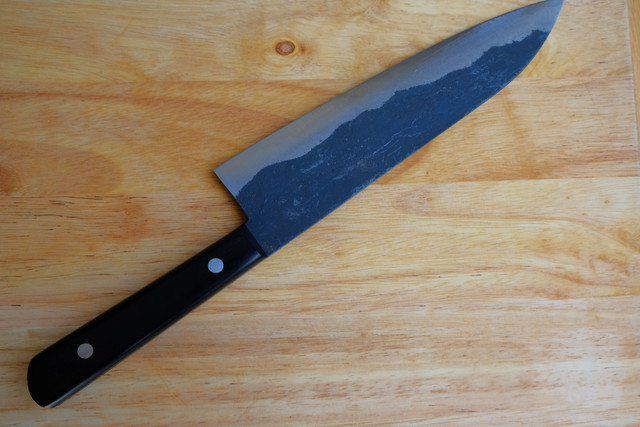
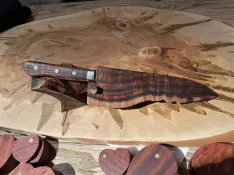
I'm putting Koa scales on kitchen knife blanks, and am interested in ideas of finishing products.
Mike
Mike



Not sure with koa. I dipped several of my knives in oil base polyurethane to make sure they were sealed. Someone has a habit of submerging or even dishwasher use on my knives. If I had it to do again, I would stabilize and polish and be done.I'm putting Koa scales on kitchen knife blanks, and am interested in ideas of finishing products.
Mike
View attachment 236567
View attachment 236568
View attachment 236569

Johnathan, Thank you. As a first coat, the de-waxed shellac helps keep the chatoyancy. I use Lacquer for my Guitars and Ukuleles to great effect, but have been concerned to expose lacquer to the elements of the kitchen. Thanks to your suggestion, I'll try the lacquer. Up until now, I have been using tung oil on the handles, but if someone soaks the handle cleaning it, the protection is poor.Good looking knives.
I've put a couple of dozen together also with various finishes. I've used rattle can catalyzed lacquer more than anything, usually over de-waxed shellac. These have held up well in daily use.
A couple got many coats of pure Tung Oil. These have done OK. This finish is fine as long as you will keep some oil handy and wipe it down occasionally.
A few heavily used knives were finished with multiple coats of Tru-Oil. This has been the most durable finish for knives that get used regularly.
Is your question specific to Koa? What finish do you normally use? What are the results?
 I was wondering if anybody has tried the Rubio Monocoat?
Thank you Doug,The few knives handles I've done I've always stabilized the blanks before I made them because I assume the knives would see some water, even if warned not to put them in the dish water or sink. So for the final finish, I just sand to 600 grit or so and them buff them on a wheel. Same with reel seat inserts. The shine will fade with use but if you buff them again it comes back quickly.

Please put up a listing of your scales & other wood. You probably could overwhelm one thread with all of your wood, so you might instead list one category, like scales, per thread. ChuckThank you Doug,
I started out stabilizing the scales, but found that due to the differences in the porosity of the koa from each different Hawaiian Island and altitude it was grown, the Cactus juice didn't seem to penetrate the darker harder blanks, and was only partially effective on the lighter grained porus pieces. I'll have to re-examine the stabilizing again, perhaps sending a few to K&G for a professional try.
Mike
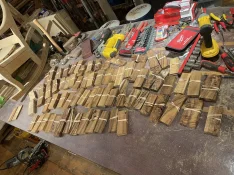
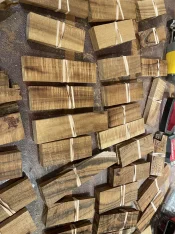
PS: I've got way more scales (and wood) that I can use. If anyone is interested, let me know what sizes, grain curl pattern and color, and I'll list some on the wood for sale pages.
Thanks Chuck,Please put up a listing of your scales & other wood. You probably could overwhelm one thread with all of your wood, so you might instead list one category, like scales, per thread. Chuck


Would be interested in bowl blanks, bigger the better, and 2.5 x 6 x 6” blanks. The curlier and darker the better. Thanks.PS: I've got way more scales (and wood) that I can use. If anyone is interested, let me know what sizes, grain curl pattern and color, and I'll list some on the wood for sale pages.


Certainly the density of the blanks will have an effect on the penetration. What kind of vacuum are you achieving when you stabilize? Maximize your vacuum, wait until all bubble have ceased flowing from the wood, increase your soak time to give the resin time to find all the porous access points. I've stabilized some green osage that was about as hard as anything I've ever done and it seemed to work. Polished up like glass. Otherwise, I'd probably go with Tru Oil.Thank you Doug,
I started out stabilizing the scales, but found that due to the differences in the porosity of the koa from each different Hawaiian Island and altitude it was grown, the Cactus juice didn't seem to penetrate the darker harder blanks, and was only partially effective on the lighter grained porus pieces. I'll have to re-examine the stabilizing again, perhaps sending a few to K&G for a professional try.
Mike
PS: I've got way more scales (and wood) that I can use. If anyone is interested, let me know what sizes, grain curl pattern and color, and I'll list some on the wood for sale pages.


Johnathan, Thank you. As a first coat, the de-waxed shellac helps keep the chatoyancy. I use Lacquer for my Guitars and Ukuleles to great effect, but have been concerned to expose lacquer to the elements of the kitchen. Thanks to your suggestion, I'll try the lacquer. Up until now, I have been using tung oil on the handles, but if someone soaks the handle cleaning it, the protection is poor.