

In the section entitled 'Recent finds, coming attractions & wood showcase' you'll see that founding member 'Shoeless Joe Shadetree' posted photos of extremely rare alligator juniper root burl (Juniperus deppeana) from a fallen tree in Arizona.
Root burls are hard to come by for the obvious reason that they are hidden, but also because the best are from species of trees in out-of-the-way places. Think of chittum and thuya burl. Alligator juniper and thuya root burl are from trees growing at elevation and in challenging conditions (wind and climatic extremes), and all all three are from trees growing in nutrient poor substrate and little water.
I reckon root burls are my favourite as they exhibit small eyes often arranged as cat's paws, and tightly packed and contorted annular rings. While not usually dense and heavy, root burls are very sturdy, like the trees they come from.
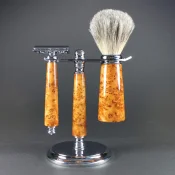
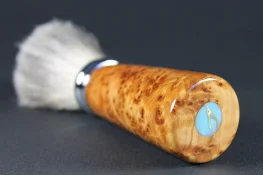
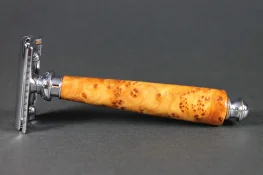
In the attached photographs, you see a matched shaving set made up with some of Joe Shadetree's wood. I believe this may well be the only shave set ever made from alligator juniper root burl. Feel free to tell me know if you differently. The burl wood is super to work with. Each of this shave set's pieces were sanded through 26 applications from 120 to 12,000 grit, then buffed with tripoli and white diamond. The finish is 30 coats of cyano-acrylate (CA). The inset on the bottom of the badger hair shaving brush is turquoise and pyrites, from the mine at Kingman, Arizona. I estimate the tree this root burl came from was well over 100 years old.
Root burls are hard to come by for the obvious reason that they are hidden, but also because the best are from species of trees in out-of-the-way places. Think of chittum and thuya burl. Alligator juniper and thuya root burl are from trees growing at elevation and in challenging conditions (wind and climatic extremes), and all all three are from trees growing in nutrient poor substrate and little water.
I reckon root burls are my favourite as they exhibit small eyes often arranged as cat's paws, and tightly packed and contorted annular rings. While not usually dense and heavy, root burls are very sturdy, like the trees they come from.
In the attached photographs, you see a matched shaving set made up with some of Joe Shadetree's wood. I believe this may well be the only shave set ever made from alligator juniper root burl. Feel free to tell me know if you differently. The burl wood is super to work with. Each of this shave set's pieces were sanded through 26 applications from 120 to 12,000 grit, then buffed with tripoli and white diamond. The finish is 30 coats of cyano-acrylate (CA). The inset on the bottom of the badger hair shaving brush is turquoise and pyrites, from the mine at Kingman, Arizona. I estimate the tree this root burl came from was well over 100 years old.
Last edited:


