

Below is my evaluation and test results of a new hardwax oil I found on Amazon. As noted below, this is not a solicitation, and I am not being compensated in any way for this review. There is no discount codes or affiliate links. If you decide you want to try this product, its available on Amazon or on the company website. I also got the blessing of the Admin to post this review in advance. I welcome any questions or critiques anyone has. Enjoy!
INTRODUCTION & DISCLOSURES:
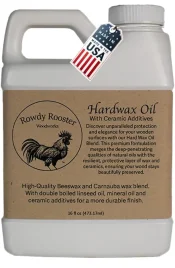
I was perusing Amazon one day and stumbled upon a unique wood finish – a hardwax oil that contains a ceramic additive. The product is made by a small company called Rowdy Rooster, based out of Orwigsburg, PA (https://rowdyroosterwoodworks.com/). The price point of $29 for a pint was very attractive, so I decided to buy it to see how it performed. I decided I was going to do some stain testing on this finish and opted to pit it against the ever-popular Rubio Monocoat Oil+2C.
In the process of doing some research on the product, I decided to contact the manufacturer to get more info on the cure time. I had a lengthy technical discussion with the owner of Rowdy Rooster – Amzi Smith – and I learned a great deal about the product development, the company’s other offerings, and the vision and goals for their product line. Amzi was not only very transparent about everything, but he also geeked out as much as I do about this sort of topic. To be perfectly clear, neither Amzi nor Rowdy Rooster provided any direction in how I conduct my evaluation or how I write my review. I had already decided to do the stain testing with Rubio prior to contacting the company. I paid for the product out of my own pocket and was not reimbursed for the purchase or in any way compensated for my evaluation. I am just doing this because I enjoy it and because I think this company deserves recognition.
I also need to note that Rowdy Rooster did not develop their hardwax oils to compete with Rubio, Odie’s, or any other popular hardwax oil on the market. It is not their intention that this hardwax oil be a direct competitor to Rubio, Odies, Natura, Osmo, etc. It was solely my decision to compare this Rowdy Rooster hardwax oil to Rubio Monocoat hardwax oil. Any conclusions I drew between the two hardwax oils should be taken at face value and not be treated as being indicative of finish quality.
MATERIAL DATA & COST COMPARISON:
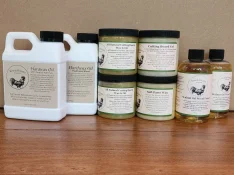
Rowdy Rooster offers 2 hardwax oils – a more conventional hardwax oil and the one I evaluated which contains ceramic additives. Both Rowdy Rooster hardwax oils are 1 component finishes, though there is a siccative in the linseed oil to accelerate curing. The composition of the hardwax oil w/ceramics is as noted below with notes from Amzi explaining the ingredient usage in parentheses. No claims are made by me or the manufacturer as to food safety of this finish. The finish was developed with furniture makers in mind.
According to Amzi, the product was formulated to have a shelf life of multiple years. All Rowdy Rooster products are formulated and tested in a lab environment for behavioral characteristics such as viscosity, absorption times, curing time (which is also composed of controlled results as well as in use testing), temperature stability and performance. Then once reviewed for production compliance and procedural steps our products are tested in-use with wood species typical to the states and commonly used for furniture, oak, black walnut and maple.
Perhaps the most attractive feature of this finish is the price. This hardwax oil is a fraction of the cost of its competitors. A comparison of the total cost and cost per ounce for 2 common competitors is below. These are prices listed on the manufacturer’s website at the time of this writing.
TEST SYNOPSIS & INITIAL IMPRESSIONS:
My initial impressions were that Rowdy Rooster shows more chatoyance and contrast than Rubio, but the final color and tone of the cured hardwax oils are otherwise the same. In liquid form, the viscosity of the oils are nearly identical. Once fully cured, Rowdy Rooster retained a more silky/oily feel, but no oil residue came off on my fingers or with vigorous rubbing of a paper towel. Cured Rubio felt completely dry to the touch and somewhat rough.
Since I was originally conducting this test for my own use, I planned the test according to my typical usage and not necessarily according to manufacturer’s recommendations. As such, I applied 2 coats of Rubio Monocoat instead of a single coat as directed by the manufacturer. The Part B hardener was used in normal 1:3 ratio to Part A for both coats. For the Rowdy Rooster, the instructions say to apply at least 2 coats, so I applied 3 coats. All coats were spaced out at least 24 hours. Both test pieces cured for 1 month before any testing was performed. I did not include an unfinished test piece as a baseline, because I felt as though I have a very good idea of how the material would perform on a test like this.
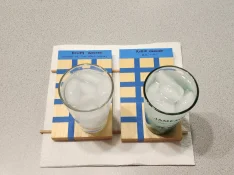
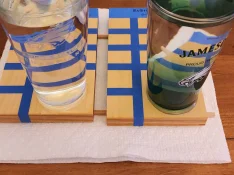
My stain testing consisted of sample boards of ¾” Baltic birch plywood (cut from the same board). I conducted a water ring test with a glass pint of ice water on the test piece for 6 hours followed by stain testing for a 1 hour duration with ketchup, mustard, hot coffee, red wine, white vinegar, Windex, simple green (10:1 from concentrate), zep orange degreaser, Clorox bathroom cleaner with bleach, 70% isopropyl alcohol, and black and green sharpie markers. The test pieces were gently wiped down with mild soapy water and patted dry. This was done to remove any stain materials sitting on the surface, as that would not be representative of stain penetration. This wiping also removed some surface residues leftover from a few cleaners.
Water Ring Test (GO BIRDS!!!):
Stain Tests:
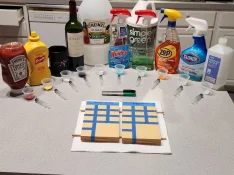
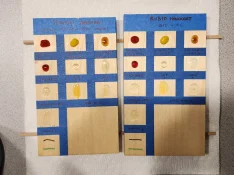
After I had completed my testing, I decided I should probably also make up some test pieces of hardwoods to show the appearance on something other than Baltic birch ply. I created 4 small samples using offcuts of soft maple, genuine mahogany, purpleheart, and what I believe is some kind of acacia. These samples were only fabbed up last night, so the finish is only 1 coat and is not cured. I did not create any sample of Rubio, so this is only Rowdy Rooster.
TEST RESULTS & CONCLUSIONS:
In summary, both products provided considerable protection over what would be expected of raw wood. As stated previously, I do not have a baseline for comparison, but anyone who has worked with plywood at all knows it is essentially just a sponge for stains and water is its enemy.
For all tests, it seems as though the Rowdy Rooster didn’t seal out moisture as well as Rubio. Rowdy Rooster still provided considerable moisture protection, but Rubio performed closer to a varnish or polyurethane. From my past experience using Rubio Monocoat, I assume a significant contribution to the water resistance of this finish is due to the Part B hardener. In hindsight, a test comparing Rowdy Rooster to Rubio Part A alone would be a more appropriate material comparison.
Both Rowdy Rooster and Rubio showed a water ring from the ice water pint test. The ring from the rowdy rooster was more pronounced than Rubio. Both are difficult to see unless viewed from a sharp angle.
The results of the stain tests are summarized below (broken out into 2 tables for space):
Food & Sharpie Markers:
Key:
0 – No detectable stain
1 – Faint stain, only detectable at certain angles & lighting conditions
2 – Light stain, visible at multiple angles or under bright to moderate light
3 – Moderate stain, visible at all angles under most lighting conditions, significant stain removal at cleanup
4 – Dark stain, visible under all conditions, slight stain removal at cleanup
5 – Severe stain, no stain removal at cleanup
Cleaners & Miscellaneous:
Key:
0 – No detectable damage or stain
1 – Faint damage/stain, only detectable at certain angles & lighting conditions
2 – Light damage/stain, visible at multiple angles or under bright to moderate light, slight sheen change
3 – Moderate damage/stain, visible at all angles under most lighting conditions, moderate sheen change
4 – Substantial damage/stain, visible under all conditions, severe sheen change and/or slight discoloration
5 – Severe damage/stain, no stain removal at cleanup, wood fibers exposed and significant discoloration
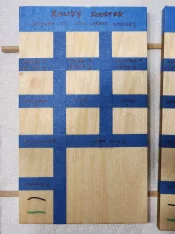
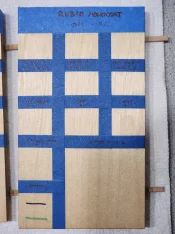
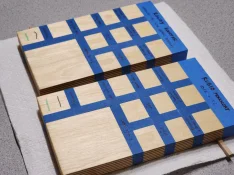
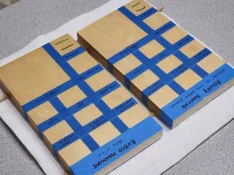
Rubio performed the same or better than Rowdy Rooster in every test conducted, but it should be noted that the results between the two were extremely close except for the red wine and mustard tests where the difference in performance was more notable. Both Rowdy Rooster and Rubio struggled with the sharpie markers and Clorox bathroom cleaner. They both did better than expected with red wine and hot coffee. Rowdy Rooster performed surprisingly poor against mustard. Although not pictured, I wiped the sharpie tests with 70% isopropyl alcohol at the very end, and both finishes saw approximately a 50% removal of the sharpie markers.
Its not clear to me what contribution if any the ceramic additives have on the performance of this hardwax oil, since I did not compare the standard Rowdy Rooster hardwax oil to the ceramic version. Amzi stated the ceramics showed a slight increase in protection during his lab testing, so at this point I can only take him at his word. This is a very unique ingredient; therefore, I cannot draw on experience to make predictions or assessments.
After evaluating the test results, I believe this Rowdy Rooster hardwax oil is a good finish that is well suited for pieces that will not see regular exposure to food or cleaners. I think it would make a nice non-dining furniture finish. The silky feel and superior chatoyance and contrast make it a good choice for fine furniture and any pieces with figure and/or contrasting grain. The price point is likely to be a major selling point for many as it’s a mere fraction of the cost of other hardwax oils.
Full resolution images/videos and additional images not pictured above can be viewed at this link: https://photos.app.goo.gl/otRugLHz7eAJ4uMK9
INTRODUCTION & DISCLOSURES:
I was perusing Amazon one day and stumbled upon a unique wood finish – a hardwax oil that contains a ceramic additive. The product is made by a small company called Rowdy Rooster, based out of Orwigsburg, PA (https://rowdyroosterwoodworks.com/). The price point of $29 for a pint was very attractive, so I decided to buy it to see how it performed. I decided I was going to do some stain testing on this finish and opted to pit it against the ever-popular Rubio Monocoat Oil+2C.
In the process of doing some research on the product, I decided to contact the manufacturer to get more info on the cure time. I had a lengthy technical discussion with the owner of Rowdy Rooster – Amzi Smith – and I learned a great deal about the product development, the company’s other offerings, and the vision and goals for their product line. Amzi was not only very transparent about everything, but he also geeked out as much as I do about this sort of topic. To be perfectly clear, neither Amzi nor Rowdy Rooster provided any direction in how I conduct my evaluation or how I write my review. I had already decided to do the stain testing with Rubio prior to contacting the company. I paid for the product out of my own pocket and was not reimbursed for the purchase or in any way compensated for my evaluation. I am just doing this because I enjoy it and because I think this company deserves recognition.
I also need to note that Rowdy Rooster did not develop their hardwax oils to compete with Rubio, Odie’s, or any other popular hardwax oil on the market. It is not their intention that this hardwax oil be a direct competitor to Rubio, Odies, Natura, Osmo, etc. It was solely my decision to compare this Rowdy Rooster hardwax oil to Rubio Monocoat hardwax oil. Any conclusions I drew between the two hardwax oils should be taken at face value and not be treated as being indicative of finish quality.
MATERIAL DATA & COST COMPARISON:
Rowdy Rooster offers 2 hardwax oils – a more conventional hardwax oil and the one I evaluated which contains ceramic additives. Both Rowdy Rooster hardwax oils are 1 component finishes, though there is a siccative in the linseed oil to accelerate curing. The composition of the hardwax oil w/ceramics is as noted below with notes from Amzi explaining the ingredient usage in parentheses. No claims are made by me or the manufacturer as to food safety of this finish. The finish was developed with furniture makers in mind.
- Beeswax (self-explanatory)
- Mineral Oil (for absorption and to provide a capillary path for the curing oil)
- Boiled Linseed Oil (polymerized and contains a proprietary drier)
- Carnauba Wax (self-explanatory)
- Odorless Mineral Spirits (for absorption and to provide a capillary path for the curing oil)
- Silicone Dioxide 20nm (shown surface protection improvement without a change of color in the final result)
According to Amzi, the product was formulated to have a shelf life of multiple years. All Rowdy Rooster products are formulated and tested in a lab environment for behavioral characteristics such as viscosity, absorption times, curing time (which is also composed of controlled results as well as in use testing), temperature stability and performance. Then once reviewed for production compliance and procedural steps our products are tested in-use with wood species typical to the states and commonly used for furniture, oak, black walnut and maple.
Perhaps the most attractive feature of this finish is the price. This hardwax oil is a fraction of the cost of its competitors. A comparison of the total cost and cost per ounce for 2 common competitors is below. These are prices listed on the manufacturer’s website at the time of this writing.
Rowdy Rooster HW Oil w/Ceramic: $28.95 for 16oz = $1.80/oz
Rubio Monocoat Oil+2C: $59.99 for 390mL (13.19oz) = $4.55/oz
Odie’s Oil – Odie’s Universal Oil: $55.91 for 9oz = $6.21/oz
TEST SYNOPSIS & INITIAL IMPRESSIONS:
My initial impressions were that Rowdy Rooster shows more chatoyance and contrast than Rubio, but the final color and tone of the cured hardwax oils are otherwise the same. In liquid form, the viscosity of the oils are nearly identical. Once fully cured, Rowdy Rooster retained a more silky/oily feel, but no oil residue came off on my fingers or with vigorous rubbing of a paper towel. Cured Rubio felt completely dry to the touch and somewhat rough.
Video showing chatoyance & contrast: https://photos.app.goo.gl/k6AtReTSFqDyq7fL8
Since I was originally conducting this test for my own use, I planned the test according to my typical usage and not necessarily according to manufacturer’s recommendations. As such, I applied 2 coats of Rubio Monocoat instead of a single coat as directed by the manufacturer. The Part B hardener was used in normal 1:3 ratio to Part A for both coats. For the Rowdy Rooster, the instructions say to apply at least 2 coats, so I applied 3 coats. All coats were spaced out at least 24 hours. Both test pieces cured for 1 month before any testing was performed. I did not include an unfinished test piece as a baseline, because I felt as though I have a very good idea of how the material would perform on a test like this.
My stain testing consisted of sample boards of ¾” Baltic birch plywood (cut from the same board). I conducted a water ring test with a glass pint of ice water on the test piece for 6 hours followed by stain testing for a 1 hour duration with ketchup, mustard, hot coffee, red wine, white vinegar, Windex, simple green (10:1 from concentrate), zep orange degreaser, Clorox bathroom cleaner with bleach, 70% isopropyl alcohol, and black and green sharpie markers. The test pieces were gently wiped down with mild soapy water and patted dry. This was done to remove any stain materials sitting on the surface, as that would not be representative of stain penetration. This wiping also removed some surface residues leftover from a few cleaners.
Water Ring Test (GO BIRDS!!!):
Stain Tests:
After I had completed my testing, I decided I should probably also make up some test pieces of hardwoods to show the appearance on something other than Baltic birch ply. I created 4 small samples using offcuts of soft maple, genuine mahogany, purpleheart, and what I believe is some kind of acacia. These samples were only fabbed up last night, so the finish is only 1 coat and is not cured. I did not create any sample of Rubio, so this is only Rowdy Rooster.
Video showing finish on hardwood samples: https://photos.app.goo.gl/f2hNZr2LPpeBvACUA
TEST RESULTS & CONCLUSIONS:
In summary, both products provided considerable protection over what would be expected of raw wood. As stated previously, I do not have a baseline for comparison, but anyone who has worked with plywood at all knows it is essentially just a sponge for stains and water is its enemy.
For all tests, it seems as though the Rowdy Rooster didn’t seal out moisture as well as Rubio. Rowdy Rooster still provided considerable moisture protection, but Rubio performed closer to a varnish or polyurethane. From my past experience using Rubio Monocoat, I assume a significant contribution to the water resistance of this finish is due to the Part B hardener. In hindsight, a test comparing Rowdy Rooster to Rubio Part A alone would be a more appropriate material comparison.
Both Rowdy Rooster and Rubio showed a water ring from the ice water pint test. The ring from the rowdy rooster was more pronounced than Rubio. Both are difficult to see unless viewed from a sharp angle.
Video showing results of water ring test (next day): https://photos.app.goo.gl/YCt9gpYnYBwJphsr6
The results of the stain tests are summarized below (broken out into 2 tables for space):
Food & Sharpie Markers:
Ketchup | Mustard | Hot Coffee | Red Wine | Sharpie Markers | |
| Rowdy Rooster | 0 | 2 | 1 | 3 | 5 |
| Rubio | 0 | 0 | 0 | 2 | 5 |
0 – No detectable stain
1 – Faint stain, only detectable at certain angles & lighting conditions
2 – Light stain, visible at multiple angles or under bright to moderate light
3 – Moderate stain, visible at all angles under most lighting conditions, significant stain removal at cleanup
4 – Dark stain, visible under all conditions, slight stain removal at cleanup
5 – Severe stain, no stain removal at cleanup
Cleaners & Miscellaneous:
White Vinegar | Windex | Simple Green | ZEP Degreaser | Clorox w/Bleach | 70% Iso. Alcohol | |
| Rowdy Rooster | 0 | 1 | 1 | 1 | 3 | 0 |
| Rubio | 0 | 0 | 0 | 0 | 3 | 0 |
0 – No detectable damage or stain
1 – Faint damage/stain, only detectable at certain angles & lighting conditions
2 – Light damage/stain, visible at multiple angles or under bright to moderate light, slight sheen change
3 – Moderate damage/stain, visible at all angles under most lighting conditions, moderate sheen change
4 – Substantial damage/stain, visible under all conditions, severe sheen change and/or slight discoloration
5 – Severe damage/stain, no stain removal at cleanup, wood fibers exposed and significant discoloration
Rubio performed the same or better than Rowdy Rooster in every test conducted, but it should be noted that the results between the two were extremely close except for the red wine and mustard tests where the difference in performance was more notable. Both Rowdy Rooster and Rubio struggled with the sharpie markers and Clorox bathroom cleaner. They both did better than expected with red wine and hot coffee. Rowdy Rooster performed surprisingly poor against mustard. Although not pictured, I wiped the sharpie tests with 70% isopropyl alcohol at the very end, and both finishes saw approximately a 50% removal of the sharpie markers.
Its not clear to me what contribution if any the ceramic additives have on the performance of this hardwax oil, since I did not compare the standard Rowdy Rooster hardwax oil to the ceramic version. Amzi stated the ceramics showed a slight increase in protection during his lab testing, so at this point I can only take him at his word. This is a very unique ingredient; therefore, I cannot draw on experience to make predictions or assessments.
After evaluating the test results, I believe this Rowdy Rooster hardwax oil is a good finish that is well suited for pieces that will not see regular exposure to food or cleaners. I think it would make a nice non-dining furniture finish. The silky feel and superior chatoyance and contrast make it a good choice for fine furniture and any pieces with figure and/or contrasting grain. The price point is likely to be a major selling point for many as it’s a mere fraction of the cost of other hardwax oils.
Full resolution images/videos and additional images not pictured above can be viewed at this link: https://photos.app.goo.gl/otRugLHz7eAJ4uMK9

