

Had a chance to do a little looking this evening. My study didn't really turn up anything new.
My Brown-Driver-Briggs Hebrew and English Lexicon (BDB) doesn't suggest anything for almug.
One of my study Bibles has a note that reads, "Its identity is unknown, though some suggest it is juniper."
One interesting thing to note though is a connection with 2 Chronicles 2:8 and 2 Chronicles 9:10-11, with the building of the temple being chronicled there as well. These verses mention algum wood. That swapping of those two letters also occurs in the Hebrew text. Keep in mind that these ancient scrolls would have been hand copied and occasionally copying errors would get missed. Some of the copying would even be done with one person reading from a scroll and a room full of people writing down what was read to them. This could lead one down the path of studying variants in texts, etc.
For algum, my BDB only mentions sandalwood - "perh. sandal-wood". Which is what Strong's Concordance also suggests.
In 2 Chronicles 9:11 echoes 1 Kings 10:12 and it's said that the algum wood was made into steps (could also mean supports), but also into lyres and harps. As steps or supports - both sandalwood and juniper are rot resistant (though perhaps not so much of a concern in the dry climate of Jerusalem as it would be somewhere with a wet climate), though juniper would've yielded larger pieces of timber - important, depending on where and how it was used in construction. As tone woods - juniper can be a tone wood and a search for sandalwood instruments suggests that it can also be used in musical instruments.
Considering that almug and algum are both used to refer to the exact same thing in different accounts, it's certain that these two words refer to the same wood.
To be honest, I'm not sure we can say for certain which wood is being referenced - juniper or sandalwood - or if it could even be another wood. Both of these woods would have been fitting for use in the building of the Lord's house and for instruments in use there. No expense was spared in searching out the best for the building of the temple and, since suitable wood for the endeavor did not exist in the area of Jerusalem or in Israel, such wood had to be imported.
So, in the end, a long post to say that, after doing some study, I don't know and have no suggestions, beyond what has already been given, as to which wood is being spoken of. A case could be made for it being either wood.
This post brought to you by the following printed resources, as well as a few digital resources:
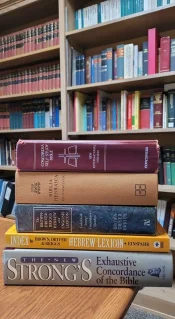
Now back to work! I needed to grab these off the shelf tonight anyways - tonight I'm working on preparing a sermon on Psalm 73:23-26 for a funeral on Thursday.
My Brown-Driver-Briggs Hebrew and English Lexicon (BDB) doesn't suggest anything for almug.
One of my study Bibles has a note that reads, "Its identity is unknown, though some suggest it is juniper."
One interesting thing to note though is a connection with 2 Chronicles 2:8 and 2 Chronicles 9:10-11, with the building of the temple being chronicled there as well. These verses mention algum wood. That swapping of those two letters also occurs in the Hebrew text. Keep in mind that these ancient scrolls would have been hand copied and occasionally copying errors would get missed. Some of the copying would even be done with one person reading from a scroll and a room full of people writing down what was read to them. This could lead one down the path of studying variants in texts, etc.
For algum, my BDB only mentions sandalwood - "perh. sandal-wood". Which is what Strong's Concordance also suggests.
In 2 Chronicles 9:11 echoes 1 Kings 10:12 and it's said that the algum wood was made into steps (could also mean supports), but also into lyres and harps. As steps or supports - both sandalwood and juniper are rot resistant (though perhaps not so much of a concern in the dry climate of Jerusalem as it would be somewhere with a wet climate), though juniper would've yielded larger pieces of timber - important, depending on where and how it was used in construction. As tone woods - juniper can be a tone wood and a search for sandalwood instruments suggests that it can also be used in musical instruments.
Considering that almug and algum are both used to refer to the exact same thing in different accounts, it's certain that these two words refer to the same wood.
To be honest, I'm not sure we can say for certain which wood is being referenced - juniper or sandalwood - or if it could even be another wood. Both of these woods would have been fitting for use in the building of the Lord's house and for instruments in use there. No expense was spared in searching out the best for the building of the temple and, since suitable wood for the endeavor did not exist in the area of Jerusalem or in Israel, such wood had to be imported.
So, in the end, a long post to say that, after doing some study, I don't know and have no suggestions, beyond what has already been given, as to which wood is being spoken of.
A case could be made for it being either wood.This post brought to you by the following printed resources, as well as a few digital resources:
Now back to work! I needed to grab these off the shelf tonight anyways - tonight I'm working on preparing a sermon on Psalm 73:23-26 for a funeral on Thursday.


