• New Woodbarter Hats Are Available!!! Scroll down on the main page to the Member Activities & Site Support, Then click on Wood Barter SCHWAG and go to the topics on hats by Woodtickgreg to order your hat. There's only a limited quanity, so don't wait to get yours.

An olive colored ironwood, mystery wood or ??!

TimR

Sawdust Engineer
Full Member
Messages
6,241
Reaction score
10,646
Location
Lake Park, GA
First name
Tim
@Friedrich9 , @Big Ry , @daniscool , @Mr. Peet
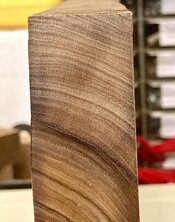
Ok guys, I’m going out on a limb even using term ironwood, but it has a density of about 69.84 pcf, not a floater. I sanded both sides of oxidation and sanded ends thru grits to 600. The end grain shots are 1-1/8” across. I don’t have microscope but using 10x pores seem tight and uniform. I don’t have much sense of smell but my wife likened the fresh cut as sweet and perhaps like cardamom.
Density comes out to 69.84 pcf conservative given void on one end
Whatcha think?
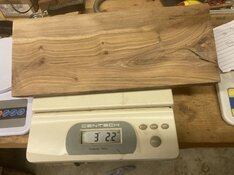
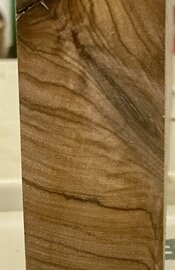
IMG_5746.jpeg

IMG_5745.jpeg

IMG_5743.jpeg
 

Big Ry

Member
Full Member
Messages
1,279
Reaction score
1,437
Location
Philadelphia, PA
First name
Ryan
To me it looks like Italian olive (Olea europaea) with the swirling brown and the structure of the end grain. It would also be consistent with that density, but it seems there may be larger ranges than wood database provides. Either way, Italian olive is typically pretty heavy stuff. I have live edge slabs, turning blanks, off-cuts, ect. Theyre all quite dense. If youre up for it, I'd actually give it a bath to see if it truly sinks. That's one way to obtain some useful data. I was trying to ID a small piece labelled as lignum a month or so ago. My PEC caliper-measured density said it was around the same - 69pcf, but when I threw it in a cup of water it didn't completely sink. One corner poked above the surface, so clearly it was slightly less than 62.4pcf. Having said that, I measured the weight using my scale that I now believe to be inaccurate. This test was one of the things that made me question the scale's accuracy.
 

Friedrich9

Member
Full Member
Messages
1,008
Reaction score
1,207
Location
Ohio
First name
Frederick
It very well could be cape olive. I’d be lying if I said I had the eye to distinguish between the different Olea species. Or a sub variety of the cape olive. It looks a little darker than Italian olive wood. But this isn’t a group of woods I have a lot of experience with
 

TimR

Sawdust Engineer
Full Member
Messages
6,241
Reaction score
10,646
Location
Lake Park, GA
First name
Tim
  • Thread Starter Thread Starter
  • #7
To me it looks like Italian olive (Olea europaea) with the swirling brown and the structure of the end grain. It would also be consistent with that density, but it seems there may be larger ranges than wood database provides. Either way, Italian olive is typically pretty heavy stuff. I have live edge slabs, turning blanks, off-cuts, ect. Theyre all quite dense. If youre up for it, I'd actually give it a bath to see if it truly sinks. That's one way to obtain some useful data. I was trying to ID a small piece labelled as lignum a month or so ago. My PEC caliper-measured density said it was around the same - 69pcf, but when I threw it in a cup of water it didn't completely sink. One corner poked above the surface, so clearly it was slightly less than 62.4pcf. Having said that, I measured the weight using my scale that I now believe to be inaccurate. This test was one of the things that made me question the scale's accuracy.
Sank in 10 inches of water like the proverbial rock. Sitting on the bottom of the container.

IMG_5805.jpeg
 

TimR

Sawdust Engineer
Full Member
Messages
6,241
Reaction score
10,646
Location
Lake Park, GA
First name
Tim
  • Thread Starter Thread Starter
  • #10
I was thinking more likely a rock similar to the one in the story of Sisyphus. :good2:
or the same stone that took down Goliath!!😀
 
Last edited:
Top