
• New Woodbarter Hats Are Available!!! Scroll down on the main page to the Member Activities & Site Support, Then click on Wood Barter SCHWAG and go to the topics on hats by Woodtickgreg to order your hat. There's only a limited quanity, so don't wait to get yours.

Beetles

DLJeffs

Member
Full Member
Messages
6,889
Reaction score
17,535
Location
central Oregon
First name
Doug
I bought some new resin that is supposed to cure slower, at lower temperature, so less bubble formation. And we're supposed to be in the 80's all this week. The resin says it's best to cast when the resin temperature will be above 70F. So my next project is going to be this. This is a 6 inch long coconut beetle. We caught this checking under the street lights back when I was in high school. I injected it with formaldehyde and pineed it into position on that styrofoa,. It's been in a box ever since.
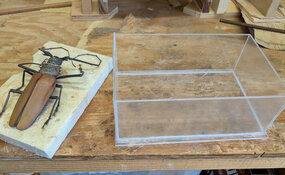
coconut beetle with acrylic mold.jpg

I figure three layers. The first will be a base, about 75% cured, and then stick the beetle in so it is secure and won't float. I'll paint the underside of the beetle heavily right before sticking it into the resin, and then pour it up to the jaw level. That will cover the underside and hopefully minimize bubbles. Then the last pour will cover the beetle sufficiently to give me room to sand and polish the final. The mold is hand made from 1/16" acrylic plastic. When we did this back when I was in high school we used old aluminium pans. This will be better because I can see through the sides and see what's going on under the beetle, etc. I'll wax the inside of the mold before starting the pour but I fully expect to have to trim it off with my bandsaw, we'll see how it goes.

If this one goes well, I have a matched pair of rhinoceros beetles and a pair of fire beetles to also cast.
 
Last edited:

DLJeffs

Member
Full Member
Messages
6,889
Reaction score
17,535
Location
central Oregon
First name
Doug
  • Thread Starter Thread Starter
  • #2
Started on the coconut beetle today. This is an all day project, once you start you need to be on standby for the next step. I poured about a 3/8" base layer right around two (I had to go get mix cups and measure and mark volume lines on them). Then that had to set a couple hours to (1) set up stiff enough to support the beetle so it wouldn't sink to the bottom, and (2) the instructions said the best way to hide the line between layers is to wait about 4 hours between layers. So around 6pm I went out and mixed a larger batch, painted the bottom of the beetle, set it into the mold, and poured the second layer. Then I found it still wanted to float so I devised a little hold-down that I'll go out and remove in another half hour. The resin will be set up enough to hold the beetle in position.

coconut beetle first two layers.jpg

Then I discovered I had too much leftover resin to waste, so I decided to use it for the base layers for the two smaller fire beetles. I cut the bottom off a feta cheese container for one of them and quickly cut and glued together another acrylic mold for the other. These beetles set on their bellies (the coconut beetle stood on it's legs) so these can go onto the first layer sooner because they float rather than sink.

fire beetle base layer.jpg

underside of fire beetle precoated.jpg

So far it's looking pretty good. The resin still heats up as it cures but it seems to stay very clear and release bubbles easily. The big concern will come when I completely cover the beetles (which are hollow and filled with air) and as the resin heats up, that air expands and has no where to go except out along the surface of the beetle.
 

DLJeffs

Member
Full Member
Messages
6,889
Reaction score
17,535
Location
central Oregon
First name
Doug
  • Thread Starter Thread Starter
  • #3
Well, so much for that. The final pours turned out more or less just like they always did when I was in high school. The exothermic reaction of the epoxy causes the air inside the beetles to expand and it's forced to find the path of least resistance. From a scientific standpoint, the specimens would still be useful, but from an aesthetic perspective, they're ruined. I guess a pressure pot is the only way to prevent the air from escaping like this and I don't have one of those.

coconut beetle close up.jpg

coconut beetle final pour.jpg

fire beetle in cheese mold.jpg fire beetle in acrylic mold.jpg
 
Last edited:

Nubsnstubs

Where is it???
Full Member
Messages
4,269
Reaction score
10,281
Location
Tucson, Arizona
First name
Jerry
Well, so much for that. The final pours turned out more or less just like they always did when I was in high school. The exothermic reaction of the epoxy causes the air inside the beetles to expand and it's forced to find the path of least resistance. From a scientific standpoint, the specimens would still be useful, but from an aesthetic perspective, they're ruined. I guess a pressure pot is the only way to prevent the air from escaping like this and I don't have one of those.

View attachment 289955

View attachment 289954

View attachment 289956View attachment 289957
The large beetle looks like it's lungs were crushed, but the other two look like they farted. :sofa:
That's too bad, especially the coconut beetle as you probably won't ever get another one.
Do you think if you had a pressurized pot, would it have crushed them because of the voids inside the body, or would the pressure have been equalized?.............. Nubs
 
Last edited:

DLJeffs

Member
Full Member
Messages
6,889
Reaction score
17,535
Location
central Oregon
First name
Doug
  • Thread Starter Thread Starter
  • #5
I don't know Jerry. I have never tried one of these in a pressure pot. I think as long as you increased the pressure slowly enough that the pressure inside the beetle's exoskeleton had a chance to equalize with the increased pressure on the outside, it wouldn't damage the beetle. In my experience, these beetles have lots of little holes, some natural and some made by me when I injected them with formaldehyde, for the air to escape. My science teacher in high school, and the guy who got me into collecting and casting these, had a bell jar in his room. I tried for a couple years to figure out a way to cast the beetles inside the bell jar, so we could cast them in a vacuum. Removing the air seems like the best way to prevent it from expanding in the hot epoxy. But being glass, i couldn't figure out a way to get a hose inside to pour in the epoxy. We tried pouring these in an ice bath, experimenting with different ratios of resin and catalyst, etc. I even tried injecting epoxy into a beetle to fill the void with epoxy, but we never solved the problem of expanding air. I think the best solution will be when they develop an epoxy that isn't exothermic. I had high hopes for that coconut beetle too. And you're correct, those are the last ones I have. I have a mated pair of rhinoceros beetles still that haven't been cast but I think I'll wait on them now.
 
Last edited:

Sprung

Amateur Sawdust Maker
Full Member
Messages
9,733
Reaction score
16,243
Location
WI
First name
Matt
Well, so much for that. The final pours turned out more or less just like they always did when I was in high school. The exothermic reaction of the epoxy causes the air inside the beetles to expand and it's forced to find the path of least resistance. From a scientific standpoint, the specimens would still be useful, but from an aesthetic perspective, they're ruined. I guess a pressure pot is the only way to prevent the air from escaping like this and I don't have one of those.

View attachment 289955

View attachment 289954

View attachment 289956View attachment 289957

An idea to consider trying before considering a total loss - maybe drilling a couple tiny holes on opposite ends of the air bubbles,, and also certainly into the high points as well, into the air bubbles. Put resin into a syringe and force into one hole to fill the air bubble. The other hole(s) lets air out and resin flow and could allow you to fill in the bubble. Never done anything like I've proposed, but could maybe let you save these - or at least try to.
 

vegas urban lumber

Member
Full Member
Messages
4,058
Reaction score
6,519
Location
las vegas
First name
trev
Well, so much for that. The final pours turned out more or less just like they always did when I was in high school. The exothermic reaction of the epoxy causes the air inside the beetles to expand and it's forced to find the path of least resistance. From a scientific standpoint, the specimens would still be useful, but from an aesthetic perspective, they're ruined. I guess a pressure pot is the only way to prevent the air from escaping like this and I don't have one of those.

View attachment 289955

View attachment 289954

View attachment 289956View attachment 289957
drill a hole in the air bubble, chip the opening larger, then slow pour or syringe in fresh thin epoxy to fill the void
dang sprunger beat me to it
 

vegas urban lumber

Member
Full Member
Messages
4,058
Reaction score
6,519
Location
las vegas
First name
trev
or do them upside down on a pre set bed of epoxy, then polish the top side as the air would have traveled down (once turned over) if any
 
Top