

My daughter and I were over at the local craft/artisan store in our little town about a month ago. I sell a few bowls and a few candle holders there every year and was replenishing my stock for the holiday season. Anyway, she saw a French rolling pin and really liked it but it was $60, which we both thought was ridiculous, so I told her I'd just make her one.
I had a few nice billets of Billy Webb Wood on hand so decided to use one. Billy Webb wood LOOKS to be coarse grained because of the interlocked grain pattern, but it is quite hard/dense and closed grain (diffuse porous with small pores) so makes a great rolling pin.
I screwed up slightly in that one end is just a hair thicker than the other but she was happy about that because it provides slightly more flexibility.
Here it is after quite a few uses.

And here it is moistened with water to show what it looks like after an application of food safe mineral spirits (aka butcher block oil). This is not well focused but shows the color quite well.

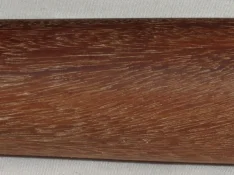
And here's a closeup unmoistened, to show what I mean when I say it LOOKS to be coarse grained.
I had a few nice billets of Billy Webb Wood on hand so decided to use one. Billy Webb wood LOOKS to be coarse grained because of the interlocked grain pattern, but it is quite hard/dense and closed grain (diffuse porous with small pores) so makes a great rolling pin.
I screwed up slightly in that one end is just a hair thicker than the other but she was happy about that because it provides slightly more flexibility.
Here it is after quite a few uses.
And here it is moistened with water to show what it looks like after an application of food safe mineral spirits (aka butcher block oil). This is not well focused but shows the color quite well.
And here's a closeup unmoistened, to show what I mean when I say it LOOKS to be coarse grained.


