• New Woodbarter Hats Are Available!!! Scroll down on the main page to the Member Activities & Site Support, Then click on Wood Barter SCHWAG and go to the topics on hats by Woodtickgreg to order your hat. There's only a limited quanity, so don't wait to get yours.

Commandancy of the The Alamo

Wildthings

ASTROS '23 ALCS CHAMPIONS runnerup
Full Member
Messages
9,219
Reaction score
15,018
Location
Gulf Coast of Texas
First name
Barry
  • Thread Starter Thread Starter
  • #41
LOL I take no credit for this as it's a copy and paste..I just love TX history and passing it along!
 

Kevin

Wood is good.
Founding Member
In Memoriam
Messages
30,918
Reaction score
37,297
Location
Texas
First name
Kevin
LOL I take no credit for this as it's a copy and paste..I just love TX history and passing it along!

I know you didn't write it but you good at deciding what to paste lol.
 

Wildthings

ASTROS '23 ALCS CHAMPIONS runnerup
Full Member
Messages
9,219
Reaction score
15,018
Location
Gulf Coast of Texas
First name
Barry
  • Thread Starter Thread Starter
  • #43
Even though it's a 180 years later my heart saddens knowing what tomorrow will bring -- God Bless Texas and its Heroes!


The Alamo - Day 12

DAY 12: March 5, 1836

Santa Anna announces to his officers that he plans to attack the Alamo in the morning and orders them to prepare their troops for assault. Although evidence is lacking, tradition holds that Travis gathered his command together one final time to offer them the chance to leave. According to one account, Travis draws a line in the sand and asks the garrison to make a decision to stay or leave. Only one man, Moses Rose, chooses to leave.

To Jesse Grimes
March 3, 1836

Do me the favor to send the enclosed to its proper destination instantly. I am still here, in fine spirits and well to do, with 145 men. I have held this place for ten days against a force variously estimated from 1,500 to 6,000, and shall continue to hold it till I get relief from my country or I will perish in its defense. We have had a shower of bombs and cannon balls continually falling among us the whole time, yet none of us has fallen. We have been miraculously preserved. You have no doubt seen my official report of the action of the 24th ult. in which we repulsed the enemy with considerable loss; on the night of the 25th they made another attempt to charge us in the rear of the fort, but we received them gallantly by a discharge of grape shot and musquertry, and they took to their scrapers immediately. They are now encamped in entrenchments on all sides of us.

All our couriers have gotten out without being caught and a company of 32 men from Gonzales got in two nights ago, and Colonel Bonham got in today by coming between the powder house and the enemy's upper encampment....Let the convention go on and make a declaration of independence, and we will then understand, and the world will understand, what we are fighting for. If independence is not declared, I shall lay down my arms, and so will the men under my command. But under the flag of independence, we are ready to peril our lives a hundred times a day, and to drive away the monster who is fighting us under a blood-red flag, threatening to murder all prisoners and make Texas a waste desert. I shall have to fight the enemy on his own terms, yet I am ready to do it, and if my countrymen do not rally to my relief, I am determined to perish in the defense of this place, and my bones shall reproach my country for her neglect. With 500 men more, I will drive Sesma beyond the Rio Grande, and I will visit vengeance on the enemy fighting against us. Let the government declare them public enemies, otherwise she is acting a suicidal part. I shall treat them as such, unless I have superior orders to the contrary.

My respects to all friends, confusion to all enemies. God Bless you.

W. Barret Travis
 

Wildthings

ASTROS '23 ALCS CHAMPIONS runnerup
Full Member
Messages
9,219
Reaction score
15,018
Location
Gulf Coast of Texas
First name
Barry
  • Thread Starter Thread Starter
  • #44
The Alamo - Day 13
DAY 13: March 6, 1836

March 6, 1836

The Mexican columns formed up in their positions at midnight and lay on the ground surrounding the Alamo. At 5 AM Santa Anna rode to the north emplacement and ordered bugler Jose Maria Gonzales to bugle 'Attention' and then 'Charge'. He then began to play the Deguello.

The Texans were jarred awake by the sound of the Mexican charge and the men scrambled to their positions on the walls. Each man had several preloaded muskets in place. The Texan artillery started firing grapeshot which took a heavy toll on the advancing Mexicans. Witnesses in the city reported that the inside of the fort was fully illuminated from the constant firing.

The main force of the attack was focused on the north wall. They took heavy casualties and were beginning to stall when Santa Anna ordered more men into the attack. The Texan artillery also forced the Mexicans to the east and west of the fort to shift to the north.

Travis and his slave Joe were defending the north wall. Travis discharged his shotgun and then took a Mexican bullet to the forehead. He fell to the base of the wall and landed dead against the earthworks as the Mexicans overwhelmed the north wall.

The men inside the fort turned to face the Mexicans coming inside. Mass chaos ensued and there was firing in all directions. Almaron Dickinson ran into the church and told his wife Susana that all was lost. He gave her a kiss and rejoined the fight.

A group of Texans attempted to escape on foot to the east on the Gonzales road. They were run down and killed by Mexican lancers. The east, west and south walls were also overran. The Mexicans entering the south wall would have found Jim Bowie in a room near death from his fever. David Crockett and his men from Tennessee were forced to abandon their position on the south wall and head to the church for cover. With most of the defenders in the open dead, the fighting shifted to bloody to room to room combat as the Mexicans went about finishing off the few remaining defenders.

The Mexicans turned the captured Texan 18 pounder toward the church, the last holdout for the defenders, and blasted a sand bag barricade at the door. Almaron Dickinson fired his cannon from the back of the church at the Mexicans coming inside but he had no time to reload before being overtaken. Irishman Robert Evans made for the powder magazine with a torch to keep the Mexicans from taking the gunpowder but was cut down before he could make it.

It was over. Santa Anna came down from the north fortification and walked into the Alamo observing the pools of blood and mutilated bodies. A small group of captured Texans were brought into the courtyard. Santa Anna was enraged that his orders for no quarter were not followed and ordered the men to set upon them with swords. There were some accounts that David Crockett was one of these men, however there is no conclusive evidence of this. The Mexicans set about looting the bodies while Santa Anna had Joe, Travis's captured slave, identify the bodies of the Alamo leaders.

By 8 AM Santa Anna was giving a report to be sent back to Mexico City. The bodies of the Texan defenders were ordered to be stacked and burned and the bodies of the Mexican dead were buried. The exact numbers are not known but it is thought that 257 Texans were killed. They took with them 300-1000 Mexican soldiers.

Several of the Mexican officers noted that another such victory would be their ruin.

Sam Houston left Washington-on-the-Brazos for Gonzales to take charge of the 400 men now gathered there to go to the aid of the Alamo. He arrived there on March 11. Later that day news of the fall of the Alamo arrived. Thus began the Runaway Scrape that would end on April 21 at San Jacinto amid cries to "Remember the Alamo!" "Remember Goliad!"
 

Tony

Hardwood Enthusiast
Staff member
Global Moderator
Full Member
Messages
21,054
Reaction score
28,417
Location
San Antonio, TX
First name
Tony
Even though it was 180 years ago, I always feel a pretty deep sorrow on this day. I guess part of it is that I am a huge Texas fan, both present and the history that came before. Mostly I think it's just thinking about all those people who knew it was going to end in death but stood and fought bravely anyway. Tony

FB_IMG_1457321999050.jpg

This is the earliest known photo of the Alamo. It is a daguerreotype taken in 1849.
 

Wildthings

ASTROS '23 ALCS CHAMPIONS runnerup
Full Member
Messages
9,219
Reaction score
15,018
Location
Gulf Coast of Texas
First name
Barry
  • Thread Starter Thread Starter
  • #46
Texas Revolution - Battle of Coleto - (Day 1)March 19
Colonel James Fannin was the commander of the Texan troops at Fort Defiance in late 1835 and early 1836. During the siege of the Alamo in February 1836 he attempted a march of 100 miles to relieve the Texan forces at the Alamo but due to poor preparation for the journey and word that general Urrea's Mexican forces were approaching Goliad, he turned back. After the Alamo fell to Santa Anna's forces the Texians received orders from General Sam Houston to fall back to Victoria. Fannin therefore abandoned the fort but proceeded without adequate supplies and without haste on his retreat.

By 09:00 on March 19 they began their retreat from Goliad, during a period of heavy fog. The Texan force included the San Antonio Greys, the Red Rovers, the Mustangs commanded by Burr H. Duval, a militia from Refugio commanded by Hugh McDonald Frazer, Texan regular soldiers commanded by Ira Westover, and the Mobile Greys. Nine heavy artillery pieces with different calibers were ordered by Fannin to be taken by the Texans, along with 1000 muskets, but he neglected to ensure that a good amount of food and water was transported. Carts loaded with heavy equipment were being pulled by hungry and tired oxen. Urrea did not realize the Texians had left until 11:00. The two hour lead was removed, when a Texan cart crossing the San Antonio River broke, a cannon had to be brought out of the river, and Fannin ordered that the oxen be allowed to graze for a period of time after the Texans had proceeded about a mile past Manahuilla Creek, resulting in the retreat being stopped. John Shackelford, Burr H. Duval, and Ira Westover opposed Fannin's decision to allow the oxen to graze, arguing that they should continue their retreat until they reached the protection of the Coleto Creek timber. Shackelford would state that Fannin argued that the Mexican army against them was poor, and that Urrea would not follow them.

In an effort to catch Fannin's troops Urrea left his artillery, and some of his men, in Goliad. He began his pursuit with, according to Mexican sources, 80 cavalrymen and 360 infantrymen. Mexican mounted scouts determined the location of the Texans, and reported the size of the force, which Urrea concluded was smaller than he originally thought. As a result, he ordered 100 of his soldiers to go back to Goliad to help secure Presidio La Bahía. He also ordered the artillery he left in Goliad to be brought to him, and that the artillery would be escorted by some of the soldiers he was sending back. Meanwhile, Albert C. Horton's 30 cavalrymen were serving as advance guards, and were positioned to cover all sides of the Texan force. The rear guard was not alert, and did not detect the Mexican cavalry that was approaching the Texians. Shortly after they resumed their march another Texan cart broke down, and its cargo had to be transferred to another one, delaying the retreat again. Shortly after, Fannin had sent Horton to scout the Coleto Creek timber that was in sight, then the Mexican cavalry overtook Fannin's Texians. As the Texans tried to get to high ground 400 to 500 yards away from the position they were in when the cavalry overtook them, the ammunition cart broke.

The Texan soldiers formed a square against the Mexicans. The high grass of the prairie meant the Texan view of the Mexicans was impaired. The Texians had little water. Each Texian soldier received three to four muskets. The square was three ranks deep. The front line contained the San Antonio Greys and Red Rovers, whilst Duval's Mustangs and Frazer's Refugio militia formed part of the rear line. The left flank was covered by Westover's regulars, whilst the right was protected by the Mobile Greys. In the corners of the square, the artillery had been positioned. Fannin stood in the rear of the right flank. In addition, a number of sharpshooters were deployed around Abel Morgan's hospital wagon, which could no longer be moved after the ox that was moving it was killed by Mexican fire.

The Mexican soldiers then attacked the square. The left of the Texian square was confronted by the rifle companies under Morales, and the right was assaulted by the grenadiers and part of the San Luis Battalion. The Mexican formations involved in this attack on the right of the square was under the personal supervision of Urrea. The Jiménez Battalion under Col. Mariano Salas fought the front, and Col. Gabriel Núñez's cavalry was ordered against the rear of the square. By sunset, when Urrea ordered the Mexicans to cease any more major attacks against the square due to a lack of Mexican ammunition, the majority of the action of 19 March was over. The Mexicans had assaulted the square three times. Making effective use of their bayonets, multiple muskets, and nine cannons, the Texians had prevented the Mexicans each time from breaking the square. Urrea said that he was impressed with the fact that the Texians had managed to maintain the square against the three charges, and he was also impressed with the Texian weapon fire. Dr. Joseph H. Barnard, a Texian, recorded that by sunset seven Texians had been killed. He also recorded that sixty Texians, including Fannin, had been wounded. Forty of the sixty had been wounded several times.

After sunset, Urrea ordered Mexican sharpshooters to be positioned in the tall grass around the square, and that they fire at the Texians. Before Texian sharpshooters were able to remove the threat posed by the Mexican sharpshooters, by firing at the flash caused by the Mexican guns, the Mexican sharpshooters were able to inflict more Texian casualties. As a result of all the fighting that occurred on 19 March, the Texians had suffered at least ten dead and sixty wounded, whilst the Mexicans suffered an unspecified high amount of casualties. The fighting of 19 March had not demoralised the Texian soldiers. They were encouraged by the thought that Horton would succeed in getting Texian reinforcements from Guadalupe Victoria to Fannin. However, Horton had not been able to break through the Mexican defences. During the day's fighting the Texian soldiers that were retreating to Guadalupe Victoria after the earlier battle of Refugio were close enough to Fannin to hear gunfire. However, they were exhausted and hungry, and did not move to the square. Urrea stationed three detachments of Mexican troops around the square, to prevent the Texians in the square from escaping, and during the night Mexican false bugle calls were sounded to keep the Texians alert.

The Texians' lack of water, and the inability to light fires in the square, meant the wounded Texians could not be treated. The pain being experienced by the wounded resulted in the general decrease in morale amongst the Texian soldiers during the night. The poor weather during the night further lessened the morale of the soldiers. The lack of water also meant that the artillery could not be used effectively the next day, because water was needed to cool and clean the cannons. The fighting of 19 March had also left many Texian artillerists casualties, and ammunition for the cannons was low. All these factors contributed to the conclusion by Fannin and other officers during the night that they could not sustain another day of fighting. An idea for the Texians to escape to a more defendable position under cover of darkness, before Urrea received reinforcements, was rejected because it was decided that those who were too injured to escape, which included friends and relatives of unwounded Texians, should not be left behind. It was therefore decided that the Texians should attempt to make another stand from their current position the next day. As a result, during the night, the Texians dug trenches and erected barricades of carts and dead animals. Urrea, meanwhile, had been reinforced with munitions, fresh troops, and two or three artillery pieces from Goliad. He positioned the Mexican artillery on the slopes overlooking the Texian square.
 

Kevin

Wood is good.
Founding Member
In Memoriam
Messages
30,918
Reaction score
37,297
Location
Texas
First name
Kevin
Even though I know what's coming .... :popcorn:

For the readers like me that prefer knowing how to pronounce places and names they aren't accustomed to hearing:

Goliad - GO-lee-add

Refugio - the Mexican pronunciation is difficult for me to convey in type but this is my attempt: ruh-FOO-ee-oh but said quickly and roll the first 'r' once and even quicker than saying the rest of the word; the 'f' is a soft one. The ruh is pronounced as rug without the 'g'. Still, the written word ('specially mine) doesn't really capture the nuances in it which is why the Texian pronunciation is simply: ruh-FYUR-ee-o with the fyur pronounced as the first syllable of fury.

La Bahia - laba-HEE-uh The Texican pronunciation can be a little different depending on the generation of the speaker and his geographical location (as always even within our own native language).

Jiménez - he-MEN-iz Here's another one that has many subtle nuances for example the 'h' is a mixture of a soft 'g' & soft 'h' almost a Germanic guttural sound but no Texian ever tries that. The straight forward 'he' is all you'll ever hear from a Gringo. The 'iz' is also not straight across the board but 'iz' is close enough for crackers.

Núñez - NOON-yez

Guadalupe - gwada-LOOP-ay

Manahuilla - mana-WHEE-yah

Urrea - oo-rrRAY-ah you rrrreally have to roll the 'r' distinclty then along about the 3rd time your tongue bounces off the roof of your mouth empasize the RAY then quickly finish with the 'u'h' softly. Or you can use the much easier Texian version ya-ray-uh and barely even emphasize the ray.

Time for a definition:
Shackelford - impervious to cold weather. :sarcastic2:

Even within the various Spanish speaking cultures no single one pronounces things the same, and all these words have slightly or marked differences even within every country. The south of Spain for example is sort of like the south here - many of the northerners turn up a nose to their speech (and look down on them). The only reason I'm covering all that is because someone is going to read this and try to explain to me how Jiménez is not pronounced in Uruguay the way I typed it as pronounced here, as if I & most other readers didn't know that. My first wife was 100% Mexican descent (both parents born & reared there) that spent her formative years growing up in Portugal, and I know how different many of her pronunciations were from those of her own mother who didn't speak English at all.

Hijack over - back the war . . . . .

:sniper:
 

Wildthings

ASTROS '23 ALCS CHAMPIONS runnerup
Full Member
Messages
9,219
Reaction score
15,018
Location
Gulf Coast of Texas
First name
Barry
  • Thread Starter Thread Starter
  • #49
Texas Revolution - Battle of Coleto (Day 2) March 20
At 06:15 on March 20, the Mexicans were grouped for battle. After one or two rounds were fired by Mexican artillery Fannin and his officers re-iterated their conclusion that the Texians could not take another day's fighting, and decided to seek honorable terms for surrender. They drafted terms of surrender, which included statements that the Texian wounded would be treated, that they would be gain all the protection expected as prisoners of war, and that they would be paroled to the United States of America. However, Santa Anna had stated earlier that any Texian can only be allowed to surrender unconditionally. As a result, Urrea could not guarantee that all the terms would be followed by Santa Anna. He stated that he would talk to Santa Anna on behalf of the terms of surrender presented by the Texians. The document of surrender was signed by Benjamin C. Wallace, Joseph M. Chadwick, and Fannin. As a result of the signing, the battle of Coleto ended.

Those Texans that could walk were sent to Goliad, under Mexican escort. It would take until about March 23 until those Texans that could not walk were transported to Goliad. During that time, Mexican physicians were told that wounded Mexicans were a priority to treat, as opposed to the wounded Texans. Fannin arrived in Goliad on March 22. Urrea, meanwhile, had moved onto Guadalupe Victoria, from where he wrote to Santa Anna a letter recommending that the Texan prisoners should be treated with clemency.

The Battle of Coleto was significant because it showed that Texan troops involved in the battle, despite being relatively untrained, were able to stand up to the Mexican troops against them and obey their commanders. The battle was primarily lost because Fannin did not act decisively enough to ensure success and he underestimated the quality of the Mexican force against him. It also illustrated that Fannin was reluctant to co-ordinate his actions with other Texan forces, a trait that was common amongst many Texian commanders.

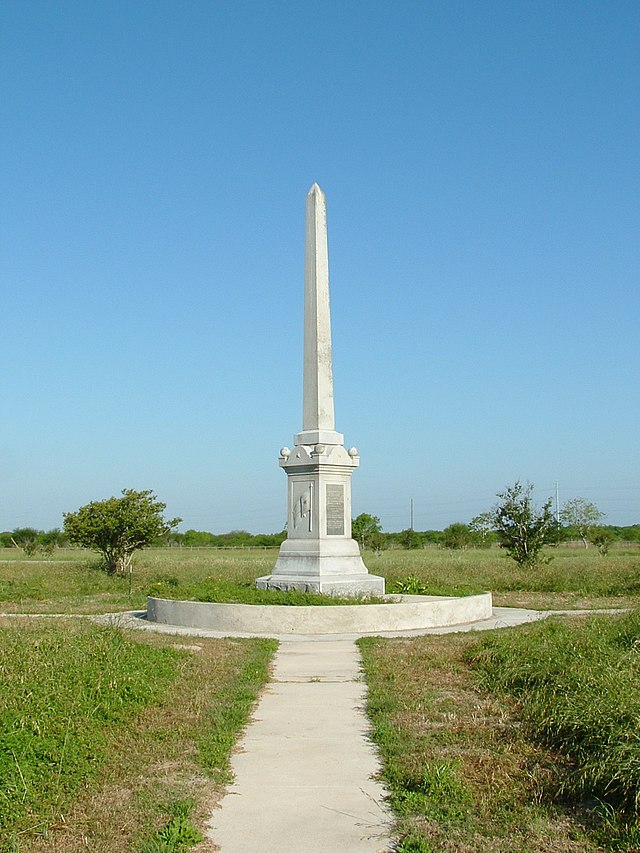
640px-Statue_on_the_Battlefield_of_Coleto.jpg


An obelisk commemorating the war at Fannin Battleground State Historic Site.
 

Wildthings

ASTROS '23 ALCS CHAMPIONS runnerup
Full Member
Messages
9,219
Reaction score
15,018
Location
Gulf Coast of Texas
First name
Barry
  • Thread Starter Thread Starter
  • #50
Let's jump ahead 7 years as this is some interesting info

March 25th, 1843 -- Texas force decimated after black bean lottery

On this day in 1843, seventeen Texans were executed at Salado, Tamaulipas, Mexico. As the members of the defeated Mier expedition were being marched from Mier to Mexico City, they attempted a mass escape on February 11. Some 176 were recaptured, and Mexican dictator Santa Anna ordered that one in ten of the prisoners be shot. The victims were chosen by a lottery in which each man drew a bean from an earthen jar containing 176 beans, seventeen of which were black. This event has come to be known as the Black Bean Episode. The bodies were returned to Texas and are buried on Monument Hill at La Grange, Fayette County

We'll return to the present 1836 tomorrow, Saturday the 26th.
 
Last edited:

Kevin

Wood is good.
Founding Member
In Memoriam
Messages
30,918
Reaction score
37,297
Location
Texas
First name
Kevin
:popcorn:

And no admission charge. I hope many of oour members are enjoying this as much as me.
 

scrimman

Termite extrodinare
Full Member
Messages
540
Reaction score
431
Location
Texas
First name
Sean
Week after next I should be being massacred (along with a few dozen other friends) a scant 50 yards from one of the three actual massacre sites at Goliad, but being that I'm portraying Nicolas Fagan, a member of the Refugio Militia and one of the few actual Texians to take the field at Goliad and Colleto Creek, I'll be pulled out of the line 'just in time' by my friend Don Carlos De La Garza (who incidentally captained the 'irregular' local forces during that fight) and be spared. I'll try to post some pictures, but it's not real often folks take pictures of me there. (not real photogenic, you see...) We try REAL hard to take you back to those days in 1836, and it is a real treat to be part of it. Hope some of y'all make it down that way one of these days.
If you;re interested in this subject and you get a chance, you should read the book 'Texian Illiad' by Dr Stephen Harding. It's about the best book that I've ever found over the subject of the Texian revolution. Even 10 years after tripping over this hobby it dumbfounds me just how much is NOT in the history books.

Here are some pics of some earlier events (I'm the guy in the last pic in the green vest):
1381328_10152361363578377_432297845_n.jpg
1604826_10201624972453108_375027070_n.jpg
1932290_10202815302998003_1846534_n.jpg
10151385_10202815220675945_1855654597_n.jpg
10154169_10202815332038729_734450998_n.jpg
11079585_436535486516470_896536126169427709_o.jpg
 
Last edited by a moderator:

Kevin

Wood is good.
Founding Member
In Memoriam
Messages
30,918
Reaction score
37,297
Location
Texas
First name
Kevin
If you;re interested in this subject and you get a chance, you should read the book 'Texian Illiad' by Dr Stephen Harding. It's about the best book that I've ever found over the subject of the Texian revolution. Even 10 years after tripping over this hobby it dumbfounds me just how much is NOT in the history books.

I agree with all you said. Really cool that you're a reenactor I know that has to be fun and interesting.
 

Tony

Hardwood Enthusiast
Staff member
Global Moderator
Full Member
Messages
21,054
Reaction score
28,417
Location
San Antonio, TX
First name
Tony
Week after next I should be being massacred (along with a few dozen other friends) a scant 50 yards from one of the three actual massacre sites at Goliad, but being that I'm portraying Nicolas Fagan, a member of the Refugio Militia and one of the few actual Texians to take the field at Goliad and Colleto Creek, I'll be pulled out of the line 'just in time' by my friend Don Carlos De La Garza (who incidentally captained the 'irregular' local forces during that fight) and be spared. I'll try to post some pictures, but it's not real often folks take pictures of me there. (not real photogenic, you see...) We try REAL hard to take you back to those days in 1836, and it is a real treat to be part of it. Hope some of y'all make it down that way one of these days.
If you;re interested in this subject and you get a chance, you should read the book 'Texian Illiad' by Dr Stephen Harding. It's about the best book that I've ever found over the subject of the Texian revolution. Even 10 years after tripping over this hobby it dumbfounds me just how much is NOT in the history books.

Here are some pics of some earlier events (I'm the guy in the last pic in the green vest):
View attachment 100260
View attachment 100261
View attachment 100262
View attachment 100263
View attachment 100264
View attachment 100259

That is too cool! I would love to be a part of either Texas Revolution or Civil War re-enactments, just have never had the time. Tony
 

Wildthings

ASTROS '23 ALCS CHAMPIONS runnerup
Full Member
Messages
9,219
Reaction score
15,018
Location
Gulf Coast of Texas
First name
Barry
  • Thread Starter Thread Starter
  • #55
Thanks Sean for that great information and pictures!! I would love to be part of the audience one day!! Now back to the problems in 1836!

Goliad - the Massacre (Prelude)
After the battle of Coleto those Texans that could walk were sent to Goliad, under Mexican escort. It would take until about March 23 until those Texans that could not walk were transported to Goliad. During that time, Mexican physicians were told that wounded Mexicans were a priority to treat, as opposed to the wounded Texans. Fannin arrived in Goliad on March 22. General Urrea, meanwhile, had moved onto Guadalupe Victoria, from where he wrote to Santa Anna a letter recommending that the Texan prisoners should be treated with clemency.
On March 23, Santa Anna replied to Urrea's letter regarding Fannin and the other captured Texans. In this communication, he directly ordered Urrea to execute the prisoners which he dubbed "perfidious foreigners." This order was repeated in a letter on March 24. Concerned about Urrea's willingness to comply, Santa Anna also dispatched a note to Colonel José Nicolás de la Portilla, commanding at Goliad, ordering him to shoot the prisoners. Received on March 26, it was followed two hours later by a conflicting letter from Urrea telling him to "treat the prisoners with consideration" and to use them to rebuild the town. Though a noble gesture by Urrea, the general was aware that Portilla lacked sufficient men to guard the Texans during such an endeavor. Weighing both orders during the night, Portilla concluded that he was required to act on Santa Anna's directive.

Tomorrow we will see the rest of the story......
 

Wildthings

ASTROS '23 ALCS CHAMPIONS runnerup
Full Member
Messages
9,219
Reaction score
15,018
Location
Gulf Coast of Texas
First name
Barry
  • Thread Starter Thread Starter
  • #56
Goliad - the Massacre March 27, 1836
Santa Anna sent a direct order to the "Officer Commanding the Post of Goliad" to execute the prisoners in his hands. This order was received on March 26 by Col. José Nicolás de la Portilla, whom Urrea had left at Goliad. Two hours later Portilla received another order, this one from Urrea, "to treat the prisoners with consideration, and especially their leader, Fannin," and to employ them in rebuilding the town. But when he wrote this seemingly humane order, Urrea well knew that Portilla would not be able to comply with it, for on March 25, after receiving Santa Anna's letter, Urrea had ordered reinforcements that would have resulted in too large a diminution of the garrison for the prisoners to be employed on public works.
Portilla suffered an unquiet night weighing these conflicting orders, but he concluded that he was bound to obey Santa Anna's order and directed that the prisoners be shot at dawn. At sunrise on Palm Sunday, March 27, 1836, the unwounded Texans were formed into three groups under heavy guard commanded by Capt. Pedro Balderas, Capt. Antonio Ramírez, and first adjutant Agustín Alcérrica (a colonel in the Tres Villas Battalion in April 1836).
The largest group, including what remained of Ward's Georgia Battalion and Capt. Burr H. Duval's company, was marched toward the upper ford of the San Antonio River on the Bexar road. The San Antonio Greys, Mobile Greys, qqv and others were marched along the Victoria road in the direction of the lower ford. Capt. John Shackelfordqv's Red Rovers and Ira J. Westover's regulars were marched southwestwardly along the San Patricio road. The guard, which was to serve also as a firing squad, included the battalions of Tres Villas and Yucatán, dismounted cavalry, and pickets from the Cuautla, Tampico, and Durango regiments.
The prisoners held little suspicion of their fate, for they had been told a variety of stories-they were to gather wood, drive cattle, be marched to Matamoros, or proceed to the port of Copano for passage to New Orleans. Only the day before, Fannin himself, with his adjutant general, Joseph M. Chadwick, had returned from Copano, where, accompanied by Holsinger and other Mexican officers, they had tried to charter the vessel on which William P. Miller's Nashville Battalion had arrived earlier (these men had been captured and imprisoned at Goliad, also). Although this was really an attempt by Urrea to commandeer the ship, the vessel had already departed. Still, Fannin became cheerful and reported to his men that the Mexicans were making arrangements for their departure. The troops sang "Home Sweet Home" on the night of March 26.
At selected spots on each of the three roads, from half to three-fourths of a mile from the presidio, the three groups were halted. The guard on the right of the column of prisoners then countermarched and formed with the guard on the left. At a prearranged moment, or upon a given signal, the guards fired upon the prisoners at a range too close to miss. Nearly all were killed at the first fire. Those not killed were pursued and slaughtered by gunfire, bayonet, or lance. Fannin and some forty (Peña estimated eighty or ninety) wounded Texans unable to march were put to death within the presidio under the direction of Capt. Carolino Huerta of the Tres Villas battalion.
From two groups shot on the river roads, those not instantly killed fled to the woods along the stream, and twenty-four managed to escape. The third group, on the San Patricio road, was farther from cover; only four men from it are known to have escaped. A man-by-man study of Fannin's command indicates that 342 were executed at Goliad on March 27. Only twenty-eight escaped the firing squads, and twenty more were spared as physicians, orderlies, interpreters, or mechanics largely because of the entreaties of Francita Alvarez, a "high bred beauty" whom the Texans called the "Angel of Goliad", and the brave and kindly intervention of Col. Francisco Garay. Many of those who eventually escaped were first recaptured and later managed a second escape. Two physicians, Joseph H. Barnard and John Shackelford, were taken to San Antonio to treat Mexican wounded from the battle of the Alamo; they later escaped.
After the executions the bodies were burned, the remains left exposed to weather, vultures and coyotes, until June 3, 1836, when Gen. Thomas J. Rusk gathered the remains and buried them with military honors.
 

Wildthings

ASTROS '23 ALCS CHAMPIONS runnerup
Full Member
Messages
9,219
Reaction score
15,018
Location
Gulf Coast of Texas
First name
Barry
  • Thread Starter Thread Starter
  • #57
While we are waiting on the next chapter in our story of Texas Independence here is an article written by Dr. Stephen L. Hardin, a professor of History at Victoria College. It's a long read but very interesting to us Texians. I've stood in that building in Washington-on-the-Brazos and imagine that day so long ago.....

March 2, 1836:
The Myth and Meaning of Texas Independence
By Dr. Stephen L. Hardin
Professor of History
The Victoria College
Victoria, Texas


March 2, 1836 dawned, frigid and gray; cutting winds blew through glassless windows. Texians – as they styled themselves – huddled close, pulled blankets tight, and gave birth to a dream. At the Town of Washington, fifty-nine representatives voted into existence a sovereign nation: the Republic of Texas. Tennessean George C. Childress had drafted the independence document. In word and spirit it borrowed heavily from Thomas Jefferson” original 1776 declaration. No matter. Anglo-Celtic Texians proudly embraced the values and traditions of their founding fathers. “The same blood that animated the hearts of our ancestors in ’76 still flows in our veins,” one frontier preacher affirmed. Still, not all the delegates were of that blood. Four Mexican residents signed the declaration on behalf of their Tejano constituents. By their presence and with their signatures, they demonstrated that they too shared Jefferson’s values – and his vision of liberty. Thus began a decade of independence singular in the annals of American history.

The ramshackle surroundings seemed neither appropriate, nor especially auspicious. The Convention met in an unfinished building lacking glass in the windows or even doors. In lieu of glass, delegates tacked rags tight across the windows. They could have saved themselves the trouble. On March 1, as the members gathered in the Town of Washington, a blue norther swept in. By the morning of the second, the thermometer had plummeted to a brisk thirty-three degrees as gusts whistled through fluttering window cloth.

If the Washington “Convention Center” proved bleak, so too did the rest of the rustic frontier settlement. It did not make a favorable impression upon Virginia native Colonel William Fairfax Gray. He may have tasted sour grapes, for he had earlier applied for the job of convention secretary. Although he did not receive the post, he nevertheless maintained a record of the proceedings in his diary. In numerous instances, Gray’s account is more complete than the official minutes. Still, he found the Town of Washington a “disgusting place.” Cold, uncomfortable, and unappreciated, Gray described Washington in wholly uncharitable terms:

It is laid out in the woods, about a dozen wretched cabins or shanties constitute the city; not one decent house in it, and only one well-defined street, which consists of an opening cut out of the woods. The stumps still standing. A rare place to hold a national convention in. They will have to leave it promptly to avoid starvation.

Even here in Texas most folks still remain unclear about the meaning of that cold March day in 1836. Myth and misunderstanding also obscure the event. Many believe, for example, that the delegates signed the Texas Declaration on March 2. Not true. The delegates read and approved the document on that day, but remember that they did not have a photocopier at their disposal. Clerks worked through the night. Perforce, the five hand-written copies were not ready for signatures until the following day. Nor did all sign even then. Seven delegates had not yet arrived on March 3. As they dragged in, the latecomers added their names for a total of fifty-nine signatories. Nowadays Texans remember the small hamlet where the delegates gathered as Washington-on-the-Brazos. Nobody called it that in 1836. Texians back then simply called it the “Town of Washington.” Not until later would ‘Washington-on-the-Brazos” come into common usage.

Whether one observes March 2 or March 3, one constant remains; the delegates could not have picked a worse time to declare independence. To many contemporary observers, such confidence appeared reckless. As delegates brazenly declared Texas independent, the artillery of Mexican dictator Antonio López de Santa Anna hammered the walls of the Alamo. Just four days later his troops would assault the crumbling fort and wipe out every rebel defender. At the same time, General José Urrea’s division swept northward through the coastal prairies. He would subsequently capture the entire rebel command of Colonel James W. Fannin, Jr. following the Battle of Coleto on March 19. Acting upon Santa Anna’s orders, Mexican troops executed Fannin and the majority of his Goliad garrison, some 342 men. The twin defeats at San Antonio and Goliad generated panic among Texian settlers who fled toward the Louisiana border. The “Runaway Scrape” they called it. To declare independence amid all this chaos seemed more than unduly hopeful. Indeed, to most it resembled a fool’s errand.

On April 21, General Sam Houston’s vengeful army swept the Mexican camp at San Jacinto and the skeptics recanted. On that momentous afternoon, enraged Texians slaughtered 650 Mexican soldados and took another 700 prisoner. Most important, the following day Texians captured President-General Santa Anna. At San Jacinto Texians won a great victory, but only with the capture of the Mexican dictator did the battle become decisive?

Sandwiched between the defeat at the Alamo and the victory at San Jacinto, it is not all that startling that the importance of March 2 gets lost in the glare of those two shining episodes. The date is not a state holiday; public schools do not let out; newscasters rarely recall the event.

Even in 1836, Texians did not consider the approval of Childress’s declaration a momentous occasion. Nearly all the representatives had arrived in Washington knowing that independence was a forgone conclusion. Gray captured the lackadaisical nature of the proceedings in his diary, but was so underwhelmed that he could not manage to spell Childress’s name correctly. The important news of the day, at least as far as Gray was concerned, was the break in the weather: “The morning clear and cold, but the cold somewhat moderated.” Only then, did he mention – in an offhand manner – that the Convention had approved the declaration of independence:

The Convention met pursuant to adjournment. Mr. Childers [sic], from the committee, reported a Declaration of Independence, which he read in this place. It was received by the house, committed to a committee of the whole, reported without amendment, and unanimously adopted, in less than one hour from its first and only reading. It underwent on discipline, and no attempt was made to amend it. The only speech made upon it was a somewhat declamatory address in committee to the whole by General Houston.

And it was done. At the end of the day, the delegates merely rubber-stamped a question that they had already decided.

So apathetic were the delegates concerning the document–or, perhaps, so chaotic were conditions–that all five of the original hand-written copies went missing. In 1896 an original copy turned up in the files of the U.S. State Department. It appears that Texas agent William H. Wharton deposited his copy there in 1836. As Commissioner of the Texas Republic, he had traveled to Washington, D. C. to inquire about admitting Texas into the Union. If annexation proved impossible, he then was to push for the recognition of Texas as an independent nation. He must have submitted one of the original copies to support the claim that Texas was, in fact, an independent nation and not merely a breakaway province within the Mexican Republic. State Department officials returned the precious document to Texas. Today this it resides deep inside a vault at the State Library in Austin. A reproduction of this copy is on permanent display at the state capitol. The archivists, having lost it for so long, are not willing to take chances with the only surviving original.

So here we are near the end of the twentieth century. What do the events of 163 years ago have to do with us? What does it all mean? Of late the delegates have not fared too well at the pens of activist historians. They see Texas independence as the action of ungrateful snits that willfully ignored Mexican generosity. Typical of this new breed is Colorado writer Jeff Long. In his book Duel of Eagles: The Mexican and U.S. Fight for the Alamo, he sides with the Mexicans.

It was grotesque that a host of squatters, land speculators, and short-term colonists should expect the Mexican government to grant them government conducted in the English language. Mexico had not forced the Anglo-Americans to come to Texas. Mexico had certainly not promised those who did come “that they should continue to enjoy that constitutional liberty and republican government to which they had been habituated in the land of their birth, the United States of America.” To the contrary, those settlers in Texas who were legitimate had pledged themselves to a set of regulations extended by a whole new authority.”

Like many of his ilk, Long has a reductionist understanding of Texas history. To be sure Mexicans were astoundingly generous to norteamericano colonists. A head of a household normally received a league and a labor. That amounted to a whopping 4,605 acres. Additionally, immigrants could also expect a tax rebate until they got on their feet in their adopted homeland. Americans who had been ruined in the Panic of 1819 flocked to Mexican Texas by the thousands. And they were grateful to Mexico for the chance–and a place–to make a fresh start. To most American immigrants, it seemed as if Mexico offered more opportunity than the “land of opportunity” itself. Still – and this is the part Mr. Long conveniently remembers to forget – most Texians immigrated under the Mexican Constitution of 1824. Under that covenant Mexican citizens enjoyed a republican form of government and most of the power of government resided at the state and local levels. Indeed, the Mexican federalists were great admirers of the United States Constitution of 1787 and employed it as a model for their 1824 charter. When Santa Anna revoked the Constitution of 1824 and declared himself dictator in 1835, all bets were off. American Mexicans considered themselves bound to the old constitution and were not about to sit still and be quiet while a military dictator appropriated the reins of government. They were not, however, alone it that. Many Federalistias –Mexicans loyal to the Constitution of 1824 – also took up arms to resist Santa Anna’s centralist regime.

So the revolt that began near Gonzales in October 2, 1835, was a civil war – not a bid for complete separation from Mexico. Both Anglo-Celtic Texians and the native Tejanos fought for self-government within the federalist system created by the Constitution of 1824. The war was not, as some have insisted, a “culture conflict.” Indeed, many Texas Mexicans joined with norteamericano neighbors to resist the centralistas.

Having said that, why did Texians overwhelmingly support complete separation from Mexico only five months later? Is Long correct? Was the Texas Revolution merely a shameless land grab? Once again, the answer is more involved than some allow themselves to believe. Texians were disappointed when Federalists from the interior did not rush to Texas to take up the struggle. Texian leaders had tried to squash any mention of independence, fearing that such remarks might alienate Mexican federalists. By February 1836, however, a majority of Texians had concluded that they could expect no help from that quarter. Why had the federalists south of the Rio Grande been so unwilling to support the Texian federalists? The short answer is that they simply did not trust the Anglo-Americans.

Mexican federalists had plenty of reasons to mistrust their northern neighbors. They recalled the two decades from 1800 to 1820 as the era of the filibusters. Throughout that period, American soldiers of fortune such as Philip Nolan, Augustus Magee, and James Long (apparently no relation to the Colorado revisionist) had attempted to wrest Texas away from Spain. Mexicans declared their independence from Spain in 1821, but many still remembered the filibusters and mistrusted Americans. Mexican Secretary of State Lucas Alamán expressed such concern succinctly. “Where others send invading armies,” he groused, “[the Americans] send their colonists.” He understood that American newspapermen wrote incendiary articles calling for the occupation of Texas. He knew that in 1829 President Andrew Jackson had dispatched the brutish Anthony Butler to Mexico with an offer to buy Texas. He was also aware that Americans almost constantly spoke of the “reannexation of Texas,” a crack-brained belief that Texas should have been a part of the Louisiana Purchase owing to the short lived La Salle colony of 1685. Little wonder then that Mexican federalist viewed the colossus to the north and its wayfaring citizens as a threat to Mexican nationhood.

Texas leaders came to understand that alone they could not win the war. If Mexican federalists would not lend a hand, they must enlist assistance from the United States. War is the most expensive of all human endeavors. While Texians claimed thousands of acres of disposable land, they were cash poor. To win this war they first had to fight it. But that required troops, weapons, and provender and all those items cost money – lots of it! They were not so naïve as to believe that President Jackson would risk an international incident by openly supporting the Texas rebels against Mexico. They did, however, hope to enlist the support of individual Americans who believed in their cause. The ad interim government dispatched Stephen F. Austin–the most famous Texian–as an agent to the United States. Once back in the “old states” the empresario appealed to citizens to provide volunteers, funds, and supplies for Texas. He and other Texas agents visited American banks to secure loans for the Texas war effort.

That is where they consistently encountered problems. Banks in the north would not even consider supporting with their money a cause that might ultimately bring another slave state into the union. Southern bankers, while more sympathetic, would not lend their money so long as the war remained a domestic Mexican squabble. They let Austin and the other agents know, however, that they might be interested if – and only if, Texians declared their complete separation from Mexico.

Why this southern support for Texas independence? Southerners anticipated that an independent Texas would remain independent for, say, three or four months, before entering the union as a slave state. In 1836 the United States had an equal number of free and slave states. Since both free and slave states voted as a block, it created a legislative gridlock with neither side being able to gain advantage. Southerners believed that adding Texas to the list of slave states would tilt the congressional balance of power in their favor.

Austin may have been lukewarm concerning slavery, but he was a firebrand in the cause of Texas. In a rambling letter dated January 7, 1836, he neatly summed up the situation.

I go for Independence for I have no doubt we shall get aid, as much as we need and perhaps more – and what is of equal importance – the information from Mexico up to late in December says that the Federal party has united with Santa Anna against us, owing to what has already been said and done in Texas in favor of Independence so that our present position under the constitution of 1824, does us no good with the Federalists, and is doing us harm in this country, by keeping away the kind of men we most need[.] [W]ere I in the convention[,] I would urge an immediate declaration of Independence – unless there be some news from the [Mexican] interior that changed the face of things – and even then, it would require very strong reasons to prevent me from the course I now recommend.

When Stephen Fuller Austin spoke, Texians listened. By March 2, nearly all of them believed that their best hopes for the future rested on complete separation from Mexico.

How did Tejanos regard the independence announcement? The fighting had severely tested the loyalty of Texas-born Mexicans, most of whom resisted the inexorable movement toward independence. While many were willing to fight, even die, for the Constitution of 1824, they were understandably hesitant to support an open break with their mother country. The politically astute among them realized that in an independent Texas they would be woefully outnumbered by norteamericanos and thus relegated to minority status in a land dominated by foreigners who possessed little knowledge of or appreciation for their distinctive culture.

The war cast Tejanos into a whirlpool of changing politics and shifting loyalties. Wealthy landowners like José Antonio Navarro, Erasmo Seguín, and Plácido Benavides had been early proponents of American emigration. They were willing to abet slavery to promote the cotton trade and economic growth for the province. Having placed their economic and political bets on their new allies, when open revolt erupted federalist Tejanos could only try to play out their hand.

Independence forced Tejanos to make hard choices. Some like Navarro and the Seguíns opted to support the new republic. But others like Benevides, the alcalde of Victoria, could not force their principles to bend that far. Benevides was a Mexican first, a federalist second. He had seen much hard fighting at the siege and storming of Béxar in 1835, but when he heard of the March 2 declaration he went to Goliad commander James W. Fannin and informed him he was leaving the army. He could not abide centralist despotism, but neither could he be a party to striping Mexico of Tejas. He believed his only honorable option was to return to his ranch and sit out the war as a non-combatant. Fannin understood his plight and sent him home with his blessing. Still other Tejanos, like Carlos de la Garza, Juan Moya, and Agustín Moya, resented the influx of foreign settlers, view opposition as disloyalty to their motherland, and flocked to the centralist banner. These were not men who wet their fingers to test the prevailing winds; they did not plot their course according to the latest public opinion poll. They were deeply rooted in principle and tradition. Each of these Texas Mexicans followed his heart and while the path did not always lead to victory, it never led to dishonor.

That was then; this is now. Why should modern Texans observe the events of 163 years ago? Why should they stop for a moment every March 2 to reflect on the meaning of Texas Independence Day?

The first reason is historical – this day marks the creation of the Republic of Texas. For almost a decade Texas existed as a sovereign nation. It exchanged foreign ministers with other countries; it had a national army and navy (though neither was especially effective); it maintained a national currency (though, to be sure, the money was never worth much). When Texas joined the Union in 1845, it did so as a nation and thus demanded rights not accorded to mere territories. By order of Joint Resolution of the U.S. Congress, Texas retained possession of its public lands. So large was the landmass of Texas, the same resolution allowed Texas to divide into as many as five states. In 1850 Texans did, in fact, sell a portion part their western holdings to pay off the debt incurred during the Republic period. Since then, however, they have been reluctant to part with even so much as an inch of their sacred soil – the resolution notwithstanding. Texas nationalism has proved stronger that political expediency.

The second reason is psychological, perhaps even spiritual. The Republic of Texas was an ephemeral empire. Like the spring bluebonnets, it bloomed, blossomed, and blanched with the sands of time. But also like the state flower, its scent lingers in the hearts and imaginations of every Texan. A moment ago I referred to Texas nationalism. Many outside the state would, no doubt, find that remarkably pretentious, but those who live here understand the truth of it. Texas existed as a nation for ten years; Texans got used to the idea; and nationalism is a difficult habit to break. The novelist John Steinbeck perhaps said it best:

Texas is a state of mind. Texas is an obsession. Above all, Texas is a nation in every sense of the word.

March 2 is a day to celebrate Texas distinctiveness. Now I’m not saying that Texans are better that other folks, but I am saying that we’re different. And if a people consider themselves different, they are. March 2 should be to Texans what St. Patrick’s Day is to the Irish. But what if you are a Tejano. Should you want to celebrate the day that Texas separated itself from Mexico? You bet! Even as early as 1835 Tejanos were distinctive from other Mexicans. The ranching culture that developed in Texas produced its own clothing, its own music, its own customs, and its own food. Gringos call it “Mexican food,” but all one has to do to put the lie to that assertion is to eat the food in the interior – or try to. It is rather bland and not nearly as good as the Tejano food (we might as well call it what it really is) right here at home. We sometimes call it Tex-Mex, but in truth, it’s all Tex and precious little Mex. It is found nowhere else on earth. How many things might we say that of? Tejano music is not Mexican; it is not American. It is Texan and is found nowhere else on earth. Tejanos also speak a variety of Spanish called Tex-Mex. But try using it in Mexico City or worse yet, in Seville. Again, it is a unique language and is found nowhere else on earth. Truth is if you’re a Texan – be you brown, black, white, yellow, or red – you don’t rightly belong anywhere else. Steinbeck nailed that too. “A Texan outside of Texas is a foreigner,” he observed. That applies to Tejanos as much as, probably more than, other Texans. After all, whose family has lived here the longest?

Even today it is common to hear natives claim to be “Texans first, Americans second.” It is impossible to believe that they would feel that way had the Texas Republic never existed. There in Washington on that cold, windy day in March of 1836, delegates, both Anglo and Tejano, shouted to the world that they were different. Not Mexican were they, not American, but something else. They were, they insisted, TEXIANS. They gave birth not only to a dream, but also to a mystique. Not all Texians wanted to join the Union in 1845. Early settler, ranger, and Indian fighter, Robert Hall spoke for many of the old breed. “I was opposed to annexation,” he groused, “and voted first, last, and all time for the Lone Star.” The degree of Texas nationalism may be a matter of debate, but it is perhaps significant, that even when they joined the Union, the old Texians could not bear to part with their cherished flag. And even today, the banner of nation continues to swell over the Lone Star State.
 

Wildthings

ASTROS '23 ALCS CHAMPIONS runnerup
Full Member
Messages
9,219
Reaction score
15,018
Location
Gulf Coast of Texas
First name
Barry
  • Thread Starter Thread Starter
  • #58
The Runaway Scrape is full blown right now. Texians fleeing in advance of Santa Anna's armies. While we wait for what happens next here is some more reading on the Goliad Massacre

Daylight March 27th 1836
Escape of the Four
Alabama Red Rovers <--- click
Dillard Cooper's Remembrances of the Fannin Massacre. From Rangers and Pioneers of Texas by A.J. Sowell 1884 as reprinted from the American Sketch Book 1881. According to James T. DeShields in Tall Men With Long Rifles, Cooper died in extreme poverty in the 1890's in Llano, TX stating "during his later years the pitiful pension of $150.00 a year, provided by the great and opulent state of Texas, barely sufficed to buy food and medicines for the aged hero and his faithful wife. Napoleon was not far wrong when he said 'Republics are ungrateful.'"
......several....cried out for mercy. I remember one, a young man, who had been noted for his piety, but who had afterwards become somewhat demoralized by bad company, falling on his knees, crying aloud to God for mercy, and forgiveness. Others, attempted to plead with their inhuman captors, but their pleadings were in vain.....On my right hand, stood Wilson Simpson, and on my left, Robert Fenner....while some of them were rending the air with their cries of agonized despair, Fenner called out to them, saying: "Don't take on so, boys; if we have to die, let's die like brave men.....At that moment, I glanced over my shoulder and saw the flash of a musket.....


On the morning of the 27th of March, 1836, about daylight, we were awakened by the guards, and marched out in front of the fort, where we were counted and divided into three different detachments; we had been given to understand that we were to be marched to Copano, and from there shipped to New Orleans. The impression, however, had in some way been circulated among us, that we were to be sent out that morning to hunt cattle; though I thought at the time that it could not be so, as it was but a poor way, to hunt cattle on foot.

goliad-massacre-6-638.jpg


Our detachment was marched out in double file, each prisoner being guarded by two soldiers, until within about half a mile southwest of the fort, we arrived at a brush fence, built by the Mexicans. We were then placed in single file, and were half way between the guard and the fence, eight feet each way. We were then halted, when the commanding officer came up to the head of the line, and asked if there were any of us who understood Spanish. By this time, there began to dawn upon the minds of us, the truth, that we were to be butchered, and that, I suppose, was the reason that none answered. He then ordered us to turn our backs to the guards. When the order was given not one moved, and then the officer, stepping up to the man at, the head of the column, took him by the shoulders and turned him around.

By this time, despair had seized upon our poor boys, and several of them cried out for mercy. I remember one, a young man, who had been noted for his piety, but who had afterwards become somewhat demoralized by bad company, falling on his knees, crying aloud to God for mercy, and forgiveness. Others, attempted to plead with their inhuman captors, but their pleadings were in vain, for on their faces no gleam of piety was seen for the defenseless men who stood before them. On my right hand, stood Wilson Simpson, and on my left, Robert Fenner. In the midst of the panic of terror which seized our men, and while some of them were rending the air with their cries of agonized despair, Fenner called out to them, saying: "Don't take on so, boys; if we have to die, let's die like brave men."

At that moment, I glanced over my shoulder and saw the flash of a musket; I instantly threw myself forward on the ground, resting on my hands. Robert Fenner must have been instantly killed, for he fell with such force upon me as almost to throw me over as I attempted to rise, which detained me a few moments in my flight, so that Simpson, my companion on the right, got the start of me.

per Kenbo's whining below:


As we ran towards an opening in the brush fence, which was almost in front of us, Simpson got through first, and I was immediately after him. I wore, at that time, a small, round cloak, which was fastened with a clasp at the throat. As I ran through the opening, an officer charged upon me, and ran his sword through my cloak, which would have held me, but I caught the clasp with both hands, and tore it apart, and the cloak fell from me. There was an open prairie, about two miles wide, through which I would have to run before I could reach the nearest timber, which was a little southwest of the place from where we started.

I gained on my pursuers, but saw, between me and the timber, three others, who were after Simpson. As I neared the timber, I commenced walking, in order to recover my strength, before I came near them. When he first started, we were all near together, but as Simpson took a direct course across the prairie, I, in order to avoid his pursuers, took a circuitous course. There were two points of timber projecting into the prairie, one of which was nearer to me than the other. I was making for the furthest point, but as Simpson entered the timber, his pursuers halted, and then ran across and cut me off, I then started for the point into which Simpson had entered, but they turned and cut me oft from that. I then stopped running and commenced walking slowly between them and the other point. They, no doubt, thinking I was about to surrender myself, stopped, and I continued to walk within about sixty yards of them, when I suddenly wheeled and ran into the point for which I had first started. They did not attempt to follow me, but just as I was about to enter the timber, they fired, the bullets whistling over my head caused me to draw my head down as I ran.

As soon as I entered the timber, I saw Simpson waiting and beckoning to me. I went towards him, and we ran together for about two miles, when we reached the river. We then stopped and consulted as to the best way of concealing ourselves. I proposed climbing a tree, but he objected, saying that should the Mexicans discover us, we would have no way of making our escape. Before we arrived at any conclusion, we heard some one coming, which frightened us so, that I jumped into the river, while Simpson ran a short distance up it, but seeing me, he also jumped in. The noise proceeded from the bank immediately above the spot where Simpson was, and I could see the place very plainly, and soon discovered that two of our companions had made their escape to this place. They were Zachariah Brooks, and Isaac Hamilton. In the fleshy part of both Hamilton's thighs were wounds, one made by a gun-shot and another by a bayonet.

We all swam the river, and traveling up it a short distance, arrived at a bluff bank, near which was a thick screen of bushes, where we concealed ourselves. The place was about five miles above the fort. We did not dare proceed further that day, as the Mexicans were still searching for us, and Hamilton's wounds had become so painful as to prevent his walking, which obliged us to carry him. We remained there until about 10 o'clock that night, when we started forth, Simpson and myself carrying Hamilton, Brooks, though severely wounded, was yet able to travel. We had to proceed very cautiously and rather slowly.

Fort La Bahia being southeast of us, and the point we were making for, was about where Goliad now stands. We proceeded, in a circuitous route in a northeasterly direction. We approached within a short distance of the fort, and could not at first account for the numerous fires we saw blazing. We were not long in doubt, for the sickening smell that was borne towards us by the south wind, informed us too well that they were burning the bodies of our companions. And, here, I will state what Mrs. Cash, who was kept a prisoner, stated afterwards; that some of our men were thrown into the flames and burned alive. We passed the fort safely, and reached a spring, where we rested from our journey and from whence we proceeded on our travels.

But the night was foggy, and becoming bewildered, it was not long before we found ourselves at the spring from which we started. We again started out, and again found ourselves at the same place; but we had too much at stake to sink into despondency. So once more took our wounded companion, thinking we could not miss the right direction this time; but, at last when day began to break, to our great consternation, we found we had been traveling around the same spot, and were for the third time back at the identical spring from which we had at first set forth. It was now impossible to proceed further that day, as we dared not travel during the day, knowing we should be discovered by the Mexicans. We therefore concealed ourselves by the side of a slight elevation, amidst a thick undergrowth of bushes.

By this time, we began to grow very hungry, and I remembered an elm bush that grew at the entrance of the timber where we were concealed, which formed an excellent commissary for us, and from the branches of which we partook, until nearly every limb was entirely stripped. About 9 o'clock that morning, we heard the heavy tramp of the Mexican army on the march; and they not long after that passed within a stone's throw of our place of concealment. It seems indeed, that we were guided by an over-ruling providence in not being able to proceed further that night, for as we were not expecting the Mexican army so soon, we would probably have been overtaken and discovered by them, perhaps in some prairie, where we could not have escaped.

We remained in our hiding place the rest of the day, and resumed our journey after dark, still carrying our wounded companion. Whenever the enemy passed us, we had to conceal ourselves; and we laid several days in ponds of mud and water, with nothing but our heads exposed to view. When in the vicinity of Lavaca, we again got ahead of the Mexicans; and, after traveling all night, we discovered, very early in the morning of the ninth day, a house within a few hundred yards of the river. We approached it, and found the inhabitants had fled. When we entered the house, we discovered a quantity of corn, some chickens, and a good many eggs lying about in different places. Our stomachs were weak and revolted at the idea of eating them raw, so we looked about for some means of striking a fire, first searching for a rock, but failing to find one, we took an old chisel and ground it on a grindstone for about two hours, but could never succeed in getting the sparks to catch. We then concluded to return and try the eggs raw.

We had taken one, and Simpson was putting on his shoes, which he had taken off to rest his feet, which were raw and bleeding, and had just got one on when he remarked: "Boys, we would be in a tight place if the Mexicans were to come upon us now." So saying, he walked to the window, when to his horror, there was the whole Mexican army not more than a mile and a half off, and fifteen or twenty horsemen coming at full speed within a hundred yards of us. We took up our wounded man and ran to the timber, which was not far off, Simpson leaving his shoe behind him. We got into the timber and concealed ourselves between the logs of two trees, the tops of which having fallen together, and being very thickly covered with leaves and moss, formed an almost impenetrable screen above and around us. We had scarcely hidden ourselves from view, when the Mexicans came swarming around us, shouting and hallooing through the woods, but did not find us. We heard them from time to time, all throughout the day and next night. The next morning, just before day, the noise of the Mexicans ceased, and we concluded they had left. Simpson then asked me to go with him to get his shoe, as it would be difficult for him to travel without it, and I consented to do so. We went out to the edge of the timber and stopped some time to take observations before proceeding further. Seeing nothing of the Mexicans, we proceeded to the house, found the shoe, and possessing ourselves of a couple of ears of corn, and a bottle of water, we returned to our companions. We had no doubt that the Mexicans had gone, so we sat down and drank the water and ate an ear of corn, when Brooks asked Simpson to go with him to the house, saying he would get a chicken, and we could eat it raw. They started, and had hardly got to the edge of the timber when I heard the sound of horses’ feet, and directly afterwards the Mexicans were to be seen in every direction. I was sure they had captured Simpson and Brooks. Soon I heard something in the brush near us, but did not know whether it was the boys or Mexicans, but it turned out to be the boys, who crept undercover, and, in a few minutes, four Mexicans came riding by, passing within a few feet of where we were lying, with our faces to the ground.

After going into the woods a short distance they turned and passed out again, but it was not long after when six of them came riding quite close, three on each side of us, and leaning down and peering into our hiding place. It seemed to me they could have heard us, for my own heart seemed to raise me almost from the ground by its throbbings. I felt more frightened than I ever had been before; for at the time of the massacre, everything had come on me so suddenly that my nerves had no time to become unstrung as they now were. The Mexicans passed and repassed us, through the day, so we dared not move from our hiding place. A guard was placed around us the following night, the main body having, no doubt, gone on, and left a detachment to search for us. I think they must have had some idea of our being some of Fannin's men, or they would scarcely have gone to that trouble. About 10 o'clock that night we held a consultation, and I told my companions it would not do to remain there any longer, as the Mexicans were aware of our place of concealment, and would surely discover us the next day. We all decided then to leave, and they requested me to lead the way out. I told them we would have to crawl through the timber and a short piece of prairie, until we crossed the road near which the Mexicans were posted; that they must be careful to remove every leaf and stick in the path, and to hold their feet up, only crawling on their hands and knees, as the least noise would betray us to the enemy.

I was somewhat acquainted with the locality; for we were now not far from Texana, and I had some times hunted along these woods. Thus I led the way. Hamilton's wounds were so painful that we could move only slowly, and we must have been two hours crawling about 200 yards. When we at length passed the timber and reached the road, I stopped to make a careful survey of the situation. I could see the Mexicans placed along the road, about a hundred yards on each side of us. The moon was shining, but had sunk towards the west, which threw the shadow of a point of timber across the road, and concealed us from view. It would have been hard to discover us from the color of our clothes, as the earthy element with which they were mixed had entirely hidden the original fabric. We continued to crawl, until we reached a sufficient distance not to be discovered, when we rose up and walked. Although Hamilton had, with a great deal of pain, managed to crawl, yet it was impossible for him to walk, and his wounds had by this time become so much irritated and inflamed that he could scarcely bear to be carried. We traveled that night only a short distance, and hid ourselves in a thicket near a pond of water. Brooks had been trying to persuade me to leave Hamilton; but, although our progress was impeded by having to carry him, I could not entertain the idea for a moment. I indignantly refused, but still he would seize every opportunity to urge it upon me. He said it would be impossible for us to escape, burdened as we were with Hamilton. I could only acknowledge the truth of this, for it was a desperate case with us. The foe was around us in every direction. Brooks, finding that I was not to be persuaded, then attempted to influence Simpson.

On the tenth day out, they took the bottle and went to the pond nearby, for water. As they were returning, (I suppose Brooks did not know he was so near the place they left us), both Hamilton and myself heard Brooks urging Simpson to leave him. He told him if we remained with Hamilton, we would certainly lose our lives; but there was some slight chance of escaping, if we left him, and that Hamilton's wounds had become so much worse that he was bound to die, unless he could have rest; and, as we were doing him no good, and ourselves a great deal of injury by carrying him, it was, our duty to leave him. Now Brooks had never carried him a step; Simpson and myself having done that; yet Brooks was the first who had ever proposed leaving him; and, although there was a great deal of truth in what he was saying, yet I felt quite angry with him, as I heard him trying to persuade Simpson. Hamilton did not say a word to them when they came in, but sat with his face buried in his hands a long time.

At length, he looked up, and said: "Boys, Brooks has told you the truth; I cannot travel any further, and if you stay with me, all will be killed. Go and leave me, boys; if I have rest I may recover, and if I ever should get off safe, you shall hear from me again." He spoke so reasonably, and we were so thoroughly convinced of the truth of what he said, after a brief consultation, we decided to depart without him. Hamilton had known Brooks in Alabama; he called him to him, and gave him a gold watch and $40 in gold, telling him to give it to his mother. We then bade Hamilton farewell, all of us shedding tears as we parted, but when we turned to go, my resolution failed me, and I could not find it in my heart to leave him. I said: "Boys, don't let us leave him." But Simpson and Brooks said that we could do neither him nor ourselves any good by remaining, and that they were determined to go. I told them I would remain with him, and do the best I could for him. So they started off without me; but Hamilton insisted so much that I should leave him, that I again bade him farewell, and followed and soon overtook the others. The reason that we started off in the day, was that it was raining quite hard, and we thought there would not be much danger in traveling, but we had not gone more than half way through the next prairie. when the weather cleared up, and we saw the whole Mexican army encamped at Texana, about two miles off; but they did not discover us, and we succeeded in reaching the timber on the Navidad. In the evening we walked out to a slight eminence which overlooked the prairie, to reconnoiter. While gazing across the prairie, we could see three men on horseback, but so indistinct were they that we could not at first tell whether they were Americans or Mexicans. As they approached, we hid in the undergrowth; and as they passed, we saw that they were Mexican couriers returning to the command.

At eight we again started forth, and coming out on the prairie, we discovered a road, which we concluded had been made by the refugees in their retreat from the enemy. During all this time we had nothing to eat but leaves and herbs, and the two ears of corn that we got at the house on Lavaca river. On the twelfth day, we reached the Colorado, at Mercer's crossing. As we were very tired, we sat down on the bank to rest a little, before attempting to swim over. While sitting there, a dog on the opposite side of the river began to bark. When we heard that well-known sound, our very souls thrilled with joy, and that was the first time since the awful day of the massacre that a smile had ever illuminated our faces. We looked at each other, and then burst into a great big laugh. We were all good swimmers, but I some times took the cramp while swimming, so we concluded to cross on a log. We procured a dead mulberry pole, and hanging on to it, one at each end, and one in the middle, we crossed over to the land of freedom, and a land where we found plenty to eat. After recruiting a little, we procured horses, with the intention of joining Houston's army; but before we reached there, San Jacinto had been fought and won.

It was more than a year before I ever heard anything of Hamilton. He remained in the same place where we left him nine days, sometimes lying in the pond of water, which assuaged the pain of his wounds. At the end of that time he was so much improved that he essayed to walk to Texana, and succeeded in doing so. He said the best eating he ever had in his life, was when he first entered Texana, and ate the meat from the rawhides the Mexicans had left. The next morning he took a skiff, and made his way down to Dimmitt's landing. He had scarcely reached there when he was taken prisoner by a Mexican soldier. Not long after, other soldiers came in, and tying Hamilton on a mule, started for camp. He suffered so much from his wounds that he fainted several times, on the way. Whenever this occurred, they would untie him, lay him on the ground, and throw water into his face until he revived, when they would again mount him on the mule and proceed on their way. Hamilton remained in their hands for some time and gradually grew well of his wounds. There was a Mexican who waited on him, who seemed much attached to him, and Hamilton was led to place much confidence in him. One morning, this Mexican told him that if he wanted to live another day, he must make his escape that night, as he had learned that he and two other prisoners were to be shot before morning. Hamilton then arranged a plan for the escape of himself and two of his companions, which was a success, after many trials and tribulations.
 
Last edited:

Kenbo

Self proclaimed expert of nothing
Staff member
Global Moderator
Founding Member
Full Member
Forum Moderator
Messages
4,161
Reaction score
8,271
Location
Toronto, Ontario
First name
Ken
Okay, I'm just going to assume that you are playing by the rules because this is WAY too much reading for my liking. Jeez!!! I mean, you could have at least put in a few pictures.
 

Kevin

Wood is good.
Founding Member
In Memoriam
Messages
30,918
Reaction score
37,297
Location
Texas
First name
Kevin
Okay, I'm just going to assume that you are playing by the rules because this is WAY too much reading for my liking. Jeez!!! I mean, you could have at least put in a few pictures.

Stop making your mini Jeep for a spell Ken and read this ENTIRE thread. Your Jeep and you will be better for it.
 
Top