On this day April 21st in 1836
The Battle of San Jacinto was the concluding military event of the Texas Revolution. On March 13, 1836, the revolutionary army at Gonzales began to retreat eastward. It crossed the Colorado River on March 17 and camped near present Columbus on March 20, recruiting and reinforcements having increased its size to 1,200 men. Sam Houston's scouts reported Mexican troops west of the Colorado to number 1,325. On March 25 the Texans learned of James W. Fannin's defeat at Goliad, and many of the men left the army to join their families on the Runaway Scrape. Sam Houston led his troops to San Felipe de Austin by March 28 and by March 30 to the Jared E. Groce plantation on the Brazos River, where they camped and drilled for a fortnight. Ad interim President David G. Burnet ordered Houston to stop his retreat; Secretary of War Thomas J. Rusk urged him to take a more decisive course. Antonio López de Santa Anna decided to take possession of the Texas coast and seaports.
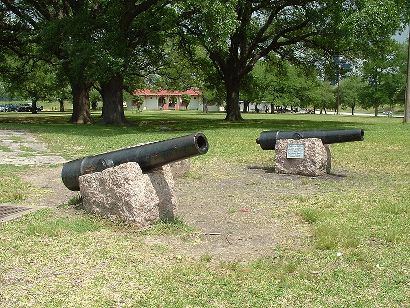
With that object in view he crossed the Brazos River at present Richmond on April 11 and on April 15, with some 700 men, arrived at Harrisburg. He burned Harrisburg and started in pursuit of the Texas government at New Washington or Morgan's Point, where he arrived on April 19 to find that the government had fled to Galveston. The Mexican general then set out for Anahuac by way of Lynchburg. Meanwhile, the Texans, on April 11, received the Twin Sisters and with the cannon as extra fortification crossed the Brazos River on the Yellow Stone and on April 16 reached Spring Creek in present Harris County. On April 17, to the gratification of his men, Houston took the road to Harrisburg instead of the road to Louisiana and on April 18 reached White Oak Bayou at a site within the present city limits of Houston. There he learned that Santa Anna had gone down the west side of the bayou and the San Jacinto River, crossing by a bridge over Vince's Bayou. The Mexicans would have to cross the same bridge to return.
Viewing this strategic situation on the morning of April 19, Houston told his troops that it looked as if they would soon get action and admonished them to remember the massacres at San Antonio and at Goliad. On the evening of April 19 his forces crossed Buffalo Bayou to the west side 2½ miles below Harrisburg. Some 248 men, mostly sick and ineffective, were left with the baggage at the camp opposite Harrisburg. The march was continued until midnight. At dawn on April 20 the Texans resumed their trek down the bayou and at Lynch's Ferry captured a boat laden with supplies for Santa Anna. They then drew back about a mile on the Harrisburg road and encamped in a skirt of timber protected by a rising ground. That afternoon Sidney Sherman with a small detachment of cavalry engaged the enemy infantry, almost bringing on a general action. In the clash Olwyns J. Trask was mortally wounded, one other Texan was wounded, and several horses were killed. Mirabeau B. Lamar, a private, so distinguished himself that on the next day he was placed in command of the cavalry.
Santa Anna made camp under the high ground overlooking a marsh about three-fourths of a mile from the Texas camp and threw up breastworks of trunks, baggage, packsaddles, and other equipment. Both sides prepared for the conflict. On Thursday morning, April 21, the Texans were eager to attack. About nine o'clock they learned that Martín Perfecto de Cos had crossed Vince's bridge with about 540 troops and had swelled the enemy forces to about 1,200. Houston ordered Erastus (Deaf) Smith to destroy the bridge and prevent further enemy reinforcements. The move would prevent the retreat of either the Texans or the Mexicans towards Harrisburg.
Shortly before noon, Houston held a council of war with Edward Burleson, Sidney Sherman, Henry W. Millard, Alexander Somervell, Joseph L. Bennett, and Lysander Wells. Two of the officers suggested attacking the enemy in his position; the others favored waiting Santa Anna's attack. Houston withheld his own views at the council but later, after having formed his plan of battle had it approved by Rusk. Houston disposed his forces in battle order about 3:30 in the afternoon while all was quiet on the Mexican side during the afternoon siesta. The Texans' movements were screened by trees and the rising ground, and evidently Santa Anna had no lookouts posted. The battle line was formed with Edward Burleson's regiment in the center, Sherman's on the left wing, the artillery under George W. Hockley on Burleson's right, the infantry under Henry Millard on the right of the artillery, and the cavalry under Lamar on the extreme right. The Twin Sisters were wheeled into position, and the whole line, led by Sherman's men, sprang forward on the run with the cry, "Remember the Alamo!" "Remember Goliad!" The battle lasted but eighteen minutes. According to Houston's official report, the casualties were 650 Mexicans killed and 730 taken prisoner. Against this, only nine of the 910 Texans were killed or mortally wounded and thirty were wounded less seriously. Houston's ankle was shattered by a musket ball
The Texans captured a large supply of muskets, pistols, sabers, mules, horses, provisions, clothing, tents, and $12,000 in silver. Santa Anna disappeared during the battle and search parties were sent out on the morning of the 22nd. The party consisted of James A. Sylvester, Washington H. Secrest, Sion R. Bostick, and a Mr. Cole discovered Santa Anna hiding in the grass. He was dirty and wet and was dressed as a common soldier. The search party did not recognize him until he was addressed as "el presidente" by other Mexican prisoners.
He was brought before Houston, who had been shot in the ankle and badly wounded. Texian soldiers gathered around, calling for the Mexican general's immediate execution. Bargaining for his life, Santa Anna suggested that he order the remaining Mexican troops to stay away. In a letter to Filisola, who was now the senior Mexican official in Texas, Santa Anna wrote that "yesterday evening [we] had an unfortunate encounter" and ordered his troops to retreat to Béxar and await further instructions.
Urrea urged Filisola to continue the campaign. He was confident that he could successfully challenge the Texian troops. According to Hardin, "Santa Anna had presented Mexico with one military disaster; Filisola did not wish to risk another." Spring rains ruined the ammunition and rendered the roads almost impassable, with troops sinking to their knees in mud. Mexican troops were soon out of food, and began to fall ill from dysentery and other diseases. Their supply lines had completely broken down, leaving no hope of further reinforcements. Filisola later wrote that "Had the enemy met us under these cruel circumstances, on the only road that was left, no alternative remained but to die or surrender at discretion".
For several weeks after San Jacinto, Santa Anna continued to negotiate with Houston, Rusk, and then Burnet. Santa Anna suggested two treaties, a public version of promises made between the two countries, and a private version that included Santa Anna's personal agreements. The
Treaties of Velasco required that all Mexican troops withdraw south of the Rio Grande and that all private property be respected and restored. Prisoners-of-war would be released unharmed, and Santa Anna would be given passage to Veracruz immediately. He secretly promised to persuade the Mexican Congress to acknowledge the Republic of Texas and to recognize the Rio Grande as the border between the two countries.
When Urrea began marching south in mid-May, many families from San Patricio who had supported the Mexican army went with him. When Texian troops arrived in early June, they found only 20 families remaining. The area around San Patricio and Refugio suffered a "noticeable depopulation" in the Republic of Texas years. Although the treaty had specified that Urrea and Filisola would return any slaves their armies had sheltered, Urrea refused to comply. Many former slaves followed the army to Mexico, where they could be free. By late May the Mexican troops had crossed the Nueces. Filisola fully expected that the defeat was temporary and that a second campaign would be launched to retake Texas.
Sion Record Bostick’s personal account of Santa Anna’s capture
Captain Moseley Baker told me on the morning of the 22nd to scout around on the prairie and see if I could find any escaping Mexicans. I went and fell in with two other scouts, one of whom was named Joel Robinson, and the other Henry Sylvester. We had horses that we had captured from the Mexicans. When we were about eight miles from the battle field, about one o'clock, we saw the head and shoulders of a man above the tall sedge grass, walking through the prairie. As soon as we saw him we started towards him in a gallop. When he discovered us, he squatted in the grass; but we soon came to the place. As we rode up we aimed at him and told him to surrender. He held up his hands and spoke in Spanish, but I could not understand him. He was dressed a common soldier with dingy looking white uniform. Under the uniform he had on a fine shirt. As we went back to camp the prisoner rode behind Robinson awhile and then rode behind Sylvester. I was the youngest and smallest of the party, and I would not agree to let him ride behind me. I wanted to shoot him. We did not know who he was. He was tolerably dark skinned, weighed about one hundred and forty-five pounds, and wore side whiskers. When we got to camp, the Mexican soldiers, then prisoners, saluted him and said 'el presidente.' We knew then that we had made a big haul. All three of us who had captured him were angry at ourselves for not killing him out on the prairie to be consumed by the wolves and buzzards. We took him to General Houston, who was wounded and lying under a big oak tree.
".........waving his hat and shouting "San Jacinto! San Jacinto! The Mexicans are whipped and Santa Anna a prisoner." The scene that followed beggars description. People embraced, laughed and wept and prayed, all in one breath. As the moon rose over the vast flower-decked prairie, the soft southern wind carried peace to tired hearts and grateful slumber. As battles go, San Jacinto was but a skirmish; but with what mighty consequences! The lives and the liberty of a few hundred pioneers at stake and an empire won! Look to it, you Texans of today, with happy homes, mid fields of smiling plenty, that the blood of the Alamo, Goliad, and San Jacinto sealed forever . Texas, one and indivisible!--Ms. Kate Scurry Terrell describing the scene among refugee families on the Sabine River.
And for @Kenbo


On a side note: I grew up about 10 miles from the battleground sight and my best friend's mother would take him and me to San Jacinto and drop us off. We were probly 12 years old - don't see that happening nowadays! We explored all the area and one time found some bones that we turned over to the officials. We reenacted that fight many a times!
GOD BLESS TEXAS!