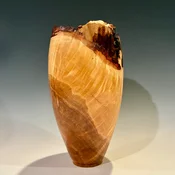
Curly/Figured Maple vase

JD1137

Member
Full Member
Messages
2,405
Reaction score
6,192
Location
Illinois
First name
John
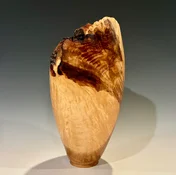
Finished off this curly/figured Maple vase. About 8” tall and 4” wide, at the widest point.

Went with a couple coats of Tung Oil, then switched to a couple coats of gloss poly.

I’m pretty sure I’m done with the finish, but I need to look at it for a while to decide if I like it.

IMG_0313.webp IMG_0314.webp
 
John, did you use WO Poly over the oil? How long for the oil to dry before applying the poly. I didn’t think they would play together.
 
  • Thread Starter Thread Starter
  • #5
John, did you use WO Poly over the oil? How long for the oil to dry before applying the poly. I didn’t think they would play together.
Tom - I only waited about 24 hours in between the 2-coats of the Tung Oil (I’ll get to the poly). It takes about 24 hours to dry because I put the first coat on thick, and let it soak in pretty good. It’s not pure Tung Oil, it’s the Minwax with dryers.

So, after the second TO application (much thinner than the first application) I waited 24 hours and could tell it was cured pretty hard. Was starting to already build a sheen with the second coat. I sanded it back with 400 grit, and decided to switch to the poly, since I didn’t want to spend the next several days layering on the Tung Oil, when I knew the poly would get it done with less effort.

I applied a relatively thin coat of poly on top of the Tung Oil and it was hard after 24 hours. Sanded with 400 and put another thin coat of poly on. Stopped there. I’ll still hit it some 800 grit after I’m sure it’s fully cured.

I agree I wouldn’t typically think poly over oil, but I don’t think anyone really knows what’s in the Minwax Tung oil product?? I’ve heard there’s no Tung Oil in it - LOL

BTW - one coat of Tung oil is probably enough for a soft sheen. Once you go to 2-coats it starts to shine.

I’m more into Walnut Oil or Danish oil for the majority of my turnings, but occasionally I go for more of a sheen on a decorative piece.

 
Finished off this curly/figured Maple vase. About 8” tall and 4” wide, at the widest point.

Went with a couple coats of Tung Oil, then switched to a couple coats of gloss poly.

I’m pretty sure I’m done with the finish, but I need to look at it for a while to decide if I like it.

View attachment 292000View attachment 292001
Beautiful piece! Great starting blank to turn out this nice! I think the gloss WOP is just fine. Chuck
 
Tom - I only waited about 24 hours in between the 2-coats of the Tung Oil (I’ll get to the poly). It takes about 24 hours to dry because I put the first coat on thick, and let it soak in pretty good. It’s not pure Tung Oil, it’s the Minwax with dryers.

So, after the second TO application (much thinner than the first application) I waited 24 hours and could tell it was cured pretty hard. Was starting to already build a sheen with the second coat. I sanded it back with 400 grit, and decided to switch to the poly, since I didn’t want to spend the next several days layering on the Tung Oil, when I knew the poly would get it done with less effort.

I applied a relatively thin coat of poly on top of the Tung Oil and it was hard after 24 hours. Sanded with 400 and put another thin coat of poly on. Stopped there. I’ll still hit it some 800 grit after I’m sure it’s fully cured.

I agree I wouldn’t typically think poly over oil, but I don’t think anyone really knows what’s in the Minwax Tung oil product?? I’ve heard there’s no Tung Oil in it - LOL

BTW - one coat of Tung oil is probably enough for a soft sheen. Once you go to 2-coats it starts to shine.

I’m more into Walnut Oil or Danish oil for the majority of my turnings, but occasionally I go for more of a sheen on a decorative piece.
Ah, so it wasn't straight tongue oil. Makes a difference with dryers included. I'd be hesitant to put a top coat over a pure oil finish - tongue, walnut, whatever. I've never tried it.
 
Beautiful piece John. The grain patterns/colors and shape work wonderfully together.

I've used poly over oil quite a bit. It works just fine as long as the poly is oil based. You should wait for the oil to dry, but doesn't have to be fully cured. As the poly has an oil base, not much different than multiple poly coats. I've only done that though with BLO (that has driers) or with Tung oil that I've added driers. Don't think I've used poly over walnut oil, but should be fine as long as you allow extra time for the oil to dry before the poly.

If you allow enough time for the oil to fully cure (~30 days +/-), you can use anything over the top. I've used both nitro lacquer and WB poly over the top of oil.
 
  • Thread Starter Thread Starter
  • #10
Beautiful piece John. The grain patterns/colors and shape work wonderfully together.

I've used poly over oil quite a bit. It works just fine as long as the poly is oil based. You should wait for the oil to dry, but doesn't have to be fully cured. As the poly has an oil base, not much different than multiple poly coats. I've only done that though with BLO (that has driers) or with Tung oil that I've added driers. Don't think I've used poly over walnut oil, but should be fine as long as you allow extra time for the oil to dry before the poly.

If you allow enough time for the oil to fully cure (~30 days +/-), you can use anything over the top. I've used both nitro lacquer and WB poly over the top of oil.
Yeah - that Tung oil out of the can, I think it has driers plus it builds up on the surface, like a poly. It dries pretty hard in a relatively short period of time depending on temp and humidity.

Early on in my woodturning journey I mixed some Walnut Oil and poly together to see what happened. I kinda liked it, but didn’t use that combo very long and switched to Walnut oil or Tried and True original for almost everything I made.

I learned it would be easier “for anyone” to reapply oil only when a turning needed refurbishment.

But, somewhat surprisingly it really cured okay. One of my mentors was kinda scratching his head wondering how the poly was curing when mixed with oil. I was so new to it, I really didn’t know much about it either, but it felt dry.
 
Sam Maloof's famous finish was a mix of raw tung oil, boiled linseed oil and polyurethane in equal amounts. Remember reading that he figured there was enough driers in the BLO that would help polymerize the raw tung.

Drying oils and "poly" both cure through oxidative polymerization. The oil base used with poly finishes help produce a softer more flexible coating than the urethane alone. The belief is that Maloof wanted a softer feeling and looking finish than straight poly, while retaining some of the protection that urethane provides.

By the way, one of the cautions when using Japan Drier is to not use it in polyurethane. I know that oil poly already has driers ( or catalysts) in it, specially formulated for the mix, and assume that the addition of Japan Drier would really mess with the urethane.
 
Last edited:
Sam Maloof's famous finish was a mix of raw tung oil, boiled linseed oil and polyurethane in equal amounts. Remember reading that he figured there was enough driers in the BLO that would help polymerize the raw tung.

Drying oils and "poly" both cure through oxidative polymerization. The oil base used with poly finishes help produce a softer more flexible coating than the urethane alone. The belief is that Maloof wanted a softer feeling and looking finish than straight poly, while retaining some of the protection that urethane provides.

By the way, one of the cautions when using Japan Drier is to not use it in polyurethane. I know that oil poly already has driers ( or catalysts) in it, specially formulated for the mix, and assume that the addition of Japan Drier would really mess with the urethane.
Raw Tung oil polymerises by itself. As does raw linseed oil. It will take longer than with driers but it will absolutely polymerise. It is a very popular finish in the treen carving world. Raw Tung is surprisingly durable and food safe.
 
Raw Tung oil polymerises by itself. As does raw linseed oil. It will take longer than with driers but it will absolutely polymerise. It is a very popular finish in the treen carving world. Raw Tung is surprisingly durable and food safe.
Of course. The concern wasn't that it wouldn't polymerize, but rather by adding raw oil to the mix it would slow the dry and cure times - impractical for furniture business. (Forgive me for calling Sam Maloof a "furniture business"!

I use my own polymerized tung mix on probably 75% of finished turnings, but would love to use raw, if it would cure as fast.

But enough of this digression, let's get back to discussing John's wonderful vase.
 
Of course. The concern wasn't that it wouldn't polymerize, but rather by adding raw oil to the mix it would slow the dry and cure times - impractical for furniture business. (Forgive me for calling Sam Maloof a "furniture business"!

I use my own polymerized tung mix on probably 75% of finished turnings, but would love to use raw, if it would cure as fast.

But enough of this digression, let's get back to discussing John's wonderful vase.
Ah. That makes more sense.
 
Back
Top