• New Woodbarter Hats Are Available!!! Scroll down on the main page to the Member Activities & Site Support, Then click on Wood Barter SCHWAG and go to the topics on hats by Woodtickgreg to order your hat. There's only a limited quanity, so don't wait to get yours.

Density of Dinizia excelsa (Angelim Pedra)

Big Ry

Member
Full Member
Messages
1,243
Reaction score
1,391
Location
Philadelphia, PA
First name
Ryan
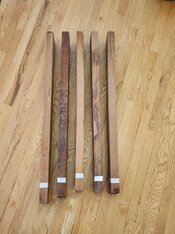
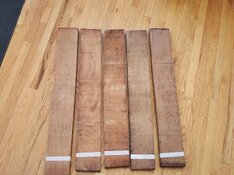
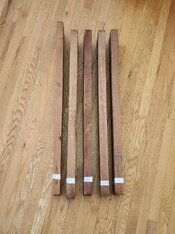
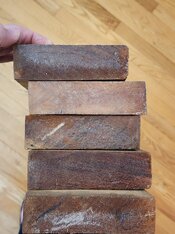
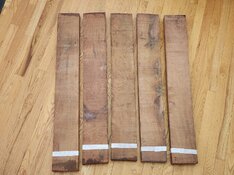
I bought 11BF of Angelim Pedra from Advantage Lumber. I only recently started using Advantage Lumber, but so far I've had a lot of problems with my orders from them - including being given the wrong species twice. So I am heavily scrutinizing this order to make sure it is correct. Its all rough-sawn 6/4 Angelim, but I don't want to cut/sand it until species is confirmed if at all possible. The reason for this is due to the difficulty they are giving me for my last order of Cumaru. They screwed up by sending me severely warped Cumaru, and 1 of the 3 boards isn't even Cumaru at all. Its very obviously a much lighter species, and it doesn't even look like the other 2 boards. Advantage is making me return the Cumaru order before they will release a replacement shipment, which makes me think they will try to weasle out of a replacement order of Angelim if they see that I cut or sanded any of the boards.

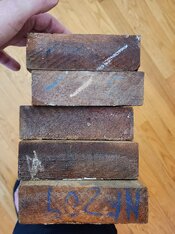
My Angelim order came as 5 boards that are all approximately the same size. I carefully measured the average dimensions of each and weighed them on my new Penn scale. I get an average density of 44.78pcf and a median density of 43.99pcf. The spread is 11.62pcf, which seems awfully large. But what is realy throwing me off is the fact that Wood Database claims the density should be 67pcf. This is the same density listed on Advantage Lumber's website, though it appears Advantage is just pulling from Wood Database anyway. Other sources online list the metric equivalent of about 40-55pcf, which is more consistent with my numbers; however, most of these sources refer to a botanical name of Hymenolobium excelsum, so I'm not even sure if its the same species.

Here are some photos of the wood, in case anyone can glean anything from photos of rough-sawn 6/4...
20260504_162240.jpg 20260504_162323.jpg 20260504_162400.jpg 20260504_162439.jpg 20260504_162542.jpg 20260504_162638.jpg
 

Mr. Peet

Member
Full Member
Messages
9,259
Reaction score
11,149
Location
northeastern PA
First name
Mark
Well, I always knew Dinizia excelsa as "Parakwa". And Hymenolobium as 'Angelim Pedra'.

Dinizia reacts to blacklight....I think.
 

Big Ry

Member
Full Member
Messages
1,243
Reaction score
1,391
Location
Philadelphia, PA
First name
Ryan
  • Thread Starter Thread Starter
  • #3
Well, I always knew Dinizia excelsa as "Parakwa". And Hymenolobium as 'Angelim Pedra'.

Dinizia reacts to blacklight....I think.
The raw wood doesn't react. But if it's wet with water or alcohol it has a very slight yellow or green fluorescence. I'm not even sure it'll show up on camera its so light.

Alcohol:
20260504_234557.jpg

Water:
20260504_234722.jpg

I decided just to sand 2 faces on one of the boards. It certainly looks like Angelim. There aren't too many species with this type of feathering, so i think that really narrows it down.

20260504_234259.jpg
20260504_234340.jpg
20260504_234309.jpg

I also remembered that i have a pen blank of angelim that I believe came in one of Paul's boxes. Aside from a slight difference in color, it looks pretty similar.

20260504_235033.jpg
20260504_235044.jpg

I also posted this question on Facebook, and Steve Earis said Angelim smells awful when wet. This wood from Advantage does smell somewhat sour, but it's not necessarily an awful smell and it's also not an unfamiliar scent. Ive definitely worked other wood with a similar scent (no idea what species). The wood has the smell even when dry; its just enhanced by the water. Interestingly the pen blank has no smell - dry or wet.
 

Nature Man

Member
Full Member
Messages
17,695
Reaction score
17,521
Location
Bulverde, TX
First name
Chuck
The raw wood doesn't react. But if it's wet with water or alcohol it has a very slight yellow or green fluorescence. I'm not even sure it'll show up on camera its so light.

Alcohol:
View attachment 288333

Water:
View attachment 288334

I decided just to sand 2 faces on one of the boards. It certainly looks like Angelim. There aren't too many species with this type of feathering, so i think that really narrows it down.

View attachment 288335
View attachment 288336
View attachment 288337

I also remembered that i have a pen blank of angelim that I believe came in one of Paul's boxes. Aside from a slight difference in color, it looks pretty similar.

View attachment 288338
View attachment 288339

I also posted this question on Facebook, and Steve Earis said Angelim smells awful when wet. This wood from Advantage does smell somewhat sour, but it's not necessarily an awful smell and it's also not an unfamiliar scent. Ive definitely worked other wood with a similar scent (no idea what species). The wood has the smell even when dry; its just enhanced by the water. Interestingly the pen blank has no smell - dry or wet.
I have a slab of this wood, and it certainly looks very much like the ones you’ve pictured. Chuck
 

Asssiss

Member
Full Member
Messages
379
Reaction score
1,192
Location
Brazil
First name
Emerson
Here in Brazil angelim pedra is avaible in any wood store.I already have some at home.I"ll looking for and show here.

Pedra means stone and some boards has a black spots (called pedra) and this is the reason of name.

The scientific name of angelim-pedra is:
Hymenolobium petraeum Ducke

That other scientific name represent other wood for us.

Angelim vermelho
Dinizia excelsa.

Your pictures looks like angelim-pedra but no stones (pedras) at your boards.

See this door and table and the stones (pedra).I hate that black spots at wood and purchased only without it.


IMG-20260505-WA0003.jpg

IMG-20260505-WA0004.jpg
Source
IMG-20260505-WA0005.jpg
 
Last edited:

Big Ry

Member
Full Member
Messages
1,243
Reaction score
1,391
Location
Philadelphia, PA
First name
Ryan
  • Thread Starter Thread Starter
  • #7
Here in Brazil angelim pedra is avaible in any wood store.I already have some at home.I"ll looking for and show here.

Pedra means stone and some boards has a black spots (called pedra) and this is the reason of name.

The scientific name of angelim-pedra is:
Hymenolobium petraeum Ducke

That other scientific name represent other wood for us.

Angelim vermelho
Dinizia excelsa.

Your pictures looks like angelim-pedra but no stones (pedras) at your boards.

See this door and table and the stones (pedra).I hate that black spots at wood and purchased only without it.


View attachment 288340

View attachment 288341
Source
View attachment 288342
Thanks for providing such great detail.

So it seems that Eric over at Wood Database is mixed up on these species. Its also very curious that Angelim vermelho and Angelim pedra come from completely different genus. That begs the question...which data is supplied at Wood Database? Is that 67pcf consistent with Angelim vermelho? What about the Janka hardness of 3,160lbf? That is quite hard, and it doesn't seem like this Angelim pedra is quite that hard.

Clearly, now I need to buy some Angelim vermelho đŸ˜†
 

daniscool

Member
Full Member
Messages
1,997
Reaction score
2,130
Location
austria
First name
Daniel
Thanks for providing such great detail.

So it seems that Eric over at Wood Database is mixed up on these species. Its also very curious that Angelim vermelho and Angelim pedra come from completely different genus. That begs the question...which data is supplied at Wood Database? Is that 67pcf consistent with Angelim vermelho? What about the Janka hardness of 3,160lbf? That is quite hard, and it doesn't seem like this Angelim pedra is quite that hard.

Clearly, now I need to buy some Angelim vermelho đŸ˜†
Angelim vermelho is a beautiful and very strong/hard wood. It has very wide parynchema which are much softer than the rest of the wood though so it might machine funny. It definitely carves weird.
 

Big Ry

Member
Full Member
Messages
1,243
Reaction score
1,391
Location
Philadelphia, PA
First name
Ryan
  • Thread Starter Thread Starter
  • #9
Angelim vermelho is a beautiful and very strong/hard wood. It has very wide parynchema which are much softer than the rest of the wood though so it might machine funny. It definitely carves weird.
It seems like many others group vermelho and pedra together, which makes it difficult to purchase one or the other.
 

Asssiss

Member
Full Member
Messages
379
Reaction score
1,192
Location
Brazil
First name
Emerson
It seems like many others group vermelho and pedra together, which makes it difficult to purchase one or the other.
In Brazil I saw angelim vermelho more than 20 years ago...the smell is not so good (remember cat feces) .Angelim-pedra is like sparrow...you can find at any wood store...some boards are very wide.
Angelim amargoso is the worst to work ...you can feel a bitter flavor at mouth when cuting and you desire to finish as soon as possible.If you don't cut you can't feel nothing bad.
 
Last edited:

Asssiss

Member
Full Member
Messages
379
Reaction score
1,192
Location
Brazil
First name
Emerson
Thanks for providing such great detail.

So it seems that Eric over at Wood Database is mixed up on these species. Its also very curious that Angelim vermelho and Angelim pedra come from completely different genus. That begs the question...which data is supplied at Wood Database? Is that 67pcf consistent with Angelim vermelho? What about the Janka hardness of 3,160lbf? That is quite hard, and it doesn't seem like this Angelim pedra is quite that hard.

Clearly, now I need to buy some Angelim vermelho đŸ˜†
Angelim-pedra is softer than angelim vermelho...raising grain a lot at angelim-pedra...my father used a lot of glue size (1/3 ratio mixed with water) to keep the fibers down and make sand easy.
 

Big Ry

Member
Full Member
Messages
1,243
Reaction score
1,391
Location
Philadelphia, PA
First name
Ryan
  • Thread Starter Thread Starter
  • #12
Angelim-pedra is softer than angelim vermelho...raising grain a lot at angelim-pedra...my father used a lot of glue size (1/3 ratio mixed with water) to keep the fibers down and make sand easy.
Are you saying that Angelim pedra has grain raising issues even after finishing? Or is that just with less-durable finishes like mineral oil, wax, maybe curing oils? I do not have a specific plan for this Angelim pedra, but I likely would not use it in a cutting board or other food prep surface that would utilize a simple oil/wax finish. I am not a big fan of wide grained woods on projects like that, so I would almost certainly only use this wood in projects in which I will be sealing the grain with poly or something else film-forming.
 

Asssiss

Member
Full Member
Messages
379
Reaction score
1,192
Location
Brazil
First name
Emerson
Are you saying that Angelim pedra has grain raising issues even after finishing? Or is that just with less-durable finishes like mineral oil, wax, maybe curing oils? I do not have a specific plan for this Angelim pedra, but I likely would not use it in a cutting board or other food prep surface that would utilize a simple oil/wax finish. I am not a big fan of wide grained woods on projects like that, so I would almost certainly only use this wood in projects in which I will be sealing the grain with poly or something else film-forming.
No... I am saying because grain raising my father used glue size a lot when sand sealing was not avaible and we must to use shellac as a sealer.
Today sand sealer became very popular and cheap all around.
Angelim-pedra has too much splinter issues and some boards can injury our hands during sanding time.
 
Last edited:

Big Ry

Member
Full Member
Messages
1,243
Reaction score
1,391
Location
Philadelphia, PA
First name
Ryan
  • Thread Starter Thread Starter
  • #14
No... I am saying because grain raising my father used glue size a lot when dando sealing was not avaible and we must to use shellac as a sealer.
Today sand sealer became very popular and cheap all around.
Angelim-pedra has to much splinter issues and some boards can injury our hands during sanding time.
Ive noticed...very similar to Wenge. I think it need to be sealed in epoxy or at least filled and covered in poly.
 

Asssiss

Member
Full Member
Messages
379
Reaction score
1,192
Location
Brazil
First name
Emerson
In Brazil the way we use to cover homes are totaly different to US or Europe or other countries.
Here the focus is just the wood he used.Angelim Vermelho...you can see here it is totaly different to Angelim-Pedra.
Beautiful wood.


Big Ry

Member
Full Member
Messages
1,243
Reaction score
1,391
Location
Philadelphia, PA
First name
Ryan
  • Thread Starter Thread Starter
  • #17
In Brazil the way we use to cover homes are totaly different to US or Europe or other countries.
Here the focus is just the wood he used.Angelim Vermelho...you can see here it is totaly different to Angelim-Pedra.
Beautiful wood.

Honestly i can't tell a difference based in this video, but the video isn't really focused on the wood grain very much
 
Top