
♫ εηdεd ♫ - Pictures for Phillip

rob3232

Member
Full Member
Messages
2,721
Reaction score
4,793
Location
WI.
First name
Rob
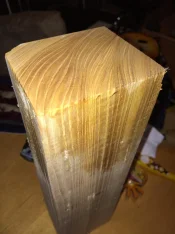
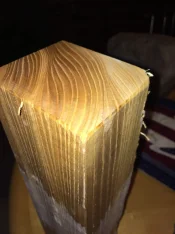
@Bubby asked about some interesting end grain. This is a piece of ash 2 3/4 x 3 3/4 x 11. Interlocked grain I think. Here are a couple of pictures. I could come up with similar pieces to fill a MFR box if this would work for you and post more pictures?
F9ADE727-50AF-4EDE-B46C-998E285F9DA4.webp

076AC05F-10BD-476D-913D-FEDC9D0F1483.webp

Thanks, Rob

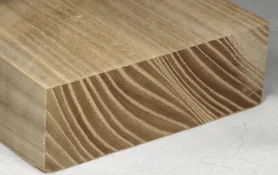
MODERATOR'S NOTE: Rob send me a piece of this and I thought I'd put a pic here to show a more correct version of the color. I verified that it does not not interlocked grain
upload_2018-2-6_14-36-29.webp
 
Last edited by a moderator:
  • Thread Starter Thread Starter
  • #3
Here is what the coffee tree looks like.

02748029-F0A5-4B78-9434-EA4840177570.webp


The pile is hard to get at so can't post pictures of all of it.
47067CFA-FB8A-482F-A488-816F68DCA004.webp
 
This is a piece of ash 2 3/4 x 3 3/4 x 11. Interlocked grain I think.
Rob, I don't think ash ever has interlocked grain and I don't see anything in that piece that suggests interlocking. Am I missing something?
 
  • Thread Starter Thread Starter
  • #5
Paul,
It was just a guess. (Bad guess)I have no idea what causes that in the end grain.
Rob
 
Paul,
It was just a guess. (Bad guess)I have no idea what causes that in the end grain.
Rob
If you mean the wide/narrow range of growth rings, that's just due to compression which can have a couple of causes. Makes for wood that can twist/warp.
 
If you mean the wide/narrow range of growth rings, that's just due to compression which can have a couple of causes. Makes for wood that can twist/warp.
So that wouldn't be ideal for a cutting board then, right?
 
So that wouldn't be ideal for a cutting board then, right?
It could cause problems. Depends on how it's cut. If cut oversized and then seasoned you'd likely have plenty of extra to remove any warp/twist unless it was really severe.
@Mr. Peet, how prone is ash to twist/warp?
 
It could cause problems. Depends on how it's cut. If cut oversized and then seasoned you'd likely have plenty of extra to remove any warp/twist unless it was really severe.
@Mr. Peet, how prone is ash to twist/warp?
Thanks, it would be for end grain cutting boards/chopping blocks. I'm going to be doing a "chaotic" design so the ash would be cut multiple times.

Thanks again!!! @phinds
 
Thanks, it would be for end grain cutting boards/chopping blocks. I'm going to be doing a "chaotic" design so the ash would be cut multiple times.
Doubt it would be a problem in that case.
 
I suggest larch. Check out the end grain larch board on my larch page. Larch is a softwood so has the additional advantage over ash of not having pores that could collect bacteria.
 
Paul was correct for the most part. Ash can have interlocked grain, but it rarely crosses over growth rings. So it is very rare in clean wood. Branches and crotches are not clean wood. Commonly, interlocked grain is assumed across growth rings. Agree with Paul, ring porous woods are best used for decorative cutting boards that are just actually serving platters in the form of a cutting board. True end grain cutting boards, food grade, ring porous woods are avoided unless the pores can be truly sealed, thus the higher used diffuse porous woods.

No, that ash with the compression wood end grain is not a good choice. You want to use woods of similar density, and similar growth ring size. If your ash was actually used, and became wet, having variable width rings equals variable expansion. Just breathing over time the board could dissemble itself.

Thanks for the great information!!! Definitely have some more research to do!
 
I suggest larch. Check out the end grain larch board on my larch page. Larch is a softwood so has the additional advantage over ash of not having pores that could collect bacteria.

Thank you for the information! Now just need to find some larch lol
 
@Bubby just FYI, I just added a new pic in the first post showing Rob's wood with a more correctly presented color.
 
Back
Top