Firewood save - Please help me I.D. this

Palaswood

Member
Full Member
Messages
505
Reaction score
575
Location
Irvine, CA
First name
Joseph
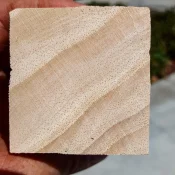
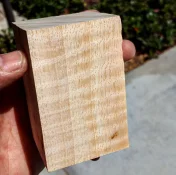
I live in Irvine in Southern California and we don't have any native trees really. Mostly we have imported landscaping trees which include a lot of Eucalyptus and sycamore. I got this from a firewood dealer who also chainsaw carves wood, and he walked me around the stacks (which come from local suburban trees that needed removal) picking out the ones with curly grain. But this wood I haven't seen before. Help me identify it please.

The whole piece is riddled with curl. It's almost as hard as black walnut and has no smell to it when working.
I have no idea what it could be so guess away.

Ask me questions and I'll answer if I can. I really appreciate the help.
IMG_20160908_145942.webp

IMG_20160908_150336.webp
 
Last edited:
Hm ... seems like that should jump right out at me, but I'm very fatigued this evening and can't seem to get my brain to engage. It's a good set of pics and a fairly distinctive look but I'm drawing a blank right now. I'll take a look at it again tomorrow when I have energy to pour through my records.

Can you pro-rate the lbs/cuft ?
 
Last edited:
  • Thread Starter Thread Starter
  • #4
Hm ... seems like that should jump right out at me, but I'm very fatigued this evening and can't seem to get my brain to engage. It's a good set of pics and a fairly distinctive look but I'm drawing a blank right now. I'll take a look at it again tomorrow when I have energy to pore through my records.

Can you pro-rate the lbs/cuft ?
That's a toughy, but I would say weight is similar to a not so dense walnut. I'm considering Rubberwood (Hevea brasiliensis) or Obeche wood (longshot). Thanks and rest easy friend!
 
  • Thread Starter Thread Starter
  • #8
Curly Rubberwood
I would totally agree except what would a latex tree be doing in south orange county? This was a locally harvested tree that was split into firewood. I dont think the end grain is a match either. I have a few rubberwood boards from a vietnamese pallet to compare. But its still on my short list along with obeche.
 
The sides look like a piece I have...
 
Rubberwood and obeche were also my first guesses too but when Marc said mango, I thought YES! but that was based on the face grain. I'm looking at the end grain and I'm now I'm back to being puzzled

obeche --- I just can't reconcile the total lack of pores in the latewood with obeche
rubberwood --- is diffuse porous and this wood is semi-ring porous
mango --- also diffuse porous, unlike this wood

I've gone though my anatomy pages and I'm just flat stumped.

Joseph, can you send me a piece so I can do fine sanding on the end grain?
 
Paul, Rubberwood can appear semi-ringpourous. The location of the plantation can have great influence on the wood and alter that typically seen in its normal environment, just need seasonal / semi-temporal weather.The furniture place up the road 1 mile sells lots of Rubberwood products. It would only take a few pieces of furniture to find a piece fitting your findings. We could stop in the next time your down.
 
Paul, Rubberwood can appear semi-ringpourous. The location of the plantation can have great influence on the wood and alter that typically seen in its normal environment, just need seasonal / semi-temporal weather.
thanks
The furniture place up the road 1 mile sells lots of Rubberwood products. It would only take a few pieces of furniture to find a piece fitting your findings. We could stop in the next time your down.
good idea
 
  • Thread Starter Thread Starter
  • #16
Remember this was from a tree that grew here in southern California, since it was harvested locally (either damaged or needed removal) and sold for firewood, which is where I got it. This was not lumber from a pallet or a crate or furniture. Rubberwood seems very similar in traits, but why would a latex tree be growing in southern California?
 
Good point Joe,

There are 9 species of Hevea recognized with 3 or so variants. None are cold hardy, but can grow in areas semi-tropical. The sporadic light frost once or twice a year is not an issue, but heavier frosts are. In the 70's, lots of rubberwood trees were planted in shopping malls in the US, later to be replaced with the colder hardy Ficus genus (fig trees). So the chances that you have a mall tree or a greenhouse tree are likely slim, unless you have lots of Greenhouses and semi-tropical weather with few frosts in a year.
 
  • Thread Starter Thread Starter
  • #18
I didnt know that about shopping malls. So cal is dry but these trees are virtually all watered by landscaping irrigation. The growth rings are far enough apart to hint at a fast growing, very well watered tree. Very interesting stuff ... Im gonna get that ornament together soon and whatever wood it is its goi g to look awesome with the rosewood.
 
Back
Top