

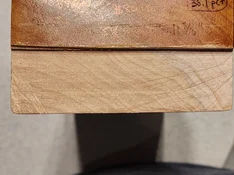
I got this block of Golden Nanmu (pheobe zhennan) from @Byron Barker, who ordered it for me from a (Chinese?) marketplace as part of a deal we worked out. It was understood that the species wasn't confirmed, since Byron hadn't previously ordered nanmu from this supplier. So this thread serves two purposes: (a) to confirm the species is in fact pheobe zhennan, and (b) if confirmed, to serve as a reference for anyone else in the future who is looking into this species.
I can find very few data points to compare against for this and any other nanmu species. Surely there is more information available in the East, but this is not at all a species commonly available in the West, especially in the US.
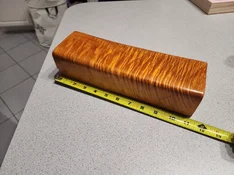
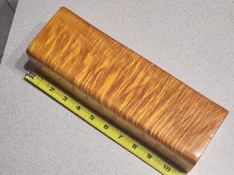
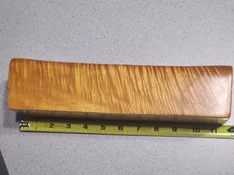
The block has a finish applied. It seems to likely be water polyurethane based on the fact that it heavily mutes the chatoyance and it's proved resistant to alcohol. It also has that plasticy feel that's common with water poly. I suspect that this finish is tinted, because wetting the raw wood doesn't come close to the same golden shade as the finished surface.
Other material data -
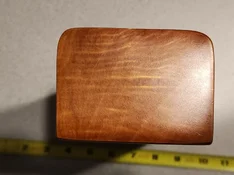
Color: finished wood is a deep gold to orange color, similar to Honduran mahogany. Again, i suspect there's tint in the finish. Unfinished wood is pale orange to slight pink color, not unlike common pear or apple.
Density: ~35pcf (approx. due to curved top face and routed edges)
Scent: smells very similar to any cheap Chinese rubberwood furniture, though that scent doesn't seem to be from the wood itself but rather a treatment or other environment factor. It's a chemical scent that I recognize immediately, though i have no clue what is from.
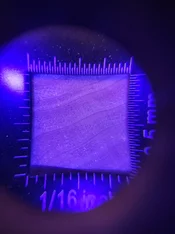
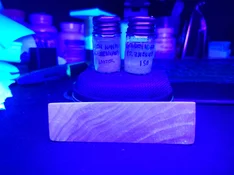
UV reactivity: very very faint isolated response (yellow?) in raw wood with low power UV light (high power light washed out reaction). No discernable reaction in water extractive or isopropyl alcohol extractive.
Froth test: as negative as negative can be
Hardness (subjective): the wood feels relatively soft. It's definitely harder then white pine or American sycamore, but I've dented it a few times with light bumps on the counter. Id estimate it's a little softer than black cherry.
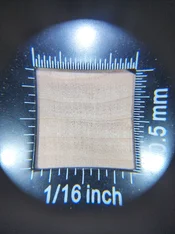
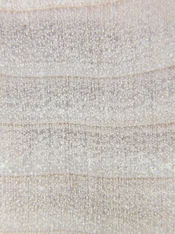
The only reference i have for pheobe zhennan is the Atlas of Hardwood Identification, which has pheobe zhennan as well as 2 other pheobe species. All 3 pheobe species are remarkably similar looking in end grain characteristics, so I'm not sure that i could even tell them apart. This block seems to be reasonably close to matching the Atlas, however it's a little hard seeing some of the end grain structures in my photos despite my best efforts to clean them up.
Photos -
I can find very few data points to compare against for this and any other nanmu species. Surely there is more information available in the East, but this is not at all a species commonly available in the West, especially in the US.
The block has a finish applied. It seems to likely be water polyurethane based on the fact that it heavily mutes the chatoyance and it's proved resistant to alcohol. It also has that plasticy feel that's common with water poly. I suspect that this finish is tinted, because wetting the raw wood doesn't come close to the same golden shade as the finished surface.
Other material data -
Color: finished wood is a deep gold to orange color, similar to Honduran mahogany. Again, i suspect there's tint in the finish. Unfinished wood is pale orange to slight pink color, not unlike common pear or apple.
Density: ~35pcf (approx. due to curved top face and routed edges)
Scent: smells very similar to any cheap Chinese rubberwood furniture, though that scent doesn't seem to be from the wood itself but rather a treatment or other environment factor. It's a chemical scent that I recognize immediately, though i have no clue what is from.
UV reactivity: very very faint isolated response (yellow?) in raw wood with low power UV light (high power light washed out reaction). No discernable reaction in water extractive or isopropyl alcohol extractive.
Froth test: as negative as negative can be
Hardness (subjective): the wood feels relatively soft. It's definitely harder then white pine or American sycamore, but I've dented it a few times with light bumps on the counter. Id estimate it's a little softer than black cherry.
The only reference i have for pheobe zhennan is the Atlas of Hardwood Identification, which has pheobe zhennan as well as 2 other pheobe species. All 3 pheobe species are remarkably similar looking in end grain characteristics, so I'm not sure that i could even tell them apart. This block seems to be reasonably close to matching the Atlas, however it's a little hard seeing some of the end grain structures in my photos despite my best efforts to clean them up.
Photos -
Last edited:


