• New Woodbarter Hats Are Available!!! Scroll down on the main page to the Member Activities & Site Support, Then click on Wood Barter SCHWAG and go to the topics on hats by Woodtickgreg to order your hat. There's only a limited quanity, so don't wait to get yours.

How to finish so that it doesn’t look finished?

Ken Martin

Member
Full Member
Messages
973
Reaction score
1,319
Location
Brandon, MS
First name
Ken
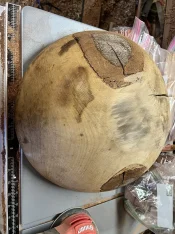
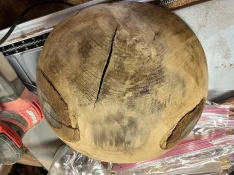
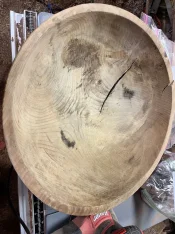
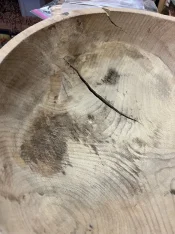
Ok, so I had a lady contact me through the local Craftsmen’s Guild. She brought me an old dough bowl that turned out to be from a 16 inch American Chestnut. It has a closed , but through-and-through split about 4” long, as well as several stains that I suspect were caused by rotten fruit or potatoes.

She decided that she doesn’t want it refinished, or rather a finish applied in multiple coats, but only cleaned up and the split repaired. I have started sanding the dirt and crud out off the surfaces and think I will need to bleach the whole thing with oxalic acid to reduce the stains.

two questions here:
1) I’m thinking that the wood needs to be sealed. What could be used to seal the wood, but leave it looking unfinished overall?

2) The split. What to seal that up with. I’m thinking epoxy infused with sanding dust. Any other suggestions?
E8556B03-80CB-40A6-94FD-AB1389BF5C43.jpeg

19FFE20C-A4F1-4026-A8DB-214DD9F52023.jpeg

531B23C1-9C5E-4A12-ADA8-6B30E2E66C5E.jpeg

980DF397-DB0B-467D-83FE-A4A9E0C225F6.jpeg
 
Last edited:
That's a rough looking bowl!

Anything you use to seal the bowl will darken it some. My choice would be an oil finish of some sort. Not a full finishing regime with multiple coats, but rather a single heavy coat to saturate the wood as much as possible with the surface wiped dry after application. I'd use polymerized tung oil as that is what I use on every turning. Walnut oil is another option.

As to the cracks and stains. I'd start by getting rid of a much staining as possible first, then address all the cracks. Epoxy with wood dust on the large cracks would be my choice and I would use thin CA glue on the hairline cracks. Before I did any crack filling, I'd give the it a good wash coat of shellac to help prevent the CA or epoxy from staining the surrounding wood.

The two patches of bark on the outside also look like they need a little help. I'd probably try to wick some CA around and underneath the edges of the bark to help keep it attached.
 
  • Thread Starter Thread Starter
  • #3
Thanks Tim, good information!

I’m not familiar with the term “wash coat” how would I apply it? Also, do you suggest that this coat of shellac be applied before, after, or instead of the tung oil? …and would you thin the tung oil and/or shellac down? If so, what do you thin each with?

The bowl responded pretty well to a light sanding with 80 grit, but I think I’d like to take that on down to at least 120 grit, if not 150. Chestnut is, after all, a very rustic wood and probably would look too polished at 220 or higher.

ou didn’t mention the oxalic acid bleaching. Do you recommend it or not …or just don’t have an opinion on it?
 
The wash coat is just a barrier coat to prevent the CA and epoxy from penetrating/staining the surface around the cracks. I usually just wipe on a 2# cut, but the cut isn't really important, just use whatever you have. It's not part of the finish as you will be sanding it away after epoxy/CA has dried.

Ive not used any oxalic acid on turnings, but think it will help remove some of the staining, and won't cause any harm.

I currently use citrus oil solvent to thin my tung, but naptha and mineral spirits both work fine for thinning. As to how much to thin, I like a consistency similar to wipe on poly. In other words, pretty thin.

As to sanding, I'd go to at least 220x, turnings are often taken much higher. With the different grain directions a higher grit is often needed to get rid of cross grain scratches that may be visible.
 
I have doe some wood bleaching and the results may be whiter that you want. I'd do a test first
 
30+ yrs in wood floor business and the few attempts to remove stains with Oxalic Acid were a waste. It lightens everything without removing the stain completely.
 
Shellac works to protect the wood against CA staining but so does a light spritz from a rattle can of lacquer. I second the PTO recommendation also. As for the big crack, epoxy and coffee grounds would be very dark and might tie in with the dark bark but would be very noticeable.
 
@Firewood Potter noted exactly what I was going to. Well, minus the 30+ years in the wood floor business. The only way to remove the stain, is likely to sand it out or turn it out, if not too deep of a stain. I have used Bar Keepers Friend applied to a stain, wet it down, and rub with fine steel wool to remove a stain. After rubbing, left it to sit a while. With my very limited experience with it, I don't know if it works with all stains, on all woods, and doesn't affect the wood surrounding the stain.

I am totally surprised to see the bark inclusions on the back. After seeing hundreds/thousands of antique/vintage wooden and burl bowls, don't think I've seen one with bark inclusions like that. Did a family member or friend make the bowl.

On the finish, I would assume she does not want "shiny" or "plasticy". I'd say one or two coats of some light colored oil would be a good candidate although it will darken some. Would she be ok with that?

Epoxy/sawdust for the cracks is ok, but I prefer CA and sawdust - but not usually that big of a crack. I'd definitely do something about the bark inclusions. Maybe wood hardener, maybe CA to stabilize them. Will likely be darker with either.
 
  • Thread Starter Thread Starter
  • #9
Thanks for all the suggestions, guys! I’ll keep them stored in the steel trap bank vault in my head for future use.

This was a project handed to me about 3 years ago and I have long since finished what I could do and given it back. It was way too warped to try and turn anything out and, if I remember correctly, the stains went through-and-through.

thanks again! It never hurts to have new tricks stored away for the
 
I did the same a few days ago with an intro. Happens to everyone. Now I don’t feel so bad about my mistake.
 
Thanks for all the suggestions, guys! I’ll keep them stored in the steel trap bank vault in my head for future use.

This was a project handed to me about 3 years ago and I have long since finished what I could do and given it back. It was way too warped to try and turn anything out and, if I remember correctly, the stains went through-and-through.

thanks again! It never hurts to have new tricks stored away for the
I am suprised I said nothing back then, but the bowl you pictured is Beech, not Chestnut.
 
Thanks, @Mr. Peet I’d argue about it with anyone else but you! All I know for sure is that it was O.L.D.!
Chestnut is ring porous, that bowl is diffuse porous. The white rot matches beech, chestnut does not get white rot. Chestnut lacks ray flecks, your wood has them. Kicker is bark. Your bowl has the thin smooth bark versus fissured chestnut bark.
 
  • Thread Starter Thread Starter
  • #16
The photographer might not have been on his best game that day. But, yeah, it was a very old bowl and heavily stained when I wrote that first post. In hindsight, beech makes a lot more sense all around.
 
Back
Top