On a serious note though, do you happen to have any longer pieces of the "barf" boxwood? Like spindle blanks or small boards?
That Peltogyne catigae ducke botanical name is confirmed? This might be the first time I've ever seen purpleheart listed by species. I've always wanted to get samples of the various species that fall under that common name, but it's almost never sold with a species name
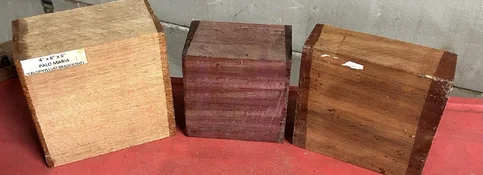
What are the other 2 bowl blanks in lot 4? If the middle one is purpleheart, is it the same peltogyne catigae ducke species?I'm sorry. I only have a few bowl blanks in the Palo Maria.
What are the other 2 bowl blanks in lot 4? If the middle one is purpleheart, is it the same peltogyne catigae ducke species?
Just a heads up. David provides many nice woods. He is a supplier, and goes on the information he is given. The last time I purchased wood under certain common names and was given Latin binomials, I asked for proof papers and was told they were not available. After working the wood, 2 out of the three species did not look to match the species name they were purchased under. Samples were sent to USDA Madison, reviewed by two different ID specialists and found to be something other than what I bought them as. I informed David of this and what genus was given by the USDA. I also e-mailed him the papers I had from the USDA. Nothing changed on his website and I heard nothing back after such. Therefore, I'd say purchase based on looks, not names.Hi @gvwp Do you have Peltogyne catigae ducke in 18” or 24” spindle blank? (either 1.5” x 1.5” or 2” x 2”)? I already generally labeled purpleheart but don’t have the species Peltogyne catigae ducke. Thanks!
I’ll take the second set if still available.
Hi @gvwp Do you have Peltogyne catigae ducke in 18” or 24” spindle blank? (either 1.5” x 1.5” or 2” x 2”)? I already generally labeled purpleheart but don’t have the species Peltogyne catigae ducke. Thanks!
Just a heads up. David provides many nice woods. He is a supplier, and goes on the information he is given. The last time I purchased wood under certain common names and was given Latin binomials, I asked for proof papers and was told they were not available. After working the wood, 2 out of the three species did not look to match the species name they were purchased under. Samples were sent to USDA Madison, reviewed by two different ID specialists and found to be something other than what I bought them as. I informed David of this and what genus was given by the USDA. I also e-mailed him the papers I had from the USDA. Nothing changed on his website and I heard nothing back after such. Therefore, I'd say purchase based on looks, not names.

Hi @gvwp thank you for getting back to me. I have generally labeled purpleheart, so I’m going to hold off on buying for now. Thank you.I have many turning pieces of Purpleheart in 1.5" x 1.5" x 18" and 24" as well as 2" x 2" x 18" and 24" all with beautiful color, however, they don't have the species Peltogyne catigae ducke on the label.
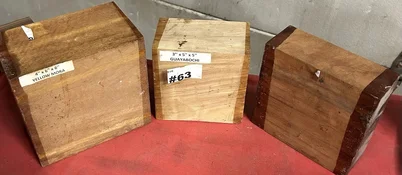
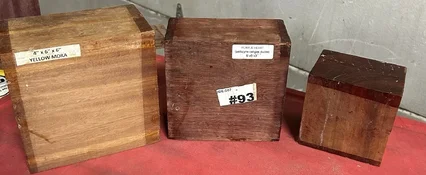
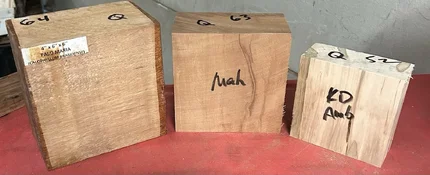
I am interested in #1, but don’t want Purpleheart. Think the 3rd block is not Purpleheart, but not sure. Hopefully, I am not getting in front of anyone else on this. ChuckHere are a few sets of kiln dried bowl blanks. Yellow Mora AKA Argentine Osage Orange. Palo Maria AKA Boxwood. I am happy to identify any that are not labeled in the photos. Each lot is a set of 3. From the top sets 1-4. $45 for any set of 3 delivered within the 48 states.
View attachment 294257
View attachment 294258View attachment 294259
View attachment 294260
David, you have most of it correct. We did talk about the woods you listed, however, I ordered Canarywood, Aliso and Garlicwood as it was listed on your sight. I wanted the Canarywood because it was loaded with purple coloring. I paid by check, so the Canarywood piece was not the one I ordered, but a substitute. I accepted this as respect to you and gave it away to a friend as a birthday gift since I could not use it. I worked the other 2 woods and found conflict as stated above. The Garlicwood was actually in the Albizia genus and the Aliso was in the Vochysia genus based on USDA Forest Service ID. I can see if I archived the e-mails I sent you and resend if you want. I had also sent hard copies to the same address I sent my check payment, so you should have had copies of the USDA papers as hard copies and electronic copies. You could not guarantee that the Guayabochi was in fact Calycophyllum spruceanum and therefore I did not purchase it. I still lack it and hope to get some some day.Thank you Mr. Peet for the footnote. To clarify you had purchased three of the less common species, specifically Palo Maria, Mani, and Guayabochi. All three of these names were indeed supplied by the South American source and were labeled as such when they arrived. You had asked me for the Latin names for these species. I told you I didn't know them but would check with my source in South America which I did and sent that info to you that was provided to me. You mentioned the Palo Maria common name was also known as South American Boxwood which I did not know and which was helpful. I don't recall seeing any info on the other two or info from the USDA. There are many species in South America and many are called different names for the same wood by the locals. It's those locals who prepare the containers that are loaded for export to the U.S. Those locals will place the names on the blanks that they are familiar with so while the more popular species often coincide with what we call the same wood in the U.S. not all species will be called the same name we are familiar with. Some common named species can also have sub species which can complicate things even more. In the end all wood is beautiful and that is what our hobby is about.
I am interested in #1, but don’t want Purpleheart. Think the 3rd block is not Purpleheart, but not sure. Hopefully, I am not getting in front of anyone else on this. Chuck