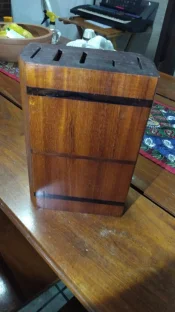
My First Project in 2005

Asssiss

Member
Full Member
Messages
456
Reaction score
1,407
Location
Brazil
First name
Emerson
Hello fellows,my first project (all by myself) was this wood knives stand.I made using four spices of Brazilian wood.Jacarandá (Dalbergia nigra); Pau Brasil (Paubrasilia echinata) e Vinhático (Plathymenia foliolosa Benth); Roxinho (Peltogyne angustiflora ) that time pictures by smartphone was not common like today.I don't have step by step but you can understand easily how I did it.

Note :Vinhático (Plathymenia foliolosa Benth)=softwood.The other three are hardwood.
Thank You ! for attention

I made the grooves at table saw
IMG-20210106-WA0077.jpeg
IMG-20210106-WA0075.jpeg
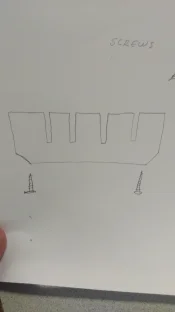
The two parts screwd and glued together

IMG-20210106-WA0073.jpeg
One side the screws are at one position

IMG-20200628-WA0103.jpg
IMG-20200628-WA0099.jpg
This side the screw at other position.The stripes on transversal way hide the screw heads.
Because some brand of knives (like Wusthof) has a large bolster I did this two gooves wider
to make all knives butt at same level.

IMG-20201205-WA0012.jpg
The glue line on center
IMG-20200628-WA0101.jpg
At side a piece of purple wood hide the glue line

IMG-20200628-WA0095.jpg

IMG-20200628-WA0091.jpg
 
Last edited:
Strips worked out well to hide the screws, and good job getting picture attachments figured out.
 
Arn, So if you read Emerson's post above, he has Jacarandá (Dalbergia nigra). So, clearly a common name issue, used in Brazil, and conflicting the name Jacaranda as I had learned it.

Arn, I realize your argument based on striping and grain but can better understand how conflict arises.
 
Last edited by a moderator:
  • Thread Starter Thread Starter
  • #4
Arn, So if you read Emerson's post above, he has Jacarandá (Dalbergia nigra). So, clearly a common name issue, used in Brazil, and conflicting the name Jacaranda as I had learned it.

Arn, I realize your argument based on stripping and grain but can better understand how conflict arises.
Mr Peet thanks for comment.In Brazil we have some woods called Jacarandá as a base name.It means we have three or four spicies using same base name but tottaly different species.
They are:

Jacarandá da Bahia (Dalbergia nigra)
Jacarandá Mimoso (mimosifolia)
Jarandá Violeta (violetwood)
Jacarandá Rosa (Platymiscium floribundum)
Jacarandá do Cerrado (Machaerium villosum)

Thanks for attention.
 
Last edited by a moderator:
Mr Peet thanks for comment.In Brazil we have some woods called Jacarandá as a base name.It means we have three or four spicies using same base name but tottaly different species.
They are:

Jacarandá da Bahia (Dalbergia nigra)
Jacarandá Mimoso (mimosifolia)
Jarandá Violeta (violetwood)
Jacarandá Rosa (Platymiscium floribundum)
Jacarandá do Cerrado (Machaerium villosum)

Thanks for attention.

When shipping becomes more affordable, I'll need Platymiscium floribundum, Peltogyne angustiflora, Plathymenia reticulata ( was foliolosa) and a whole bunch of Brazilian woods to add to my wood collection.
 
Arn, So if you read Emerson's post above, he has Jacarandá (Dalbergia nigra). So, clearly a common name issue, used in Brazil, and conflicting the name Jacaranda as I had learned it.

Arn, I realize your argument based on striping and grain but can better understand how conflict arises.
@Mr. Peet, I did write Jacarandá-da-Bahia in one the post at another thread as one of the common name in Brazil (State or region in Brazil)- so in this instance, the association and the correlation is there if stated that way as Brazilian rosewood. Jacarandá used by itself is confusing and you know that could be anything. The other debate on the Madagascar rosewood and Brazilian rosewood is in how to differentiate the two of them visually based on the characteristics and elements present (or absent). I have to stop there as Tony and Eric might give me a vacation or early retirement!

I was wondering @Asssiss why do you call this “Pau Brasil (Paubrasilia echinata)”, which is has a common name of Brazilwood and why not call it Pernambuco (Caesalpinia echinata)? Violin bow makers differentiate the 2 based on
the sonic characteristics of wood/speed of sound.
 
Last edited:
@Mr. Peet, I did write Jacarandá-da-Bahia in one the post at another thread as one of the common name in Brazil (State or region in Brazil)- so in this instance, the association and the correlation is there if stated that way as Brazilian rosewood. Jacarandá used by itself is confusing and you know that could be anything. The other debate on the Madagascar rosewood and Brazilian rosewood is in how to differentiate the two of them visually based on the characteristics and elements present (or absent). I have to stop there as Tony and Eric might give me a vacation or early retirement!

I was wondering @Asssiss why do you call this “Pau Brasil (Paubrasilia echinata)”, which is has a common name of Brazilwood and why not call it Pernambuco (Caesalpinia echinata)? Violin bow makers differentiate the 2 based on
the sonic characteristics of wood/speed of sound.

Caesalpinia echinata was changed to Paubrasilia echinata a few years ago based on DNA differences.
 
Caesalpinia echinata was changed to Paubrasilia echinata a few years ago based on DNA differences.
Can you give me the source? This will be an issue with violin bow makers. They differentiate the 2 (pernambuco versus Brazilwood) based on the velocity of sound performance on each bow blank and not on DNA. A number rating is assigned and usually a lucchi meter is use to perform this task (they use other old school way to grade velocity of sound performance). You actually get a slightly different readings say if you had a 6” wide board- the area closest to the center of the hearth (older) will have a higher number and the area closest to the outside of the tree (young) will have a lower reading. One end could have a reading of 5100 (older/closer to the hearth) and the other end could have a reading of 5000 (younger/closer to the outside of the tree). Readings from 5000-5800 plus would classify this as Pernambuco. Below those numbers will be classified as Brazilwood.

@Asssiss- nice block and beautiful Brazilwood/Pernambuco. That is pretty big size per my experience for a quartered cut section. Larger logs on average reaches to about 10-12”.
 
Last edited:
Can you give me the source? This will be an issue with violin bow makers. They differentiate the 2 (pernambuco versus Brazilwood) based on the velocity of sound performance on each bow blank and not on DNA. A number rating is assigned and usually a lucchi meter is use to perform this task (they use other old school way to grade velocity of sound performance). You actually get a slightly different readings say if you had a 6” wide board- the area closest to the center of the hearth (older) will have a higher number and the area closest to the outside of the tree (young) will have a lower reading. One end could have a reading of 5100 (older/closer to the hearth) and the other end could have a reading of 5000 (younger/closer to the outside of the tree). Readings from 5000-5800 plus would classify this as Pernambuco. Below those numbers will be classified as Brazilwood.

@Asssiss- nice block and beautiful Brazilwood/Pernambuco. That is pretty big size per my experience for a quartered cut section. Larger logs on average reaches to about 10-12”.

Not off hand, I recall Kew being involved and the international board of plants names commission???(maybe its another name) I'd have to look it up. Lack time at present.

In the mean time, check out Wikipedia. They have the name change recorded in 2016.
 
  • Thread Starter Thread Starter
  • #13
Can you give me the source? This will be an issue with violin bow makers. They differentiate the 2 (pernambuco versus Brazilwood) based on the velocity of sound performance on each bow blank and not on DNA. A number rating is assigned and usually a lucchi meter is use to perform this task (they use other old school way to grade velocity of sound performance). You actually get a slightly different readings say if you had a 6” wide board- the area closest to the center of the hearth (older) will have a higher number and the area closest to the outside of the tree (young) will have a lower reading. One end could have a reading of 5100 (older/closer to the hearth) and the other end could have a reading of 5000 (younger/closer to the outside of the tree). Readings from 5000-5800 plus would classify this as Pernambuco. Below those numbers will be classified as Brazilwood.

@Asssiss- nice block and beautiful Brazilwood/Pernambuco. That is pretty big size per my experience for a quartered cut section. Larger logs on average reaches to about 10-12”.
Arn I read your post only now.The Pau Brasil is only the two "orange stripes" at front and back.The main body is all done by Vinhático (softwood).So the stripes are from hardwood (rares) (violet wood is common) and the body from sooftwood.Sorry if Idid you thinking in different way,
Try to see this video ,The sound is not good.


Emerson
 
Last edited:
Back
Top