New specimens coming my way

Gonzalodqa

Member
Full Member
Messages
314
Reaction score
356
Location
Helsinki, Fin
First name
Gonzalo
Hey all,
I thought it may be fun to share with you a rare sample I will be getting in ... not sure how long it will take...
a couple of weeks ago I contacted a worker at the wood anatomy lab in my former university in Peru and he told me that he can send me some local wood samples.
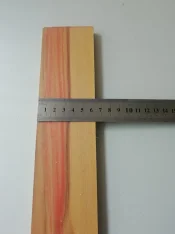
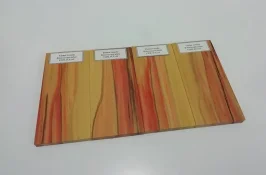
Among the samples he is sending me he is adding Pink Flame wood (Llama rosada) which is fairly rare to me because I have never heard of it before. Sadly is not a standard size, it will be 6,5 cm wide, but he told me that is the only piece he has left and he is not sure when he will have more because of the corona situation and also because this species is not really commercial so it appears only form time to time.
Well he told me the species is Rinorea sp. probably R. apiculata.
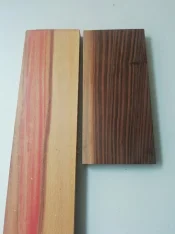
Here are some pictures he sent me. The two first are the specimen I am getting (after its cut to length) the others are sample he has had before.
Hope you enjoy
121005260_1003548416832597_8831907983606118315_n.webp

121008749_743828626196864_2172402848667395028_n.webp

101674538_574363246788610_7250287399924662272_n.webp

new.webp

thumbnail_image0.webp
 
I'm glad to hear pink flamewood is still available. See my site for a discussion of pink flamewood in the USA
 
  • Thread Starter Thread Starter
  • #3
I missed it in your site. So apparently it’s being kinda like around for some years now. This is the first time I heard from it, at first I thought it was some sort of tree reaction like in box elder but it is actually the color of the wood itself quite interesting.
I will upload pictures of the wood with end grain pictures if anyone is interested and maybe some of the other least known species
 
  • Thread Starter Thread Starter
  • #5
No idea. There is not really information abot this species. As far as I know there is not really any research or tests to see its hardness, shrinkage or anything
 
No idea. There is not really information abot this species. As far as I know there is not really any research or tests to see its hardness, shrinkage or anything
I haven't found anything either. It's quite an obscure wood.
 
No idea. There is not really information abot this species. As far as I know there is not really any research or tests to see its hardness, shrinkage or anything

The IWCS World of Wood magazine briskly covered "canilla de veija" in the May / June 2016 issue. Vince Manna wrote his article on Rinorea paniculata. He claims the wood is very prone to warp, twist and splitting. He found small holes similar to those in 'flame box elder'. It is assumed the color in 'pink flame wood' is very much like that in box elder in most regards.

I did not find any science based stats in my files for the wood.
 
  • Thread Starter Thread Starter
  • #8
Great thanks!
I was thinking the pink might appear as a defense mechanism because I know some Albizia trees do that.
I remember seeing some canilla de vieja specimens way back when I was doing my bachelor and I don’t remember the pink color though
 
The unaffected wood is pale yellow. The bright colors and flame patterns are likely a response to termite and fungus activity at the core of the base of the tree. The best colors are found in logs that had some rot at the base and colors (bright pink, yellow and some blue that mix to give ash gray, are running up in the trunk like flames. It turns brown where there are cracks. This probably does not describe all the shades that may appear. The wood is hard and dense (no stats) and hard to dry because it warps. 'Pink flame' occurs in more than one species of Rinorea in the same area. The colors are rather stable. I have a small crate (uncoated wood) that held a turning and it is unaffected by indoor and roof lighting.
 
Hey Mihaly, good to see you posting here. Wish we saw more of it.

Paul
 
  • Thread Starter Thread Starter
  • #11
The unaffected wood is pale yellow. The bright colors and flame patterns are likely a response to termite and fungus activity at the core of the base of the tree. The best colors are found in logs that had some rot at the base and colors (bright pink, yellow and some blue that mix to give ash gray, are running up in the trunk like flames. It turns brown where there are cracks. This probably does not describe all the shades that may appear. The wood is hard and dense (no stats) and hard to dry because it warps. 'Pink flame' occurs in more than one species of Rinorea in the same area. The colors are rather stable. I have a small crate (uncoated wood) that held a turning and it is unaffected by indoor and roof lighting.
Thanks for the information! is good to know that the color will not fade away easily
 
Hey all,
I thought it may be fun to share with you a rare sample I will be getting in ... not sure how long it will take...
a couple of weeks ago I contacted a worker at the wood anatomy lab in my former university in Peru and he told me that he can send me some local wood samples.
Among the samples he is sending me he is adding Pink Flame wood (Llama rosada) which is fairly rare to me because I have never heard of it before. Sadly is not a standard size, it will be 6,5 cm wide, but he told me that is the only piece he has left and he is not sure when he will have more because of the corona situation and also because this species is not really commercial so it appears only form time to time.
Well he told me the species is Rinorea sp. probably R. apiculata.
Here are some pictures he sent me. The two first are the specimen I am getting (after its cut to length) the others are sample he has had before.
Hope you enjoy
View attachment 194422

View attachment 194423

View attachment 194424

View attachment 194425

View attachment 194426
Gonzalo,

Could you PM me your Peru sample contact? Thought I had asked but don't find any notes. Thank you.
 
Last edited by a moderator:
Sorry to resurect this old thread, but i got a blank of "pink flame" from Peru. The common name, origin country, and the fact that it was imported "decades ago" is all the info i have on the wood. Mine is pinkish-orange in color but all uniform. It's just 1 solid color, fairly dense, but soft to the touch. It reminds me of some of the wamara I've gotten recently, which is unusually soft for wamara. End grain is sealed up now, but it appears to be closed grain.

Don't have my own photos yet, but these are the listing photos from eBay. It's wet in the second photo.

Screenshot_20261122_185651_eBay.webp Screenshot_20261122_185633_eBay.webp
 
When i Google that wood i get something more like the photos at the beginning of this thread... Something that looks a lot like box elder. Mine doesn't look or feel anything like that.
Use your IWCS membership to go on the IWCS website. Under the "Member's Only" section you can look up old World of Wood magazines.
 
Last edited:
Use your IWCS membership to go on the IWCS website. Under the "Member's Only" section you can look up old World of Wood magazines.
Do you know if there's a list of species that have been convered in WoW? I guess i could just make my own list if not. I can't imagine there are all that many issues printed given the frequency of publishing.
 
Do you know if there's a list of species that have been convered in WoW? I guess i could just make my own list if not. I can't imagine there are all that many issues printed given the frequency of publishing.
Well, The Bulletin started around 1953 as a monthly and had a tree of the month until it changed to World of Wood. It ran some years before mailing costs pushed it into a bi-monthly print. So maybe only 500 to 700 species covered. The Usuful Woods of the World books are basically pulled from what was in the Bulletin and World of Wood issues. I think Eric was working on and maybe completed search options on such before he passed.
 
Back
Top