

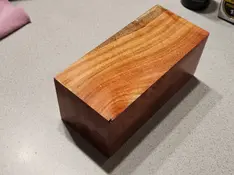
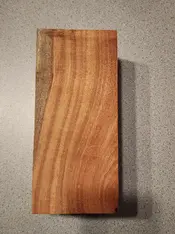
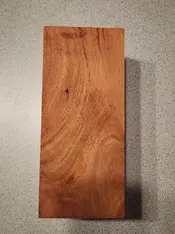
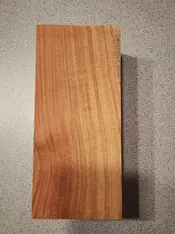
I need help identifying this turning block that i was gifted from the widow of a turner (Cort, in Madison WI from my earlier thread).
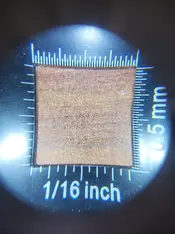
I was assuming it was eucalyptus based on the range of colors, but as soon as i got the end grain under magnification i realized that wasn't the case. The end grain is typical of many species. It exhibits subtle vasicentric parenchyma, marginal parenchyma, and many radially stacked 2-3 pore multiples. Rays are tightly spaced, continuous, and visible without magnification.
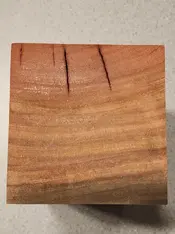
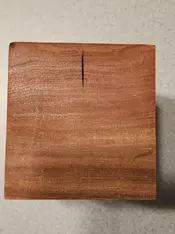
Im blanking on a genus that matches both the end grain and long grain. The end grain is pointing me towards Hymenaea spp., but everything else is a mismatch to that genus (especially density!). I believe this *should* be years-dry; however, the cracks you see in the photos developed since i took possession of the wood a couple months ago. I've had it stored in the shipping box it came in with the lid closed. I keep a very dry shop with several dehumidifiers running 24/7, so i even have cracking issues with KD wood sometimes.
Density = 47pcf
Scent = familiar generic hardwood scent. Can't place it.
UV fluorescence = subtle streaks in the wood. Appears to be yellow or green, but very dull. Didn't check extractive fluorescence. Don't put too much emphasis on this, cause it was very faint.
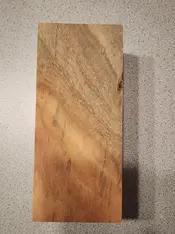
THE FIRST PHOTO IS WET
EDIT: I cross posted this on Facebook, and someone suggested canarywood which i hadn't even considered. The grain characteristics seem pretty similar to canarywood. I think what threw me off is the consistent and smooth color gradient. With canarywood, I'm used to seeing the various colors woven throughout the grain, creating an alternating color pattern. My block doesn't really alternate at all. It just fades into new colors once each. Canarywood typically has pronounced cathedral grain too, and this block does not. Having said that, i may not have seen all the species associated with canarywood, so this could be an obscure one.
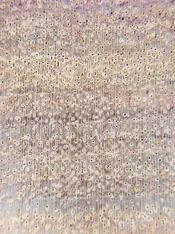
I was assuming it was eucalyptus based on the range of colors, but as soon as i got the end grain under magnification i realized that wasn't the case. The end grain is typical of many species. It exhibits subtle vasicentric parenchyma, marginal parenchyma, and many radially stacked 2-3 pore multiples. Rays are tightly spaced, continuous, and visible without magnification.
Im blanking on a genus that matches both the end grain and long grain. The end grain is pointing me towards Hymenaea spp., but everything else is a mismatch to that genus (especially density!). I believe this *should* be years-dry; however, the cracks you see in the photos developed since i took possession of the wood a couple months ago. I've had it stored in the shipping box it came in with the lid closed. I keep a very dry shop with several dehumidifiers running 24/7, so i even have cracking issues with KD wood sometimes.
Density = 47pcf
Scent = familiar generic hardwood scent. Can't place it.
UV fluorescence = subtle streaks in the wood. Appears to be yellow or green, but very dull. Didn't check extractive fluorescence. Don't put too much emphasis on this, cause it was very faint.
THE FIRST PHOTO IS WET
EDIT: I cross posted this on Facebook, and someone suggested canarywood which i hadn't even considered. The grain characteristics seem pretty similar to canarywood. I think what threw me off is the consistent and smooth color gradient. With canarywood, I'm used to seeing the various colors woven throughout the grain, creating an alternating color pattern. My block doesn't really alternate at all. It just fades into new colors once each. Canarywood typically has pronounced cathedral grain too, and this block does not. Having said that, i may not have seen all the species associated with canarywood, so this could be an obscure one.
Last edited:


