Oak of Abraham (quercus coccifera)

Big Ry

Member
Full Member
Messages
1,863
Reaction score
2,159
Location
Philadelphia, PA
First name
Ryan
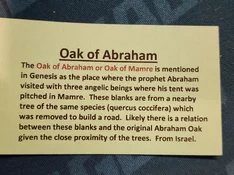
I just got these 3 pen blanks from Griffin exotic hardwoods. They are all supposed to be Oak of Abraham. The blanks are labeled 1 through 3.

Oak of Abraham / Oak of Mamre / Kermes Oak
Quercus coccifera
Origin: Israel, Mediterranean
Size: bush to small tree
Oak classification: Live (white)

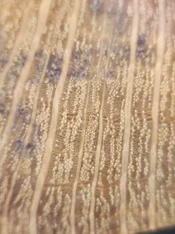
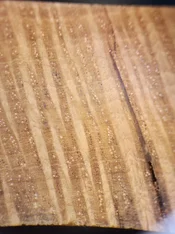
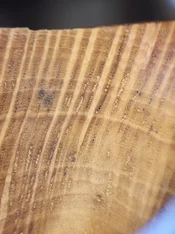
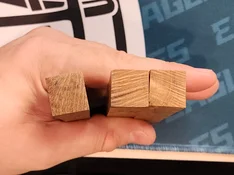
After inspecting the end grain under magnification, i can see a very distinct difference between blank 1 and blanks 2 & 3. Blank 1 has multiple rows of radial pores between medular rays, whereas with blanks 2 & 3 it's mostly a single row between the rays. There's also a clear difference in the width, length, and variability of the medular rays.

Im not entirely sure blanks 2 & 3 are actually Q. Coccifera. I feel they match better to Q. Ilex (holm oak). Thoughts?
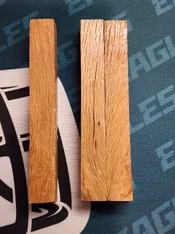
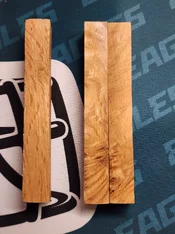
20261106_235625.webp 20261106_235647.webp 20261106_235742.webp 20261106_235959.webp 20261107_000046.webp 20261107_000123.webp 20261107_002014.webp
 
I just got these 3 pen blanks from Griffin exotic hardwoods. They are all supposed to be Oak of Abraham. The blanks are labeled 1 through 3.

Oak of Abraham / Oak of Mamre / Kermes Oak
Quercus coccifera
Origin: Israel, Mediterranean
Size: bush to small tree
Oak classification: Live (white)

After inspecting the end grain under magnification, i can see a very distinct difference between blank 1 and blanks 2 & 3. Blank 1 has multiple rows of radial pores between medular rays, whereas with blanks 2 & 3 it's mostly a single row between the rays. There's also a clear difference in the width, length, and variability of the medular rays.

Im not entirely sure blanks 2 & 3 are actually Q. Coccifera. I feel they match better to Q. Ilex (holm oak). Thoughts?
View attachment 295086 View attachment 295087 View attachment 295088 View attachment 295089 View attachment 295090 View attachment 295091 View attachment 295092
Hmm. Quite an interesting problem. Holm oak is quite common in the Mediterranean. It is also extremely heavy. Just under 1.0 specific gravity. I don’t know much about quercus cocorifera.
 
  • Thread Starter Thread Starter
  • #3
Hmm. Quite an interesting problem. Holm oak is quite common in the Mediterranean. It is also extremely heavy. Just under 1.0 specific gravity. I don’t know much about quercus cocorifera.
They are both supposed to be pretty heavy, but i haven't measured density. There's almost no available info on q. Coccifera.
 
When you sanded each piece, did they all smell the same? Blank 2 & 3 remind me of Allocasuarina but that smells different than most oaks.
 
  • Thread Starter Thread Starter
  • #7
When you sanded each piece, did they all smell the same? Blank 2 & 3 remind me of Allocasuarina but that smells different than most oaks.
Unfortunately I don't have a very good sense of smell. I don't recall any scent from any of these. I can rarely rely on scent for identification. It usually needs to be something very prominent and distinct like d. Nigra, guaiacum, plectrocarpa, etc. If I'm running stock through the tablesaw, that creates enough dust for me to smell the more subtle scents, but a pen blank isn't nearly enough for that.

Are any Allocasuarina endemic to the Mediterranean? All the ones listed on wood database say they are from Australia. I didn't see any with 1-2 rows of radially stacked pores either.

One thing that threw me off a bit with #2 & #3 is that the ray width seems to vary along the length of the ray. Initially i thought that it might be the cut - i thought maybe the fibers weren't running parallel to the blank's longitudinal axis. And that is in fact the case at the bottom end (the end i photographed). But when i inspected the other end i saw the same exact end grain pattern, and the grain is very straight on that end. I found this very odd. I've never seen such significant variation in the width of rays.
 
Back
Top