Object Collection - Box 1

captainamauraca

Member
Full Member
Messages
7
Reaction score
13
Location
Oneonta, New York
First name
Maura
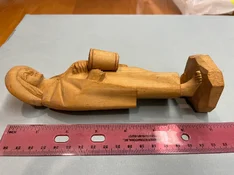
Here's my first foray into attempting to get some more information about these items- hopefully you all can help me! (Check out my intro post if you're confused as to why I'm here with these random things haha). Most of these pieces would have been acquired somewhere between the 1930s and the 1970s.

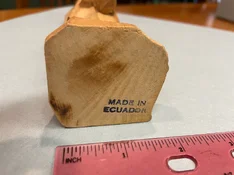
First item is listed as a 'Rosewood' figure, made in Ecuador. Seems very obviously to NOT be rosewood, any ideas on what it actually is? There are four of this set so if these don't help at all maybe I can find a better shot on one of the others.

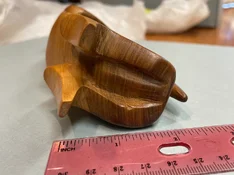
Second item is from Tanganyika, now Tanzania. Honestly not sure what wood this could be? The lighter section was not joined to the darker separately, as the grain continues across the separate colors at certain points. I'm very new to the wood type world, and most of the research I've done for this has not been super helpful. This piece is actually what prompted me to join the forum! There are two others with a very similar ratio and placement of the color separation.

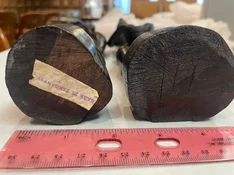
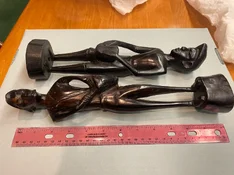
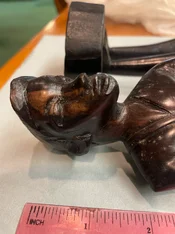
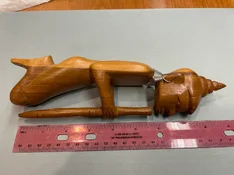
Third set is also listed as from Tanganyika (again, now Tanzania), and part of me thinks it's African Blackwood? These pieces are fairly heavy for their size. Unfortunately, where the end grain should be, it is obscured by tool marks. But I'm including a shot of some color variation on one of the pieces if this is helpful?
B1-RoseEcuadorEnd.webp B1RoseEcuador.webp B1-TanganyikaEnd.webp B1-Tanganyika.webp B1TanganyikaEnd.webp B1Tanganyika.webp B1TanganyikaClose.webp
 
last - My guess ABW- see if it sinks in sink full of water- it should sink like a rock- the white- normal aberrations in the wood
 
The light and dark areas in #2 are almost certainly sapwood and heartwood. A lot of trees use the outer rings of wood (sapwood) to transport water, but pump complex chemicals into the inner wood. In at least some cases, those chemicals protect against fungi or insects. Those chemicals often have strong colors -- in a few cases they can even be extracted and used as dyes, such as fustic and haematoxylin.

Anyway, you see that color contrast in a lot of woods. Black walnut is a familiar North American example, with cream-colored outer wood and rich brown inner wood. That statue isn't black walnut (probably), and I don't know African woods well enough to tell you what it might be, but at least I can say that that color change is probably heartwood on the front of the statue vs. sapwood on the back.
 
@captainamauraca Maura, Sorry that I can't help you with identification but I will be following this thread as I have a similar drummer figure (#3) and have wondered where it was from. I assumed ABW or an Ebony for the wood but just a guess. The piece I have has more detailed carving so maybe a different artist? It even had similar stickers at some point in its past.

IMG_4576.webp IMG_4577.webp IMG_4578.webp IMG_4579.webp IMG_4580.webp
 
Here's my first foray into attempting to get some more information about these items- hopefully you all can help me! (Check out my intro post if you're confused as to why I'm here with these random things haha). Most of these pieces would have been acquired somewhere between the 1930s and the 1970s.

First item is listed as a 'Rosewood' figure, made in Ecuador. Seems very obviously to NOT be rosewood, any ideas on what it actually is? There are four of this set so if these don't help at all maybe I can find a better shot on one of the others.

Second item is from Tanganyika, now Tanzania. Honestly not sure what wood this could be? The lighter section was not joined to the darker separately, as the grain continues across the separate colors at certain points. I'm very new to the wood type world, and most of the research I've done for this has not been super helpful. This piece is actually what prompted me to join the forum! There are two others with a very similar ratio and placement of the color separation.

Third set is also listed as from Tanganyika (again, now Tanzania), and part of me thinks it's African Blackwood? These pieces are fairly heavy for their size. Unfortunately, where the end grain should be, it is obscured by tool marks. But I'm including a shot of some color variation on one of the pieces if this is helpful?
View attachment 294198 View attachment 294200 View attachment 294201 View attachment 294203 View attachment 294204 View attachment 294205 View attachment 294206
#3 -- The two most famous African woods that are really dark are African blackwood (Dalbergia melanoxylon) and Gaboon ebony (Diospyros crassiflora). Both are extremely dark, hard, and heavy. I've handled both, but I'm not sure how to tell them apart. However, Gaboon ebony is West African; African blackwood grows in Tanzania, and I would assume that a carver would use local wood. So I'd vote for African blackwood here.

Sculptures like that are called vinyago in Swahili (singular is kinyago), and maybe searching or looking up that term would shed more light.

Side note: African blackwood is also known as grenadilla, and it's the wood of choice for high-end clarinets and oboes (although your average high school band probably uses plastic instruments). Your local music department might just have some material for comparison.
Ebony is much less oily.

As for the first one, you will need to take some end grain shots to help someone like @Mr. Peet figure it out.
 
The abw white spots are sap wood aberrations.. Just show up inside. Coco does it but not nearly as often. My experience is by no means technical. Just observed. I have sold 1000s of clarinet rejects. Still have plenty.
Gabon as said above is less oily . Smell is different. Not as much silica in Gabon, it can be a real blade killer in abw. I will not cut with my carbide bandsaw blade. Nice to machine clean stuff. My bet, just by location alone abw.
 
Here's my first foray into attempting to get some more information about these items- hopefully you all can help me! (Check out my intro post if you're confused as to why I'm here with these random things haha). Most of these pieces would have been acquired somewhere between the 1930s and the 1970s.

First item is listed as a 'Rosewood' figure, made in Ecuador. Seems very obviously to NOT be rosewood, any ideas on what it actually is? There are four of this set so if these don't help at all maybe I can find a better shot on one of the others.

Second item is from Tanganyika, now Tanzania. Honestly not sure what wood this could be? The lighter section was not joined to the darker separately, as the grain continues across the separate colors at certain points. I'm very new to the wood type world, and most of the research I've done for this has not been super helpful. This piece is actually what prompted me to join the forum! There are two others with a very similar ratio and placement of the color separation.

Third set is also listed as from Tanganyika (again, now Tanzania), and part of me thinks it's African Blackwood? These pieces are fairly heavy for their size. Unfortunately, where the end grain should be, it is obscured by tool marks. But I'm including a shot of some color variation on one of the pieces if this is helpful?
View attachment 294198 View attachment 294200 View attachment 294201 View attachment 294203 View attachment 294204 View attachment 294205 View attachment 294206
The S. American wood, let me think on it.

First thought with the second wood was 'Tamboti', but 'White seringa' might be better to look into. Kirkia acuminata Also look into Wattle, Peltophorum africanum.

The third, as others said, look into African black wood and ebony. Another would be Wild pear, Dombeya rotundifolia. It is often carved and dyed black to sell to tourists, buying, thinking it is one of the others mentioned.
 
Back
Top