Object Collection - Box 2

captainamauraca

Member
Full Member
Messages
7
Reaction score
13
Location
Oneonta, New York
First name
Maura
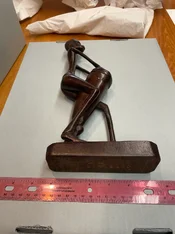
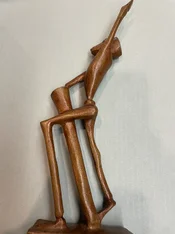
Hi all! Thanks so much for your help on box 1, I feel pretty good about the possible id's, and have been doing some more research through the sources linked to this forum, and recommendations from members. In box 2, there are only two wooden pieces, both supposedly from Jamaica- although they fit closely to African conventions. As such, they may be either/or. They aren't very heavy, though the second one is very light (in color and weight).
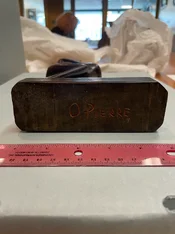
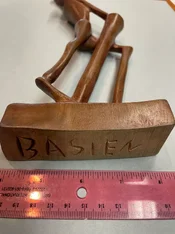
The first, darker piece, I think might be cocuswood. I'm more skeptical about the second piece, and thought it might be chechen, but it's missing the darker variation that I saw commonly on examples from the wood id sites. What do you think? Again, apologies that pictures are not super great, as these are archival I cannot sand away anything for a clear shot of end grain. Nor can I submerge them in water for weight testing. (Somehow we also do not own a scale in the archives, so I can't even calculate their density :cry2:)

IMG_3122.webp IMG_3119.webp IMG_3117.webp IMG_3116.webp
 
You said #2 is very light in weight. It's hard to be precise if you can't measure density on your artifacts, but chechen wood is pretty dense -- supposed to be about 880 kg/m3, or 0.88 g/cm3. By comparison, "lightweight" domestic woods are typically 0.3 to 0.5 g/cm3 (pine's about 0.4, tulip poplar's about 0.5), and "heavy" hardwoods are about 0.7 to 0.8 (sugar maple and beech about 0.7, Osage orange about 0.8). Anything made from chechen should feel pretty heavy, so my best guess from 2000 miles away is that #2 isn't chechen. West Indies mahogany is about 0.6, so could #2 be mahogany? Virola is even lighter (average 0.53), so is that another candidate? I dunno. But #2 doesn't sound like chechen.
 
Another thought: A quick web search of "Jamaican wood carving" suggested that Jamaican carvers use lignum vitae (extremely dense, so not #2), blue mahoe (distinctive color not seen in either #1 or #2), and "cedar root." The cedar is not a true cedar: it's "Spanish cedar" (Cedrela odorata), which is a flowering plant, not a conifer, but which has an aroma similar to true cedar. Its density varies but is about 0.4 to 0.5 g/cm3. That might be the best candidate for a light wood that Jamaican carvers are known to use.
You said #2 is very light in weight. It's hard to be precise if you can't measure density on your artifacts, but chechen wood is pretty dense -- supposed to be about 880 kg/m3, or 0.88 g/cm3. By comparison, "lightweight" domestic woods are typically 0.3 to 0.5 g/cm3 (pine's about 0.4, tulip poplar's about 0.5), and "heavy" hardwoods are about 0.7 to 0.8 (sugar maple and beech about 0.7, Osage orange about 0.8). Anything made from chechen should feel pretty heavy, so my best guess from 2000 miles away is that #2 isn't chechen. West Indies mahogany is about 0.6, so could #2 be mahogany? Virola is even lighter (average 0.53), so is that another candidate? I dunno. But #2 doesn't sound like chechen.
 
Last edited:
Cocouswood is extremely dense. It would easily sink in water. Chechen isn't as dense, but it's still very dense. You would never characterize either of these wood species as "light". So I'm pretty sure you have the IDs incorrect. Chechen also has interlocking grain, which means it's not easy to carve.

It's difficult to say what you have without more information. I understand you may not be able to manipulate them in any way, but can you get clearer and more zoomed in photos? Can you speak to the finish that may be on them, if any? Do they react under UV light, and if so what color and how intense?
 
On the first one, the engraved name on the bottom, "O. Pierre," looks lighter than the surrounding wood. I'm guessing that the dark color is a varnish or some other finish, and the natural wood color is lighter -- it'd be close to the color you see inside the incited lines of the letters.

I assume that any carver making items for general sale will use inexpensive local wood as much as possible. A bit more Googling suggests that Jamaican carvers use Spanish cedar (Cedrela odorata ) and also guango, a.k.a. monkeypod or raintree (Samanea saman ). Guango is medium density (0.6 g/cm3), while Spanish cedar is lighter (0.4-0.5 g/cm3). Guango is noted for being chatoyant (i.e. having a "shimmering" or "velvety" way of reflecting light), but finish might make this hard to see.

I found a handout on Jamaican wood species and their traditional uses -- maybe this will be helpful?

 
This is not great lighting, but it's a closeup of a piece of Spanish cedar. It loosely seems to match what I can see of the grain on the second sculpture, above the N in "BASIEN." Although the sculpture might have interlocking grain. Maybe? Hard to say. I dunno. Anyone else want to comment here? Bue-ller?

20261029_130921.webp
 
Back
Top