

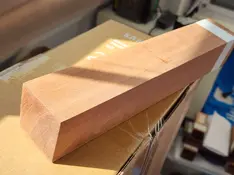
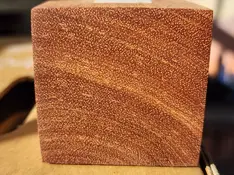
I bought this blank as decades-dry "Pink Flame" (presumed Rinorea paniculata), but its become quite clear that this identification is wrong. The macro appearance of Pink Flame is strikingly similar to Box Elder, whereas my block is a uniform pale brown-pink color. The end grain is also substantially different from other Rinorea species.
Having said that, its entirely possibly that this wood is NOT from Peru or even from South America.
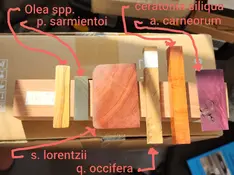
Color Comparison:
Original photos: https://photos.app.goo.gl/X51eHr2nLRurGS9o7
Additional photos: https://photos.app.goo.gl/WDvvhzX1e7YB886u8
What I have determined so far:
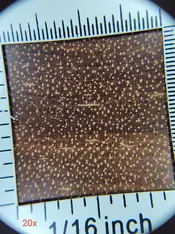
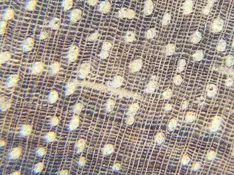
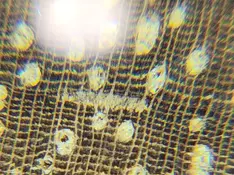
Vessels: diffuse porous, small diameter, mostly solitary (a few 2-pore multiples scattered throughout), pores clogged
Parenchyma: Not distinct around pores, fine uniformly spaced banded axial parenchyma, **apparent irregular, localized widened banding**
Rays: fine, at nearly the same spacing as the banded parenchyma
Scent: I'm not good at this, so nothing remarkable
Density: 65pcf
UV Fluorescence: None in wood, water extractive, or isopropyl alcohol extractive using combination 365+405nm light source.
Froth test: Positive
Of particular interest to me is the irregular localized widened horizontal banding. It reminds me of the resin pockets in cherry, but I don't think these are resin pockets at all. I am assuming these will be very important for identification, but I don't have any clue where to start.
The best matches I can come up with:
1. Eschweilera spp. - Jicarillo, Mata-mata - Very similar banded parenchyma and rays, mostly singular pores
2. Lecythis spp. - Jarana - Apparently species of this genus exhibit the irregular localized horizontal banding described above
3. Manikara spp. - Massaranduba/Bulletwood, Sapodilla - Very simlar in appearance and grain, except rays aren'y typically as prominent and 3-6 pore multiples is very common. Edit: side by side comparison looks to be a poor match.
Having said that, its entirely possibly that this wood is NOT from Peru or even from South America.
Color Comparison:
Original photos: https://photos.app.goo.gl/X51eHr2nLRurGS9o7
Additional photos: https://photos.app.goo.gl/WDvvhzX1e7YB886u8
What I have determined so far:
Vessels: diffuse porous, small diameter, mostly solitary (a few 2-pore multiples scattered throughout), pores clogged
Parenchyma: Not distinct around pores, fine uniformly spaced banded axial parenchyma, **apparent irregular, localized widened banding**
Rays: fine, at nearly the same spacing as the banded parenchyma
Scent: I'm not good at this, so nothing remarkable
Density: 65pcf
UV Fluorescence: None in wood, water extractive, or isopropyl alcohol extractive using combination 365+405nm light source.
Froth test: Positive
Of particular interest to me is the irregular localized widened horizontal banding. It reminds me of the resin pockets in cherry, but I don't think these are resin pockets at all. I am assuming these will be very important for identification, but I don't have any clue where to start.
The best matches I can come up with:
1. Eschweilera spp. - Jicarillo, Mata-mata - Very similar banded parenchyma and rays, mostly singular pores
2. Lecythis spp. - Jarana - Apparently species of this genus exhibit the irregular localized horizontal banding described above
3. Manikara spp. - Massaranduba/Bulletwood, Sapodilla - Very simlar in appearance and grain, except rays aren'y typically as prominent and 3-6 pore multiples is very common. Edit: side by side comparison looks to be a poor match.
Last edited:

