

I'm still using the two workbenches that I built 50 years ago, with a radial arm saw between them and they are not set up to allow me to add a Moxon vise, which (1) I need, but (2) doesn't work for me because a standard Moxon vise (bench-top or built-in) typically opens no more than 2 to 3 inches and I need 10 inches. Also, If I did a standard Moxon vise and just made it so that it would open 10 inches, When I used it with a one or two inch plank, I'd have 8 or 9 inches of rod poking out into my fat gut. No fun.
SO ... I decided to build my own style bench-top model, eliminating the drawbacks of the standard models. I've generally had a tendency to over engineer things and this one was no exception.
First I decided how I wanted it to work and then I drew it up w/ Sketchup. Like a standard benchtop model, it clamps onto any open edge of a workbench. In order to avoid the sticking-out-and-poking-me-in-my-fat-gut problem and at the same time to have the full range from zero to the ten inches I wanted, I settled on a design with double rails on both sides and inserted rods stopping a floating rear end to the adjustment rods. Like this (rods not shown).
As you can see, I decided on two cross rods, with the adjustment rod in between them so that the floating rear adjustment rod holder wouldn't tend to be torqued one way or the other.
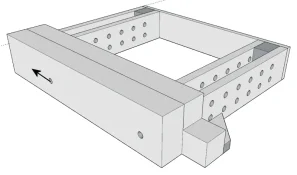
Front view (the left adjustment rod hole is shown in the wrong place)
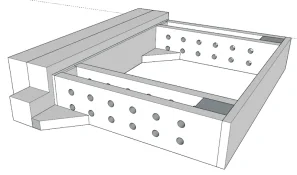
Rear view. The dark pieces at the rear center of each double-rail are the rear holders for the adjustment rods.
I made the whole thing out of scrap wood. The front looks very nice because it's a piece of good quality cherry plywood scrap. I made minor adjustments to the design as I built it.
SO ... Here's how it turned out. First in the "normal" mode of holding a single plank:
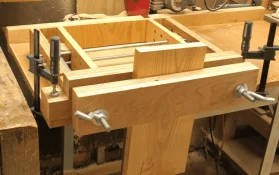
With a single plank there's about 2 inches of rod that could poke me in the gut.
Now with 8" worth of planks
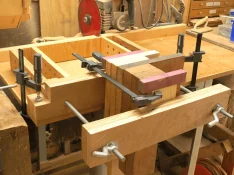
And there are still only a couple of inches of rod to poke me and if it were at the full 10 inch extension there would be NO rod to poke me. This set-up is how I do my end grain processing, and I sometimes do up to 10 inches worth of pieces (including the sacrificial pieces (purpleheart in this case) on each end of the setup.
By having multiple sets of holes, not just ones for one plank and ten inches, I can have anything from zero to 10 inches and still never have more than a couple of inches of rod poking out.
The reason for the clamp across the top of the pieces being held is that when I do end grain processing, I stack the pieces upside down so that they all line up on the surface I'm going to fine sand. Then I clamp it so that when I turn the stack over to put in the vise they don't move apart from each other.
Here's the detail on the rear adjustment rod holder both at the single plank setting and then at full extension (where the support rods aren't needed at all)
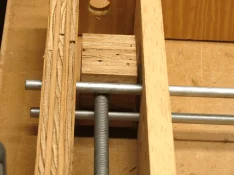
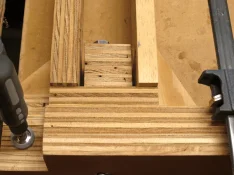
As is standard on a Moxon vise, I used channels instead of holes for the front adjustment rod opening so that the front can move to allow holding irregular shaped objects.
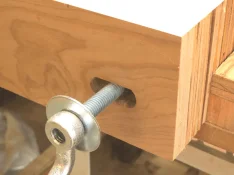
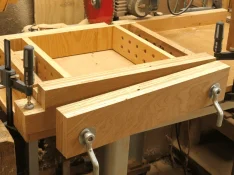
The pic with with front angled looks like it's drooping down but it's not.
I have a bench vise but it's a 3-rod system and the face only exends a couple of inches above the rods so if one of the pieces I'm processing is much more than 6 inches long that vise just won't work. That's why I need the Moxon vise in the first place. For many years I've been using a home-made kludge that did the job but which was REALLY annoying to use. I'm looking forward to using this going forward with my end grain processing.
SO ... I decided to build my own style bench-top model, eliminating the drawbacks of the standard models. I've generally had a tendency to over engineer things and this one was no exception.
First I decided how I wanted it to work and then I drew it up w/ Sketchup. Like a standard benchtop model, it clamps onto any open edge of a workbench. In order to avoid the sticking-out-and-poking-me-in-my-fat-gut problem and at the same time to have the full range from zero to the ten inches I wanted, I settled on a design with double rails on both sides and inserted rods stopping a floating rear end to the adjustment rods. Like this (rods not shown).
As you can see, I decided on two cross rods, with the adjustment rod in between them so that the floating rear adjustment rod holder wouldn't tend to be torqued one way or the other.
Front view (the left adjustment rod hole is shown in the wrong place)
Rear view. The dark pieces at the rear center of each double-rail are the rear holders for the adjustment rods.
I made the whole thing out of scrap wood. The front looks very nice because it's a piece of good quality cherry plywood scrap. I made minor adjustments to the design as I built it.
SO ... Here's how it turned out. First in the "normal" mode of holding a single plank:
With a single plank there's about 2 inches of rod that could poke me in the gut.
Now with 8" worth of planks
And there are still only a couple of inches of rod to poke me and if it were at the full 10 inch extension there would be NO rod to poke me. This set-up is how I do my end grain processing, and I sometimes do up to 10 inches worth of pieces (including the sacrificial pieces (purpleheart in this case) on each end of the setup.
By having multiple sets of holes, not just ones for one plank and ten inches, I can have anything from zero to 10 inches and still never have more than a couple of inches of rod poking out.
The reason for the clamp across the top of the pieces being held is that when I do end grain processing, I stack the pieces upside down so that they all line up on the surface I'm going to fine sand. Then I clamp it so that when I turn the stack over to put in the vise they don't move apart from each other.
Here's the detail on the rear adjustment rod holder both at the single plank setting and then at full extension (where the support rods aren't needed at all)
As is standard on a Moxon vise, I used channels instead of holes for the front adjustment rod opening so that the front can move to allow holding irregular shaped objects.
The pic with with front angled looks like it's drooping down but it's not.
I have a bench vise but it's a 3-rod system and the face only exends a couple of inches above the rods so if one of the pieces I'm processing is much more than 6 inches long that vise just won't work. That's why I need the Moxon vise in the first place. For many years I've been using a home-made kludge that did the job but which was REALLY annoying to use. I'm looking forward to using this going forward with my end grain processing.
Last edited:


