Sparkleberry/Huckleberry identification

SA-Motors

Member
Full Member
Messages
776
Reaction score
896
Location
Raleigh, NC
First name
Steven
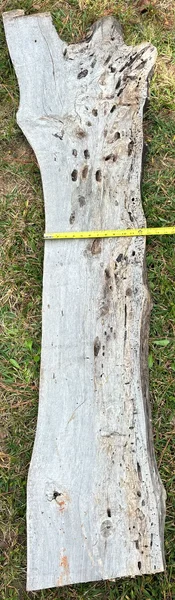
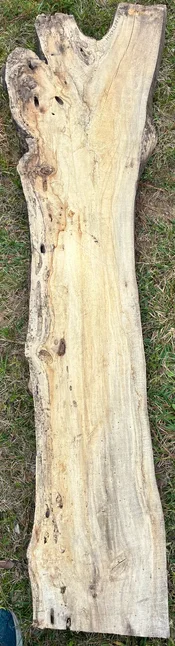
This slab I got from a sawyer in central Florida near Tampa. He said it was called sparkleberry or sometimes called huckleberry. I would be appreciative of any help to identify the species.

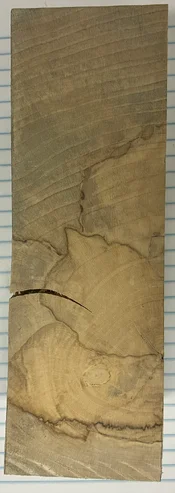
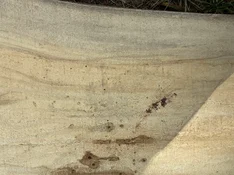
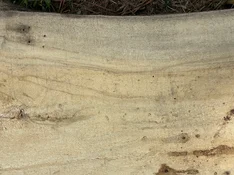
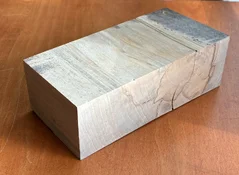
The first photo is of a block I cut from the slab and sanded smooth. The block is 6 3/8" x 3" x 2 1/8" and weighs 11.7 Oz

Density is 31.1 lb/ft3 based on the small block in the photo. But the piece has some spalting so its not as dense as it would be otherwise.

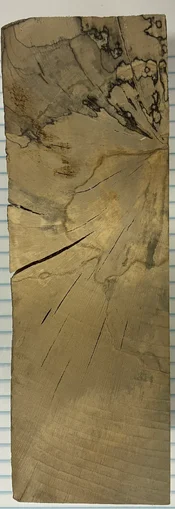
The slab is large, about 7 ft long, 13" wide at the measuring tape.

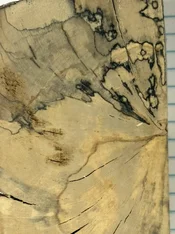
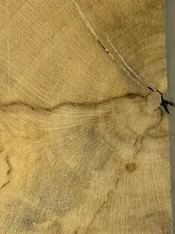
The only bark on the slab is a small amount in the crotch. I tried to get a few pictures of it.
block.webp IMG_1125.webp IMG_1126.webp IMG_1127.webp IMG_1128.webp IMG_1129.webp IMG_1117.webp IMG_1118.webp IMG_1119.webp IMG_1120.webp
 
Sparkleberry's another name for what we in Arkansas call farkleberry -- Vaccinium arboretum. It's close kin to blueberries, but unlike them it sometimes grows large enough to be counted as a small tree. (And it does have edible berries, although not as sweet as true blueberries.) "Huckleberry" is used for a lot of wild relatives of blueberries, so I guess you could call sparkleberry a kind of huckleberry.

I know nothing about the wood, but I did find a blog post about carving a spoon from it. The author says the wood's surprisingly hard and dense, and at least when fresh has a pinkish tinge. What I can see of the bark in his pictures looks like yours.


If you have any offcuts left once you're done with it, would you send me one for the xylarium?
Ha! I remember meeting him once on my trip to the US in 2012. I went to the greenwood wrights fest. He makes nice spoons. Different in style from mine. Much more of a Swedish style.
 
I do not have Sparkleberry. I had hopes of getting some in NC when there, but never got anything over any of our trips there, other than good conversation. I was also surprised to find a single sample of blueberry. It is not worked so could not look at end grain. Surprised because I have milled and supplied samples of Vaccinium corymbosum to others and lack having it in my own reference collection.

The grain you posted does match one of my bigger blueberry blocks.
 
Sorry, I posted a comment about naming stuff but moved it to the more generic section about identification resources so as not to derail this thread.
 
Last edited:
  • Thread Starter Thread Starter
  • #7


I found these 2 articles that cover Vaccinium arboretum where they mention the diameter reaching 35 cm and height of 25 ft. I saw another article which I can’t find anymore that said they can reach 33 to 35 feet tall. The articles also talk about the species doing well in sandy soil of central Florida.

Do you guys think it’s safe to conclude that the slab I have is Vaccinium arboretum?
 
@Cloud of Sawdust Farms I am happy to send you a sample. What size would you like? I can send you the block in the first photo - or cut something to size

Thank you so much! If you're offering the whole block, I'll take it with great thanks -- but if you were planning to keep more of the wood, I'd be happy with a smaller cut. We're not picky about size; we have samples ranging from pen blanks to sizable cookies. Whatever 's the least amount of hassle is fine. Thanks again!
 
Thank you so much! If you're offering the whole block, I'll take it with great thanks -- but if you were planning to keep more of the wood, I'd be happy with a smaller cut. We're not picky about size; we have samples ranging from pen blanks to sizable cookies. Whatever 's the least amount of hassle is fine. Thanks again!
Steve made this post (as well as several others) in response to an ongoing trade between he and I. I'm not saying that doesn't mean that he might have some available to sell to you, but that was the genesis of this post.

I questioned the identification due to the size of the slab. I grew up picking huckleberries at my grandparents cabin in the Poconos (@Mr. Peet you can definitely find it growing wild up there). My grandma always made huckleberry pie and not blueberry pie. It was actually my favorite pie out of the 15-20 she made lol. Anyway, the huckleberry bushes were pretty large. Recalling from childhood, I'd guess they were 15ft tall. But they were nowhere remotely close to this size. The narrowest part of this slab is over 1ft wide. That's a medium sized tree. I just didn't think it was possible for it to be huckleberry unless we were talking about a completely different huckleberry.

So is this size actually plausible for the common edible fruit bearing huckleberry?
Sparkleberry is in the same family. It grows far bigger than any native Vaccinium species in PA. The blueberry bushes in the Poconos reach a 3 inch stem diameter in about 40-75 years, and often are less than 6 feet tall. They are often shaded out long before they have chances to live that long. Vaccinium corymbosum, is our high-bush blueberry. They reach 3-5 inch stem diameters in about 50 years and often reach 6-10 feet tall. These taller ones are also called Huckleberry, a name that can be found used for both Vaccinium species as well as Gaylussacia species depending on location and local histories.
 
Sparkleberry is in the same family. It grows far bigger than any native Vaccinium species in PA. The blueberry bushes in the Poconos reach a 3 inch stem diameter in about 40-75 years, and often are less than 6 feet tall. They are often shaded out long before they have chances to live that long. Vaccinium corymbosum, is our high-bush blueberry. They reach 3-5 inch stem diameters in about 50 years and often reach 6-10 feet tall. These taller ones are also called Huckleberry, a name that can be found used for both Vaccinium species as well as Gaylussacia species depending on location and local histories.
Ok, so it is fundamentally a different species then. That makes a lot more sense. Does sparkleberry also produce a fruit that is harvested and eaten like the huckleberry in PA?
 
Ok, so it is fundamentally a different species then. That makes a lot more sense. Does sparkleberry also produce a fruit that is harvested and eaten like the huckleberry in PA?
I haven't gotten to sample it yet, but my understanding is that it's edible, but not as good as blueberries and huckleberries. Better to add a lot of sugar and make jam, than to eat fresh. Or so I'm told. I just recently found the location of a couple, so maybe next summer I can provide empirical data.
 
I haven't gotten to sample it yet, but my understanding is that it's edible, but not as good as blueberries and huckleberries. Better to add a lot of sugar and make jam, than to eat fresh. Or so I'm told. I just recently found the location of a couple, so maybe next summer I can provide empirical data.
My interest in this wood was initially three fold:

1) I don't have any yet (still true lol)
2) Potential sentimental interest (seems to not be the case after Mark's last comment)
3) Potential use in my segmented bowl project.

For #3, the verdict is still out. But it needs to be a fruit that is commonly/occasionally harvested for direct consumption in the US. For example, black cherry is out because it's seldom eaten directly and typically only used as an ingredient.

Im still interested in this wood because of #1 though lol
 
Back
Top