
• New Woodbarter Hats Are Available!!! Scroll down on the main page to the Member Activities & Site Support, Then click on Wood Barter SCHWAG and go to the topics on hats by Woodtickgreg to order your hat. There's only a limited quanity, so don't wait to get yours.

Staghorn Sumac varieties

chatometry

Member
Full Member
Messages
736
Reaction score
1,277
Location
Italy
First name
Paolo
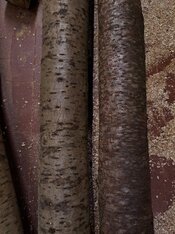
I got Staghorn Sumac small logs from two different locations, and the bark looks very different in terms of colour; as an example, these two trees were similar in size and age, yet they look very different.
20260227_082710.jpg
20260227_082724.jpg

As an additional note, the one on the right seems to grow larger (up to 8" DBH) while the one on the left typically reaches 5" DBH.

Are they different varieties? Or is it only about the growing place?
Thanks!!!
 

Mr. Peet

Member
Full Member
Messages
9,247
Reaction score
11,122
Location
northeastern PA
First name
Mark
I got Staghorn Sumac small logs from two different locations, and the bark looks very different in terms of colour; as an example, these two trees were similar in size and age, yet they look very different.

View attachment 285541
View attachment 285542

As an additional note, the one on the right seems to grow larger (up to 8" DBH) while the one on the left typically reaches 5" DBH.

Are they different varieties? Or is it only about the growing place?
Thanks!!!
One on the left was harvested dead, the one on the right was live. That influences bark colors. As for lenticels on the bark, just like freckles, some have more than others. Genetics is also in play.

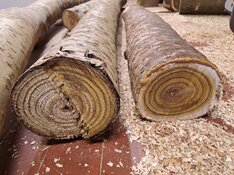
When I was a kid, neighbor had a patch of staghorn that was 50' tall, growing out of an old farm dump. Most were 4"-6" inches at DBH when they were cut for firewood. I have harvested a few 12" - 14" at DBH. Some, very rare, have an interlocked wavy grain. Below a piece I let Paul use.

1772233128393.png
Endgrain

1772233183051.png
 

chatometry

Member
Full Member
Messages
736
Reaction score
1,277
Location
Italy
First name
Paolo
  • Thread Starter Thread Starter
  • #3
Very interesting, thank you.

One on the left was harvested dead,
True, but nearby live trees had the same bark, a silver surface with few dark lenticels.
The other one has a dark bark with many reddish lenticels.
I want to add one more thing: the ones like the one on the left have the typical greenish look in the timber, while the one on the right has a more gold-looking colour.

have an interlocked wavy grain
This looks very cool. I will pay attention to this. I found one with a strange defect that I will share.
 

Mr. Peet

Member
Full Member
Messages
9,247
Reaction score
11,122
Location
northeastern PA
First name
Mark
Very interesting, thank you.


True, but nearby live trees had the same bark, a silver surface with few dark lenticels.
The other one has a dark bark with many reddish lenticels.
I want to add one more thing: the ones like the one on the left have the typical greenish look in the timber, while the one on the right has a more gold-looking colour.


This looks very cool. I will pay attention to this. I found one with a strange defect that I will share.
The red lenticels turn dark when the tree natural dies. Genetics is also in play. This was a big part. Did you notice a difference in the wood under blacklight?
 

chatometry

Member
Full Member
Messages
736
Reaction score
1,277
Location
Italy
First name
Paolo
  • Thread Starter Thread Starter
  • #5
I would say both very reactive:
20260228_211203.jpg
(the bigger, darker and with red lenticels type is on the right)

Going into more details, this piece was at yhe bottom of the trunk, where there main horizontal root turned into a vertical stem, hence the curvature. In this area, the pith is way off center:
20260213_083417.jpg

Well, the "external" part w.r.t. the curvature seems to react much differently:

20260228_211228 - Copia.jpg
 
Top