Torrefied Poplar Sword Display

goosefoot33

Member
Full Member
Messages
107
Reaction score
155
Location
Worcester, MA
First name
Nate
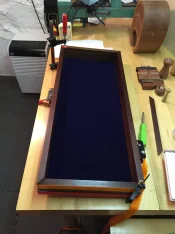
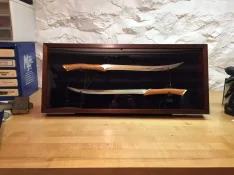
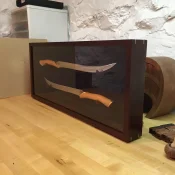
The first time I saw Torrefied wood I knew I had to start using it more since it was such a cool concept: taking a low-cost specie like Poplar or Soft Maple and making it look like $10+/BF Walnut. Here is another piece I made from Torrefied Poplar, with Hard Maple keys. It is a sword display for my co-worker who really likes Lord of The Rings. The swords are about 18-20" long, and supported by Bloodwood brackets. The blue felt is from Rockler, which is excellent stuff that I use on all my projects that call for it.

IMG_0074.webp

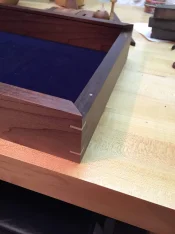
IMG_0082.webp

IMG_0087.webp

IMG_0088.webp
 
Very nice! I'm not familiar with torrified wood, can you describe the process? Tony
 
  • Thread Starter Thread Starter
  • #3
I'll interpret my understanding of it the best I can. I am sure there are more scientific and technical descriptions out there.
Basically, a load of lumber that has already been kiln-dried to the usual 6-8% is loaded in a high-temperature kiln that can reach several hundred degrees. Your typical dry kiln can only reach temperatures of about 250 degrees F. It is stickered and stacked like a regular kiln charge. The oven/kiln reaches temperatures anywhere from 450-600 degrees F. Since wood will burn at this temperature, all the oxygen within the chamber must be removed with a vacuum.
The high temperature drives out the "bound" water in the wood's cells (the remaining 6-8% moisture content), effectively getting it as close to 0% moisture content as possible. The wood's cells have completely dried out at this point, and the openings in the cells where free water previously flowed in and out of the cells will be permanently closed. The cells can no longer take up moisture, which allow the manufacturers to advertise it as an excellent material for exterior trim, decks, etc. A light torreficiation process will produce a tan-colored tone. To get the darker tone of the Poplar shown above, the wood is left in there longer. In general, producers offer three shades - light, medium, and dark.
It's tough to find - my source for it no longer carries it. The most popular species are Poplar, Soft Maple, and Ash. Other woods have been attempted, but due to their structure, didn't respond as well as these three. If you ever come across some, I recommend giving it a try. It's more brittle than the regular specie, and a smooth finish can be a bit more difficult to achieve, but it's a nice conversation starter when someone asks if it's Walnut!

 
Nice. I like how you hid the opening in the face frame. Looks like you used magnets to hold it close, right?
 
  • Thread Starter Thread Starter
  • #6
@Karl_TN Karl - yes sir, two 1/8" Neodymium magnets secured with CA glue. In the last picture, you can see the seam where the small side of the face frame meets the actual box itself. Once removed, the glass slides out the side for easy cleaning, or to add/remove things from the display.
@ironman123 Thanks Ray!
 
Cool, I've seen "toasted oak" for sale out there somewhere, I assume that is the process they use for that....
 
  • Thread Starter Thread Starter
  • #9
@Nature Man Thanks! The Bloodwood brackets were installed after the felt was adhered to the 1/4" lauan back. Once I figured out the placement of the brackets, I cut out small pieces of the felt (the same size/shape of the brackets) and removed it with a razor blade. I then pre-drilled the brackets and lauan back, and finally secured the brackets with two screws each. It is tough to see, but there are also small patches of red felt on the brackets where the swords rest to prevent minor marring of the brackets/sword handles.
 
So Basically it's Dehydrated and Baked?

The things they do with wood these days.

I thought about making a Tree out of wood once, then I realized it's been done already!

James
 
With all the work and energy it takes to process that cheap poplar wood to look like walnut, I think it would be cheaper for you to buy real walnut from me for $6 a bf planed. :haggle:
 
Cool, I've seen "toasted oak" for sale out there somewhere, I assume that is the process they use for that....

VERY nice case!

Toasted, Roasted and Baked...yep, same thing. Often different manufacturers/sellers put their own "slang subterm" to it.

It can also be difficult to work with...or at least extra precautions should be taken as the fibers become so brittle.

Example: I used a "roasted" maple neck on a guitar, and it was advised to use a slightly larger bit to drill the mounting holes so the screws wouldn't split it. One neck manufacture had so many customer issues they began predrilling.

It does become extremely stable after the process. On the neck, the manufacturer does not require a final finish as with others (woods) for warranty purposes.
 
Last edited:
In fact, the only time I have seen the word "torrefied" wood used was for guitars and such. As I understand it, heat treating the very thin woods used gives the instrument a sound like one many years older. It artificially ages the instrument's sound. But what do I know... not much when it comes to instruments.
 
In fact, the only time I have seen the word "torrefied" wood used was for guitars and such. As I understand it, heat treating the very thin woods used gives the instrument a sound like one many years older. It artificially ages the instrument's sound. But what do I know... not much when it comes to instruments.

Yes, Torrefied is a term from the music world.

Thermally modified
is the proper term. It has been out since the late 1980's in limited supply. In 2001, Mann and Parker Lumber Supply started pushing the modified Tulip Poplar as an environmentally safe alternative to chemically altered outdoor woods, (mainly southern yellow pine (SYP)). Because of the lack of carrying capacity (need for closer joists), they started offering thermally modified hickory. As a secondary market, crafters were seeing the similarity to walnut and "bog" oak and the number of available species started to grow. Being modified, the sugars and starches have been exhausted, so the wood does not readily rot, but it still can take on water. When wet, the sensitive nose smells a creosote waft for a season or two. Deck sealers are recommended, I assume to mask the smell and protect the wood that claims not to need it.

If you use an off-gas fuel, thermally modified wood can be mixed in with your charcoal but at very low amounts. It is supposed to be safe for your smoker as well...
 
Very well done project and lools great. What is the cost of this compared to say walnut? Just curious as seems lioe taking base cost of the wood, altering and selling would put cost to same or above? Either way I like it a lot. Has a Very nice look and you did a great job on the design.
 
Very well done project and lools great. What is the cost of this compared to say walnut? Just curious as seems lioe taking base cost of the wood, altering and selling would put cost to same or above? Either way I like it a lot. Has a Very nice look and you did a great job on the design.
I was wondering the same thing...
 
I can tell ya on a guitar neck (maple) the added cost for roasted is around $50 generally.
 
Back
Top