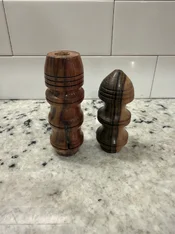
Trying to make grunt calls!

SayleBoat

Member
Messages
2
Reaction score
6
Location
Clover, SC
First name
Tommy
First post outside of the introduction thread!

I am brand new to this, completely self-taught so far. I have poured over the threads here and have found some great tutorials on building custom game calls.

To this point, I have ruined some really cheap wood trying to figure out my specs and design for my calls. And here is where I am having problems.

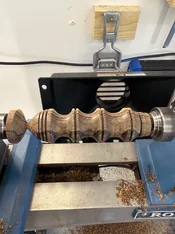
I am using my lathe and Forstner bits to drill my holes. My setup for this is to use the Nova chuck with the game call jaws, then load a drill chuck into the tailstock for drilling.

Here is where I need some help:
My Forstner bit is not long enough to drill all the way through my blank. When I turn my blank over to drill the rest of the hole, I end up with off-center holes most of the time, or they don't line up inside the call.

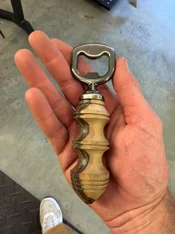
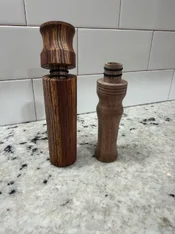
The two pictures that I posted are of some successful game call turns to this point, but are not complete. The other picture is of some finished bottle openers that I made as I was trying to just learn how to turn pieces.

Any help and guidance is greatly appreciated.
IMG_0282.webp IMG_0283.webp IMG_0274.webp IMG_0273.webp
 
@Tclem used to make grunt calls, he may be able to offer grunt-specific advice. I recall that is part of the Sillissippian language.

As to drilling the hole, first, double-check that your tailstock and headstock are truly aligned. Put a drive center in the hs and pointed live center in the ts and move the ts towards the hs and see if the points touch (quill fully retracted). Then back the ts off and extend the quill fully and see if they are still aligned. If either/both cases aren't perfectly aligned, check your ways and ts base thay they are flat, inspect the ts base for any burrs or flaws, and investigate options for trimming it into alignment (shims, etc.). If aligned, also check your ts quill to see if there is any play in it, both retracted and extended. There often is, and you may find a way to remove some of the slop (recheck alignment afterward).

In my experience, there is almost always some play in an extended quill - more the further it extends. Rather than extending the quill, I often slide my tail stock for drilling rather than moving the quill (though that can introduce slop if the ts and ways aren't a good fit).

Last, any time you have to flip a blank in a chuck, unless the blanks is perfectly square (or round) and you get alignment perfect (not easy to do), you're holes won't line up perfectly. If all the above is ok, you can get very close. When I was drilling as you describe, the best I could do was by first turning the blank consistently round between centers, so that I had centered dimples on each end. Then insert the blank into your chuck (not letting it bottom out on the chuck) and close the chuck on the blank only lightly. Bring the ts to the blank with a sharply pointed live center in it, and position the blank so the live center point is in the dimple. Tighten the chuck slightly, but not super tight. Turn on the lathe at slow speed, and turn the tail stock spindle to put some pressure on the blank - it may slide slightly further into the chuck as it isn't holding it tightly. Turn off the lathe, tighten the chuck a little, and repeat at a slightly higher speed. Do a couple such iterations then tighten the chuck fully down (with the live center still pressuring the blank). At this point you should be able to back off the ts, turn on the lathe, run up the speed and see and feel that the blank is running true. Remove the live center, insert your Jacob's chuck and bit, and approach slowly by sliding the ts towards the blank. Ensure the bit tip is centered, then lock down the ts (watch to see it stays centered). Then drill. I keep a little pressure on the quill tightening screw to reduce play. Then, when it is time to flip it and approach from the other side, you'll repeat this procedure. Sounds long and cumbersome, but really only takes 20-30 seconds on each end.

That should get you pretty close. But, most Jacob's chucks have some play in them. Any play gets exaggerated across the length of a forstner bit, so you may still not be perfect. To get even closer, take the Jacob's chuck out of the equation by buying a couple bits with tapers that match your ts taper. I have Norseman bits in my most common sizes (3/4, 5/8, 1/2, and 1/8). They are really good bits and make the process simpler and faster - and I think the length of contact surface (vs a forstner's small contact surface) helps keep things moving straight and reduces the impact of ts/quill play.

Last, remember that drilling (particularly dense woods) generates a lot of heat. Drill at slower speeds than you turn (I'm usually about 200-300 rpms, like with sanding), don't force the bit and advance slowly, with lots of backing out to allow the hole to clear and cool.
 
Last edited:
take the Jacob's chuck out of the equation by buying a couple bits with tapers that match your ts taper. I have Norseman bits in my most common sizes (3/4, 5/8, 1/2, and 1/8)
Where can one buy these w M2 tapers?
 
Back
Top