• New Woodbarter Hats Are Available!!! Scroll down on the main page to the Member Activities & Site Support, Then click on Wood Barter SCHWAG and go to the topics on hats by Woodtickgreg to order your hat. There's only a limited quanity, so don't wait to get yours.

Vortex tool

duncsuss

Trying to turn a little better each day
Full Member
Messages
4,568
Reaction score
6,560
Location
Wilmington, MA
First name
Duncan
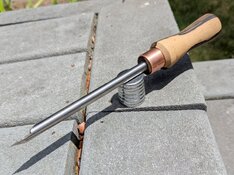
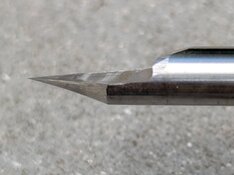
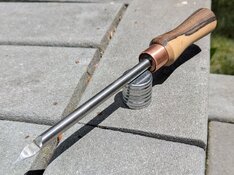
This is one of the tools I was introduced to during the course with Stuart Batty - basically a VERY sharp point, used to clean the bottom of notches (such as between two beads or a bead and a fillet, on a spindle turning). It's a 10mm diameter cylindrical rod of HSS, ground to a semi-cylinder at the end, and then sharpened to a point at about 20 degrees. I'm keeping things safe when it's not in use by capping it with the cork from a bottle of Scotch.

The handle is ziricote, and the ferrule is half of a 3/4" copper pipe coupling.
vortex tool 01.jpg

vortex tool 02.jpg

vortex tool 03.jpg
 
This is genius. I need to make one.
Very cool looking handle Duncan. Nicely done.
 
  • Thread Starter Thread Starter
  • #3
This is genius. I need to make one.
Very cool looking handle Duncan. Nicely done.
Thanks! This is the HSS rod I used Link to Amazon Any will work - but not too thin or it will be prone to chatter. Seems to work best if there's a bur from the grinder (at least, with the wood species I was using - ash, honey locust and walnut).
 
Cool looking tool.

In some respects, similar to the teardrop tool from D-Way (which I use), but I can envision things yours will do that the teardrop can't. I use the teardrop often to clean up between beads, but it doesn't have as narrow a point as yours. At times wish I had one with a finer point, and now will probably be making one.
 
  • Thread Starter Thread Starter
  • #5
At times wish I had one with a finer point, and now will probably be making one.
It really wasn't difficult - just required some patience and a cup of cold water to dip the steel into from time to time.

What I liked about it was when touched into the bottom of a notch, it created a hard shadow line (but without burning)
 
Last edited:
Here’s a few more examples of similar tools. The D-Way teardrop tool works great for beading applications like Tim said. The homemade pointy tool cuts and/or scrapes very fine detail, with three edges can cut lots before resharpening. Both 3/8” steel.

IMG_0606.jpeg IMG_0607.jpeg IMG_0610.jpeg IMG_0608_Original.jpeg
 
  • Thread Starter Thread Starter
  • #8
Here’s a few more examples of similar tools. The D-Way teardrop tool works great for beading applications like Tim said. The homemade pointy tool cuts and/or scrapes very fine detail, with three edges can cut lots before resharpening. Both 3/8” steel.

Certainly viable options - but they all have wider angles than the vortex tool, meaning they cannot get into narrow gaps quite the same.
 
They all look dangerous to me. But I bet they all would help make some amazing entries into the June Turning Challenge.... you know, just something to think about.
 
  • Thread Starter Thread Starter
  • #11
They all look dangerous to me. But I bet they all would help make some amazing entries into the June Turning Challenge.... you know, just something to think about.
Yeah, I don't think I'd be able to get it by the airport security check :sarcastic:
 
It really wasn't difficult - just required some patience and a cup of cold water to dip the steel into from time to time.

What I liked about it was when touched into the bottom of a notch, it created a hard shadow line (but without burning)

Duncan, I've always heard and have read that you are not supposed to dunk HHS into water for cooling. I could be wrong. .......... Nubs
 
  • Thread Starter Thread Starter
  • #13
Duncan, I've always heard and have read that you are not supposed to dunk HHS into water for cooling. I could be wrong. .......... Nubs
That's what I believed too, but it's what Stuart Batty did with his own tools. Given the fact that he manufactures them himself I figured it was probably okay.

Of course, they aren't being heated up too much, but enough that you don't want to touch them straight off the grinder.
 
High speed steels are air hardening so they harden from a non magnetic austenitic state into a solid martensitic state. If the steel is not heated above it's austenitising temperature it won't break by quenching. Quenching will also not have any effect except for cooling. If the tool is heated up past the temperature it was tempered to (that's multiple hundreds of degrees) it will lose hardness. If you don't heat past there, the tool will be unchanged. So unless your steel gets temper colors while grinding (straw yellow or if it's bad even blue) the properties will not change after grinding. Industrial solutions are tungsten carbide bits or water cooled CBN grinders.
 
Back
Top