• New Woodbarter Hats Are Available!!! Scroll down on the main page to the Member Activities & Site Support, Then click on Wood Barter SCHWAG and go to the topics on hats by Woodtickgreg to order your hat. There's only a limited quanity, so don't wait to get yours.

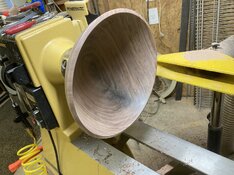
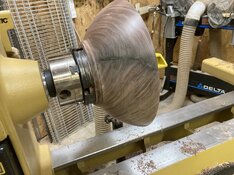
Walnut bowl with mineral stain.

TimR

Sawdust Engineer
Full Member
Messages
6,241
Reaction score
10,646
Location
Lake Park, GA
First name
Tim
Back in 2013 I helped my BIL take down a walnut tree outside my sisters kitchen window. Pretty good sized tree, this piece being at center of 3 cores. So fast forward when I remember us finding about a one inch piece of scissors tip imbedded in the blank by the telltale staining which is now the highlight of the piece. I still need to reverse and remove the tenon and I’m thinking about ordering some tung oil after seeing redwood piece by @Alancw . My BIL just recently passed away so this will be even more special to give to my sister.

IMG_5833.jpeg

IMG_5832.jpeg
 

Alancw

Member
Full Member
Messages
1,141
Reaction score
3,231
Location
Orange, CA
First name
Alan
Sorry for your loss. Beautiful work. Let’s see it again after it’s done! I use Sutherland Welles polymerized tung oil.
 

Kalai

Member
Full Member
Messages
210
Reaction score
786
Location
Big Island of Hawaii
First name
Chris
Nice bowl for sure. Wow, your lathe is so clean. After 40 years of turning, none of my lathes are that clean anymore.
Aloha.

Kalai
 

Phil.H

Member
Full Member
Messages
885
Reaction score
3,541
Location
Gardner, Ma.
First name
Phil
Nice! Should look great when finished! Will be a great gift for your sister. Sorry for the loss to you and the family!
 

JD1137

Member
Full Member
Messages
2,304
Reaction score
5,903
Location
Illinois
First name
John
Looking forward to seeing the finished product Tim - Will be a very meaningful gift, for sure. Sorry for your loss too.
 

trc65

Member
Full Member
Messages
7,449
Reaction score
23,339
Location
Cameron, Illinois
First name
Tim
Beautiful piece with a history and deep meaning. Will be a wonderful gift.

Just a thought on finish on walnut. I do like tung oil, but sometimes it makes walnut a little too dark for my taste. I use a lot of spray lacquer (semi gloss) on walnut to preserve some of the delicate color variations. Just something to consider.
 

TimR

Sawdust Engineer
Full Member
Messages
6,241
Reaction score
10,646
Location
Lake Park, GA
First name
Tim
  • Thread Starter Thread Starter
  • #7
Beautiful piece with a history and deep meaning. Will be a wonderful gift.

Just a thought on finish on walnut. I do like tung oil, but sometimes it makes walnut a little too dark for my taste. I use a lot of spray lacquer (semi gloss) on walnut to preserve some of the delicate color variations. Just something to consider.
Thanks Tim. I’m probably going to do a test first including lacquer which I have been using for alot of non food application. I’ve been using Mahoneys walnut oil for bowls that may get food contact since it does penetrate a bit and does harden well over a couple weeks. For bowls that may have food contact, wouldn’t you be concerned that the lacquer, especially when sprayed, would tend to be on surface only and diminish protection.? I may need to try some wipe on lacquer which I use to use many years ago and it should penetrate more.
Gonna take a look in our Finishes forum and may open a relevant thread since there are many options out there.
 

Alancw

Member
Full Member
Messages
1,141
Reaction score
3,231
Location
Orange, CA
First name
Alan
Beautiful piece with a history and deep meaning. Will be a wonderful gift.

Just a thought on finish on walnut. I do like tung oil, but sometimes it makes walnut a little too dark for my taste. I use a lot of spray lacquer (semi gloss) on walnut to preserve some of the delicate color variations. Just something to consider.
Maybe try walnut oil. If the bowl is going to be used, won’t lacquer quickly come off?
 

JonathanH

Member
Full Member
Messages
2,103
Reaction score
3,845
Location
Plano, Texas
First name
Jonathan
Last summer I made some tool handles from walnut that finished nicely without darkening much. I used a couple of coats of shellac wiped on and then several coats of sprayed satin lacquer. Sanded smooth in between each coat.

It is a fantastic bowl that your sister will love now matter which finish you decide upon. Nice work!
 

trc65

Member
Full Member
Messages
7,449
Reaction score
23,339
Location
Cameron, Illinois
First name
Tim
Thanks Tim. I’m probably going to do a test first including lacquer which I have been using for alot of non food application. I’ve been using Mahoneys walnut oil for bowls that may get food contact since it does penetrate a bit and does harden well over a couple weeks. For bowls that may have food contact, wouldn’t you be concerned that the lacquer, especially when sprayed, would tend to be on surface only and diminish protection.? I may need to try some wipe on lacquer which I use to use many years ago and it should penetrate more.
Gonna take a look in our Finishes forum and may open a relevant thread since there are many options out there.

Maybe try walnut oil. If the bowl is going to be used, won’t lacquer quickly come off?
As to lacquer, I've used it on bowls that have food contact (fruit bowls, candy dishes) but those aren't typically washed or handled much. Lacquer (traditional nitrocellulose) is pretty tough, and can handle abuse.

When I've used lacquer, it typically takes 3-4 coats as it soaks into the wood more than you might think. Additionally, unlike something like polyurethane, which doesn't bond well between coats without sanding for a mechanical bond, lacquer will melt together layers as each is sprayed. This is contingent upon spraying layers within the time frame on the label. If you are waiting a long time between lacquer coats, I believe that sanding is still suggested for the best bond.

Lacquer does produce a harder surface than either an oil or poly coat, and therefore is more susceptible to surface scratches.

If an item is going to be handled a lot, I would probably go with a oil finish. However, when I make and give what I consider a "user", people still treat it very gently, more as artwork than a bowl.

Bottom line, as Tim mentioned, making some test samples is always a good practice.

I don't want any of the above to be viewed as an endorsement, rather just throwing out options.

When I started turning, I used to use poly on everything as that is what I used on all the flatwork I made. That switched, after trying several options, to almost exclusively polymerized tung oil that I formulate myself. Then I had a few walnut pieces that finished a lot darker than I liked so added lacquer to the mix.
 

TimR

Sawdust Engineer
Full Member
Messages
6,241
Reaction score
10,646
Location
Lake Park, GA
First name
Tim
  • Thread Starter Thread Starter
  • #12
Thanks for additional insight Tim. I too used to use poly on most projects and now mostly use poly for some non-food applications. Would be curious on how you make your own formulation for the polymerized tung oil.
 

trc65

Member
Full Member
Messages
7,449
Reaction score
23,339
Location
Cameron, Illinois
First name
Tim
Thanks for additional insight Tim. I too used to use poly on most projects and now mostly use poly for some non-food applications. Would be curious on how you make your own formulation for the polymerized tung oil.
When I started with polymerized tung oil (PTO) I used the Lee Valley brand. Really like that as it would dry overnight so was relatively quick to build coats. I'd also mention that the cotton scraps I used for application would also turn "stiff/hard" overnight.

Started investigating and found that Sutherland Welles made the tung oil for Lee Valley. Some people claimed that the Sutherland Welles oil didn't use chemical driers, but found it hard to believe that the only thing they did was heat polymerize the oil and it would still harden overnight. Dug and dug and eventually found some MSDS/SDS documents that listed proprietary chemical driers in their formulation.

Chemical driers brings up the whole question of "food safe" which has as many opinions as there are people discussing it. I did a deep dive into the regulations that are posted here: https://www.ecfr.gov/current/title-21/chapter-I/subchapter-B/part-175

Needless to say, you almost need to be a lawyer and a chemist to understand everything there. Bottom line is chemical driers, cobalt included, are listed in the "generally accepted as safe" category when discussing finishes with food contact. The main caveat is the finish must be fully cured, with PTO that is roughly a month, depending on conditions.

In layman's terms, chemical driers work by attracting more O² and thus catalyzing the oxidative polymerization (drying and curing) of the finish.

I won't argue for or against the "food safe" nature of a finish with chemical driers, rather putting all the info out there for each to decide.

Lots of preamble to your simple question. Several years ago, to save money I started playing to formulate my own PTO (using driers) that would act the same as the Lee Valley I had been using. I'll find the thread and repost it here with all the details.

Short story is I got some heat polymerized tung oil and an equal amount of citrus solvent from The Skin Boat Store https://www.skinboats.com/?srsltid=AfmBOorKLb0Sx0pSgjW8RKgpu5n3APv7g1UuWfrqr5mXbCqeufwOILOC
The consistency of the PTO was that of dark corn syrup, so you definitely need a solvent to cut it.

Tried using their PTO thinned 50:50 as a baseline and it took over a week to dry. That proved to me that a tung oil that was heat treated alone would not perform like the Lee Valley oil I had been using. At that point, I started playing with mixing small batches with Japan Drier and testing dry times. This thread detailing my experiments is here:


I'm still using some of the original batch I made in October 2020 (stored in stop loss bags) and it's performing now as it did then.

A couple added notes for clarification. There are other chemical driers that are being used that contain no cobalt. However, they are harder (more expensive?) to find and mention has been made that they can have a lot of yellowing develop.

I don't know what Sutherland Welles uses for their driers. Have no idea if they use cobalt or not.

If anyone decides to make their own PTO with Japan Drier be aware of the toxicity and use appropriate PPE.

Long post, but it can get a little complicated with all the potential issues.

Final comment, I'm not a chemist, nor a toxicologist, or a lawyer so make your own decisions. This is just what I've done.

 

Alancw

Member
Full Member
Messages
1,141
Reaction score
3,231
Location
Orange, CA
First name
Alan
When I started with polymerized tung oil (PTO) I used the Lee Valley brand. Really like that as it would dry overnight so was relatively quick to build coats. I'd also mention that the cotton scraps I used for application would also turn "stiff/hard" overnight.

Started investigating and found that Sutherland Welles made the tung oil for Lee Valley. Some people claimed that the Sutherland Welles oil didn't use chemical driers, but found it hard to believe that the only thing they did was heat polymerize the oil and it would still harden overnight. Dug and dug and eventually found some MSDS/SDS documents that listed proprietary chemical driers in their formulation.

Chemical driers brings up the whole question of "food safe" which has as many opinions as there are people discussing it. I did a deep dive into the regulations that are posted here: https://www.ecfr.gov/current/title-21/chapter-I/subchapter-B/part-175

Needless to say, you almost need to be a lawyer and a chemist to understand everything there. Bottom line is chemical driers, cobalt included, are listed in the "generally accepted as safe" category when discussing finishes with food contact. The main caveat is the finish must be fully cured, with PTO that is roughly a month, depending on conditions.

In layman's terms, chemical driers work by attracting more O² and thus catalyzing the oxidative polymerization (drying and curing) of the finish.

I won't argue for or against the "food safe" nature of a finish with chemical driers, rather putting all the info out there for each to decide.

Lots of preamble to your simple question. Several years ago, to save money I started playing to formulate my own PTO (using driers) that would act the same as the Lee Valley I had been using. I'll find the thread and repost it here with all the details.

Short story is I got some heat polymerized tung oil and an equal amount of citrus solvent from The Skin Boat Store https://www.skinboats.com/?srsltid=AfmBOorKLb0Sx0pSgjW8RKgpu5n3APv7g1UuWfrqr5mXbCqeufwOILOC
The consistency of the PTO was that of dark corn syrup, so you definitely need a solvent to cut it.

Tried using their PTO thinned 50:50 as a baseline and it took over a week to dry. That proved to me that a tung oil that was heat treated alone would not perform like the Lee Valley oil I had been using. At that point, I started playing with mixing small batches with Japan Drier and testing dry times. This thread detailing my experiments is here:


I'm still using some of the original batch I made in October 2020 (stored in stop loss bags) and it's performing now as it did then.

A couple added notes for clarification. There are other chemical driers that are being used that contain no cobalt. However, they are harder (more expensive?) to find and mention has been made that they can have a lot of yellowing develop.

I don't know what Sutherland Welles uses for their driers. Have no idea if they use cobalt or not.

If anyone decides to make their own PTO with Japan Drier be aware of the toxicity and use appropriate PPE.

Long post, but it can get a little complicated with all the potential issues.

Final comment, I'm not a chemist, nor a toxicologist, or a lawyer so make your own decisions. This is just what I've done.
Thanks for this. I use Sutherland Welles PTO a lot. I can put a coat on daily, sometimes even more often. I know nothing re driers.
 

JonathanH

Member
Full Member
Messages
2,103
Reaction score
3,845
Location
Plano, Texas
First name
Jonathan
Woodworkers are constantly debating what is OK for food contact finishes with many internet experts who know all - I'm not referring to anyone on the forum or anything mentioned here, just from reading general Bookface talk.

From working in the print industry for a lifetime & the last 8 years in consumable supply (inks & coatings) there are many nuances to what can be used and what is not allowed on direct & secondary packaging intended for food.

Cobalt is not allowed to be used in printing inks that will be used on food packaging materials, secondary, non-direct.

Mineral oils are also not allowed in some places.

Regulatory is constantly changing. The EU drives most of this, the USA usually adopts a few years later.
 

trc65

Member
Full Member
Messages
7,449
Reaction score
23,339
Location
Cameron, Illinois
First name
Tim
Woodworkers are constantly debating what is OK for food contact finishes with many internet experts who know all - I'm not referring to anyone on the forum or anything mentioned here, just from reading general Bookface talk.

From working in the print industry for a lifetime & the last 8 years in consumable supply (inks & coatings) there are many nuances to what can be used and what is not allowed on direct & secondary packaging intended for food.

Cobalt is not allowed to be used in printing inks that will be used on food packaging materials, secondary, non-direct.

Mineral oils are also not allowed in some places.

Regulatory is constantly changing. The EU drives most of this, the USA usually adopts a few years later.

Woodworkers are constantly debating what is OK for food contact finishes with many internet experts who know all - I'm not referring to anyone on the forum or anything mentioned here, just from reading general Bookface talk.

From working in the print industry for a lifetime & the last 8 years in consumable supply (inks & coatings) there are many nuances to what can be used and what is not allowed on direct & secondary packaging intended for food.

Cobalt is not allowed to be used in printing inks that will be used on food packaging materials, secondary, non-direct.

Mineral oils are also not allowed in some places.

Regulatory is constantly changing. The EU drives most of this, the USA usually adopts a few years later.
Thanks Jonathan.

I think that the reason cobalt is allowed as a drier is because it is used as an oxidizer in very small amounts. Additionally, it is essentially bound within the matrix of the cured finish.

As you mentioned, the regs are constantly changing, as is the science. Who knows in 5 or 10 years what may change or be discovered.
 
Top