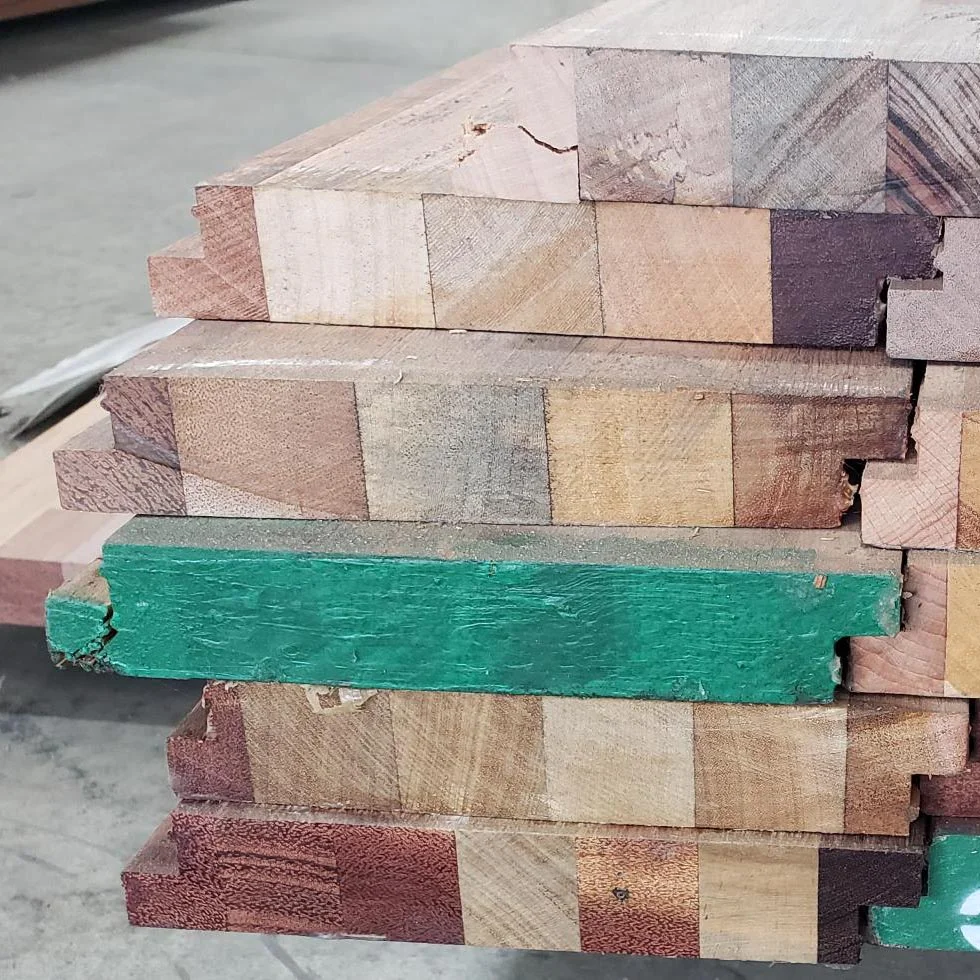
What free wood did you find today?

Been sitting against the wall in the garage for many years and he just wanted it gone. Guessing Sasquatch’s boogie board is bubinga, the other is extremely heavy thinking a rosewood. Both surfaced 2 1/4+ thick. Will get a piece of each prepped for the WB Guru’s analysis.

View attachment 258518View attachment 258519View attachment 258520View attachment 258521View attachment 258522View attachment 258523View attachment 258524View attachment 258525View attachment 258526
Where does the line start @Jonkou? :sarcastic:
I can hear “ping, ping” on that rosewood from just the looks of it.
 
A neighbor brought me a chunk of Apitong ( Keruing) to try out. Interesting stuff, very dense and very hard.

IMG_1713.webp
 
No, actually he repairs semi truck flooring, which is the main use of this wood. He says if I like how it turns out he will have tons of it. WooHoo
i've never seen a dry van floor that wasn't American hardwood butcher block. i've removed many prior to scrapping the trailer. 1200 screw/bolts in a 53 foot dry van decking. semi trailer flooring is very resale-able. 4$ per linear foot is cheap, in colorado and oklahoma it goes for $7 to $9 per linear foot for good used material
 
Last edited:
No, actually he repairs semi truck flooring, which is the main use of this wood. He says if I like how it turns out he will have tons of it. WooHoo
as a matter of fact if he has long boards of that material in even fair condition. i'd be interested in buying a trailer load
 
Also have a friend that owns a business that repairs trailers. Only thing he ever has is LVL type material. - My danged luck!
 
referred in the trade as glue lams, lams = laminated

They are not just veneer, but several grades of chips, sawdust and veneers.
No, they are not the same thing (close, but no cigar)

Laminated Veneer Lumber (LVL) and Glued Laminated Timber (Glulam) are similar in that they are both engineered wood products made by bonding together layers of wood. However, they are not the exact same thing.

LVL is typically made by layering veneers of wood together with adhesives to create a strong and versatile structural material. It is commonly used in beams, headers, and rimboards in construction.

Glulam, on the other hand, is made by bonding together solid sawn lumber pieces to create large structural members. Glulam beams are often used in heavy timber construction and architectural applications due to their strength and aesthetic appeal.

So, while both LVL and Glulam are engineered wood products that provide strength and stability, they are manufactured using slightly different processes and are used for different applications in construction.
 
I hate to tell you both, but I have LVL = limited variable language.

Secondly, I have also have Glulam = Give love until loneliness attention migrates.
 
Back
Top