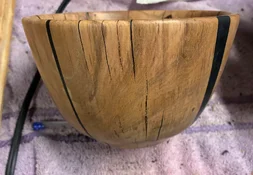
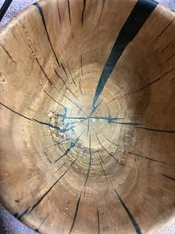
@DLJeffs ,
@Tim Carter how many coats of the Minwax wipe-on poly do you use, and how long do you let it dry between coats? Do you use the gloss?
I typically apply four coats total on most projects, depends a little on how porous the wood is and what level of glassiness I want to achieve. I like a little soft sheen rather than a glass finish on most projects.
Sand to 220 or 320, which ever you feel good about. Apply a nice even but slightly heavy coat with a soft rag (I use a piece of old t-shirt, 1x2 inches, folded by thirds into a little pad). Let cure, I usually let water based wipe-on poly cure overnight. In warmer weather it cures a little faster and I sometimes will do two coats in a day if I start early enough. If it's just slightly undercured it gums up your sand paper so best to be patient. Then lightly sand with 320 and apply a second coat. Angle the piece into the light so you can see if you've got a nice even coat or missed any spots. After it cures, sand with 400, again trying to get as even surface as you can without sanding through the previous coats. Look for shiny spots and avoid any spots that start to show sawdust the color of the wood beneath. Most of the dust should be white or pale grey color. After this one dries, rub out fully with 0000 steel wool, remove any shiny areas. Then apply one last coat making absolutely sure you achieve an even coat - use the light angle thing again. Try to make single, slow smooth passes with the soft rag, don't go back and forth and don't go over a previous pass other than to slightly overlap the edges. I try to make each pass go end to end, if I lift the pad I get tiny bubbles and uneven lumps. If you start to get streaks or you can see the pores in the wood, it's time to dip your rag again. You want a wet even surface and then leave it alone. The wipe-on will self-level and dry smooth. It's possible to apply too much poly and if you do you'll see drips or runs starting to form. I don't know how to explain what's the right amount to have on your pad, something you just have to learn by doing. If you get drips on the first couple coats you can use the pad to wipe them, but you'll probably end up with a few streaks. That's okay because you will be sanding it out anyway. But if it's the final coat, you really need to avoid this or you're back to sanding again. You can leave this last surface as is or I like to rub it with a micro pad or even a green scotch pad and then apply a coat of MinWax paste wax and buff it out. In my opinion that gets a nice warm, soft finish that emphasizes the depth and grain of your wood.
With cholla, you have to decide if you like the holes natural looking or if you want to get finish into all the holes (that's assuming you haven't filled them all with epoxy). If it's the latter, I'd fold the soft rag into a point and dip wipe-on into the holes first and then fold the rag so I have a nice flat edge and make the full surface applications.