- Thread Starter Thread Starter
- #1,181
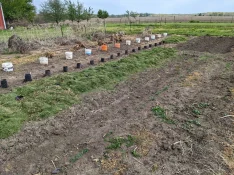
Powdery mildew got the yellow squash and zucchini and is creeping into the cucumbers. It doesn't care about my fungicide... First tomatoes came off today. Got a grocery sack full of green beans in the fridge, more to pick tomorrow. Cucumbers are still making but probably only for another week or two. Green striped Cushaw are doing great and we should have tons of them. I tilled up the purple hull pea and okra patch today and will plant them tomorrow. Red potato vines are starting to die, soooo... but they'll store ok in the ground for a little while.
Alan
I've had really good luck using a foliar spray of a simple solution of water & borax. Plants need the boron anyway and it is highly anti-fungal.Powdery mildew and several other diseases are almost impossible to control without some of the newest chemistries/active ingredients. Unfortunately, most of them are only sold in farm "sized" containers, may be restricted use and cost $$$$$.
My dad has taught me to be fearful of those full moons! I will probably follow this too. Usually memorial day is our date.The June full moon is the 4th I will probably wait until after that.
What is the spring peeper calculation?Peepers predict May 20th as our last killing frost. Wife still wants to wait until June 1st for safety. We planted starters 2 Mondays ago, greens are just breaking ground.
I would think that you would be OK for the June full moon. We are up in the NE corner of VT. and usually the coldest part of the state. I remember a year that my grandparents farm got a frost in June and another in August, it was in a valley and a bit of a frost pocket. We are on a Southwest facing slope and tend to stay a little warmer.My dad has taught me to be fearful of those full moons! I will probably follow this too. Usually memorial day is our date.
Not sure if it will work for you, but here when the spring peepers start chirping, we listen. They usually chime on and off for a few days or even a week or more, but when you get 3 nights in a row, mark your calendar 6 weeks out. That is often the timing of the last killing frost. Same rule in late July, 3 consecutive nights, 6 weeks out, about the time for a killing frost. It matches well with the katydids here as well.What is the spring peeper calculation?
Haven’t heard of this this one, but we have one for when the catydids first sing and the first frost!
After 70 years of farming my dad can look at a 5 day forecast with no rain. I’ve learned to not second guess him much about why he isn’t mowing hay with such nice weather. It’s usually pouring before the second day ends!
I often think about the intuition one gains spending time so close in a job like farming that lets you become part of the world around you.
I feel there aren’t many out there that have that opportunity much anymore. Sad to see this knowledge and so much more like it be lost.
Didn’t realize you were that far north!I would think that you would be OK for the June full moon. We are up in the NE corner of VT. and usually the coldest part of the state. I remember a year that my grandparents farm got a frost in June and another in August, it was in a valley and a bit of a frost pocket. We are on a Southwest facing slope and tend to stay a little warmer.
That's interesting. I need to do some research for around here. The sierra pacific tree frogs just started chirping, maybe last week. I wonder if there's a connection to heavy frost predictions. We did have a couple days in the 70's and one that got well into the 80s when the frogs woke up. Haven't heard them since the temps went back to normal, 50's daytime, mid-upper 30's nighttime.Not sure if it will work for you, but here when the spring peepers start chirping, we listen. They usually chime on and off for a few days or even a week or more, but when you get 3 nights in a row, mark your calendar 6 weeks out. That is often the timing of the last killing frost. Same rule in late July, 3 consecutive nights, 6 weeks out, about the time for a killing frost. It matches well with the katydids here as well.
"we have one for when the catydids first sing"What is the spring peeper calculation?
Haven’t heard of this this one, but we have one for when the catydids first sing and the first frost!
After 70 years of farming my dad can look at a 5 day forecast with no rain. I’ve learned to not second guess him much about why he isn’t mowing hay with such nice weather. It’s usually pouring before the second day ends!
I often think about the intuition one gains spending time so close in a job like farming that lets you become part of the world around you.
I feel there aren’t many out there that have that opportunity much anymore. Sad to see this knowledge and so much more like it be lost.
The old saying here is frost in 6 weeks from when the katydids first start to sing."we have one for when the catydids first sing"
Explain this one please?
Interesting. Here in the higher altitudes of Northwestern New Jersey, Katydids may start. their squawking anytime from mid August to well into September. Never noticed any correlation but then I've never paid any attention either. I have noticed their timing to start has been very off the past couple years and last year they were nearly non existent for the first time in the 21 years I've lived here. Likely due to the drought.The old saying here is frost in 6 weeks from when the katydids first start to sing.
hort.extension.wisc.edu
Yes, it’s not perfect! Last two years I think our frost has been 3 weeks later than what it always had been. Lots of time it’s mid-late September. Last few years have been after Columbus Day.Interesting. Here in the higher altitudes of Northwestern New Jersey, Katydids may start. their squawking anytime from mid August to well into September. Never noticed any correlation but then I've never paid any attention either. I have noticed their timing to start has been very off the past couple years and last year they were nearly non existent for the first time in the 21 years I've lived here. Likely due to the drought.
It's time to fish for big bluegill on their redds when the dogwoods bloom.Lots of phenological indicators out there, and in reality it's all related to degree days. Of course the base temp for calculating degree days varies by crop and pest, so watching the development (flowering) of native plants and correlating that to pest/disease development has been occurring for hundreds of years.
For instance, when chicory starts blooming it is time to start treating/monitoring for squash vine borer.
When I was at the Univ of Wisconsin, the Urban Hort group kept a detailed list of phenological indicators from county agents across the state. Here is an article discussing Phenology.
![]()
Phenology
Phenology is a branch of science that studies the life cycles of plants and animals with seasonal changes and weather. Learn more in this factsheet.hort.extension.wisc.edu