What's Growing in the Garden

Started a batch of my "Atomic" chipotle powder. Mix of Gochujang, cayenne, Calabrian, habanero, and jalapeno. Smoke for a few hours, move to dehydrator, then grind, seeds and all.
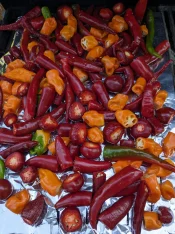
PXL_20240919_212242890.webp
 
After about 3 hours of smoke, slit all the fleshy peppers and into the dehydrator - outside.

Normally run the dehydrator in the garage, but initial drying of these peppers makes it almost uninhabitable, so it's outside. And if course, haven't had rain in 3 wks, but predicted some tonight, so it's going come inside to finish.

PXL_20240920_000208460.webp
 
@trc65

Tim, should have took pictures of our Blood gold stone peach. We had about 200 on the tree, branches bent to the ground. Last year we had 9 peaches. Most years we get about 35. This year, most split with drought, many were bitter and some great. Little, bigger than a ping-pong ball, but not by much. Deer have been feasting. All six of my chipmunks have disappeared in the past week. Assume they ate a few pits and cyanide.
I just can't grow peaches, at least for very long. Every variety I've tried lasts only a few years and succumbs to fungal gummosis.

Ive got a Reliance peach that is still alive, but just barely and has survived the longest. It's infected, but is still living and occasionally produces a crop. The other is a rootstock that survived after the top died off. It produces, but the peaches aren't particularly tasty.

My best bet for peaches has been buying a box every year from the local Farm Bureau office that sells some shipped from southern IL.
 
After about 3 hours of smoke, slit all the fleshy peppers and into the dehydrator - outside.

Normally run the dehydrator in the garage, but initial drying of these peppers makes it almost uninhabitable, so it's outside. And if course, haven't had rain in 3 wks, but predicted some tonight, so it's going come inside to finish.

View attachment 262519
When you grind up the dried peppers, skins and seeds, does it become a powder like chile powder? Nephew makes his own hot powder, but he roasts and then skins the peppers. Kind of a lot of work.

I can't seem to grow peppers. Mine only get a little over a foot high. They do produce a couple dozen peppers per season. I remember volunteer pepper plants at a closed horse farm. They came up in the 1-2' deep manure yard. 5-6' high plants. We harvested several bags of peppers in the short time we were there.
 
I don't grind it quite to the fineness of commercial chili powder, but it is fine. You can still see some tiny pieces, but nothing like you would see in pepper flakes. I'll take a picture later to illustrate. I use a coffee/spice grinder for this.
 
My atomic chili powder from last year. Haven't ground last nights batch yet, decided to make a test batch of raspberry apple sauce instead.

PXL_20240920_194248295.jpg
 
Last edited:
I was done with the pressure cooker questions. Should I be concerned about the low liquid level in the jar of beans on the left? What about the floating beans in the jar on the right? Trapped air? The jar of beans/tomatoes low level...refill and reprocess or just store in refrigerator? IMG_3053.webp

All three jars were filled to 1/4" of the very top before lids/bands were put on. The beans were cold packed (boiling water) after soaking in water (different water) for an hour (if that matters).
 
Quarter inch is too full. Beans should have one inch headspace. Probably the cause of blowing out liquid. If you don't already, an additional step to take us to use a plastic/silicone spatula to help remove air bubbles after filling with liquid. Just run it up and down the inside of jar before putting the lid on the jar

The one on the right is fine. Trapped air in the beans causing them to float. Happens with all kinds of veggies, they will sink with time.

Jars that have blown off a little bit of liquid is not unusual, but when you have beans or other produce resting above the liquid, plan on using those first. They are not going to dry out, but rather the reason is the quality of the seal. When excessive amounts of liquid blows off, there can be tiny pieces of food that get trapped between the jar and the seal. The jar may still seal, but if food particles are trapped, the seal may not last for a long period of time.

Here's a link to the National Food Preservation Center at Univ of Georgia. https://nchfp.uga.edu/how/can/canni...loosely with beans,, leaving 1-inch headspace.

It has all kinds of useful info on nearly everything you may can.
 
For the jar on the right, flip it over for a day. The floating beans will rise into the other beans and likely lock into them, or the air will work out. I flip it in the morning, then flip it back the next morning. By the time I get home that night, can see if it worked. If not, I repeat.
 
Quarter inch is too full. Beans should have one inch headspace. Probably the cause of blowing out liquid. If you don't already, an additional step to take us to use a plastic/silicone spatula to help remove air bubbles after filling with liquid. Just run it up and down the inside of jar before putting the lid on the jar

The one on the right is fine. Trapped air in the beans causing them to float. Happens with all kinds of veggies, they will sink with time.

Jars that have blown off a little bit of liquid is not unusual, but when you have beans or other produce resting above the liquid, plan on using those first. They are not going to dry out, but rather the reason is the quality of the seal. When excessive amounts of liquid blows off, there can be tiny pieces of food that get trapped between the jar and the seal. The jar may still seal, but if food particles are trapped, the seal may not last for a long period of time.

Here's a link to the National Food Preservation Center at Univ of Georgia. https://nchfp.uga.edu/how/can/canning-vegetables-and-vegetable-products/beans-snap-and-italian-pieces-green-and-wax/#:~:text=Fill jars loosely with beans,, leaving 1-inch headspace.

It has all kinds of useful info on nearly everything you may can.
Thanks, Link saved. I forgot to mention, I did do the spatula thing and I let the jars completely cool in the canner as you suggested before opening it up. I filled to 1/4" just to make the trapped air in the beans that would escape, would be replaced by water, dropping the final level to the proper level. But I see what you mean about compromising the seal.

Being the end of the growing season, I probably won't be canning anything anymore. So, I'll just refrigerate the two jars like the middle one were the liquid level is only half full.
 
These raspberries just won't stop! Continue picking 2-3 quarts every other day. They are still blossoming with lots of honeybees.

I've already got 29 quarts vac sealed in freezer and that doesn't count what we've eaten fresh, for several desserts and in raspberry apple sauce. Maybe everybody just gets a quart of raspberries for Christmas!

PXL_20240924_220118853.jpg
 
Shoot, I'd love a quart of raspberries. We get mostly blackberries out here. And huckleberries of course.
 
I don't know if I've done everything right with these, had the perfect weather, or just lucky, but never had production like this.

These are "Prelude", and the first time trying this variety. Planted 3 plants in May of 2023 and left all canes to overwinter. Had small amount of production this spring on the floricanes before Japanese beetles became a problem, but an incredible amount of primocanes emerged and that is what I'm harvesting from now. I can highly recommend this variety if it fits in your hardiness zone (4-8).

It definitely needs a trellis, which I didn't install this year, but am now looking for some black locust or hedge (for posts) to install one before next year.

Other thing I need to decide is how much of the primocanes to leave for some spring production vs cutting them back and focusing on fall production only. Thinking I may only leave 30% or so to get a few qts for fresh eating early, then I won't have to fight the Japanese beetles so much.

The main problem I have is trying to control the J. Beetles while in production. Lots of chemicals have a pre harvest interval too long to use while berries are ripening. In spring it's a constant battle. By fall, the berries are mostly big free. I haven't had to spray for anything since June.

I know, more information than most want, but again, I'd highly recommend these if anyone wants to try some red raspberries.
 
I've always considered blackberries as just a poor substitute for those who aren't lucky enough to grow (or find wild) black raspberries. I've just never liked eating the torus on blackberries.
 
I sure enjoy this thread vicariously. It’s not a garden you have but a farm. It’s amazing. I struggle to get a few tomatoes and peppers from a half dozen plants.
 
Back
Top