You all bring up an interesting point about RoundUp. When it first came out, it was touted as being safe for pets since it was just glyphosate which would be metabolized into harmless chemicals. Now that they have other herbicides in it, albeit it at low levels, do they still make that same claim?

You are using an out of date browser. It may not display this or other websites correctly.
You should upgrade or use an alternative browser.
You should upgrade or use an alternative browser.
What's Growing in the Garden
- Thread starter trc65
- Start date

Thanks for taking the time to share, Tim. Media tend to run only the sensational, written by journalists who too often only partly understand the research they're reporting on. The that gets picked up and interpreted (or even twisted) further on social media. It's no wonder people get scared, start the blame games, initiate lawsuits and spark unnecessary legislative action. At a huge cost to society.It is true that the name "Roundup" has shifted from being glyphosate only, to being used in the marketing of several different chemistries, usually mixed with glyphosate. However, there is still "Roundup" being sold that is glyphosate alone.
There are also many different companies selling glyphosate under a variety of names. Glyphosate came on the market in 1974 and has been off patent for a very long time.
There has been no study that has shown glyphosate causes non Hodgkin's Lymphoma in humans. The study that showed an increase of lymphoma in mice used 100% pure glyphosate directly applied to the mice. Studies that have been used to support lawsuits have all been statistical analysis of studies in mice using various models to try and extrapolate the results to humans. The U.S. EPA still maintains that there is no increased risk from glyphosate when used according to labeled directions.
I have been involved in research and use of glyphosate since the mid 1980's, and I have no reservations in using it.
2,4-D may be used in some mixes under the "Roundup" brand, but 2,4,5-T hasn't been on the market since 1985. Use of 2,4,5-T on most food crops was banned in the early 1970's, but some registrations remained for non crop uses until 1985.
There are a significant number of weeds that have developed resistance to glyphosate, but it still remains a valuable tool for many crop uses either alone, or in mixes with other chemistries.
And just so nobody thinks I'm a chemical "whore" (joke name used amongst researchers), I have never worked for any chemical company marketing glyphosate.
A friend in another part of the ag business is similarly frustrated by the anti-GMO lunacy of the last decade... and in our area, I'm all-too-familiar with the PFAS in the water fear-mongering.
It is always helpful to have someone knowledgeable share that knowledge in a manner that is not inflammatory. Thank you.

I worked in the Chevron Chemical plant that blended and packaged all the Ortho products for 6 years. While some of the active ingredients are hazardous, the amount of dilution we did meant a person would have to drink their weight in the stuff to be concerned.

- Thread Starter Thread Starter
- #2,624
Not entirely accurate on the development of glyphosate. It was first synthesized in the 1950's by a Swiss chemist searching for pharmaceuticals. After some brief testing, that showed no drug activity, the formula was recorded in a catalog, but nothing more was done with it. Ownership of the formula changed hands a couple of times as companies/chemical catalogs were bought and sold.In the Vietnam war, Agent Orange (50% 2,4-D and 50% 2,4,5-T) was used to clear the Vietnamese rainforest and the Natives got the same dermatitic reactions. People found that there were trace amounts of dioxin in the mixture and got annoyed so Monsanto invented glyphosate.
Around 1970, Monsanto had the rights to the formula and after synthesizing it, found its herbicidal activity.
I did not know this but it wasn’t relevant to my post either so I guess I could have said that I did know (-:.Not entirely accurate on the development of glyphosate. It was first synthesized in the 1950's by a Swiss chemist searching for pharmaceuticals. After some brief testing, that showed no drug activity, the formula was recorded in a catalog, but nothing more was done with it. Ownership of the formula changed hands a couple of times as companies/chemical catalogs were bought and sold.
Around 1970, Monsanto had the rights to the formula and after synthesizing it, found its herbicidal activity.
That's often how compounds and drugs get developed into use. Someone trying to find something else creates the compound and finds it doesn't do what they want. Someone else get's their hands on it and finds it works for something else and puts it into production.Not entirely accurate on the development of glyphosate. It was first synthesized in the 1950's by a Swiss chemist searching for pharmaceuticals. After some brief testing, that showed no drug activity, the formula was recorded in a catalog, but nothing more was done with it. Ownership of the formula changed hands a couple of times as companies/chemical catalogs were bought and sold.
Around 1970, Monsanto had the rights to the formula and after synthesizing it, found its herbicidal activity.
- Thread Starter Thread Starter
- #2,627
Post WWII really was the "wild west" in chemical development. You can't even count the number of new compounds that were synthesized, probably in the hundreds of thousands across the industry. Initially, most were focusing on drugs, and unfortunately on war. Huge catalogs were developed by each company, and were bought and sold. Internal herbicide development consisted of spraying thousands of different compounds in greenhouses looking for not only activity, but selective activity. Once a promising compound was discovered, chemists took over to refine the molecules and years of testing occurred in house. Once refined, those chemicals would then enter University testing so the chemical could be evaluated across the spectrum of varieties, soil types, environments, rotations, and potential synergies or antagonists with other crop protection chemicals.
Today, the process is more refined and the chemistries are much better understood. Now, a potential new herbicide must not only be efficacious, it also has to pass a battery of tests related to its potential toxicity to everything in the environment as well as all the breakdown products and movement through soil, air and water.
I could go on and on, but that gives you a taste of the complexity of Ag chemical development.
If anyone is interested, here is a link to the "genealogy" of Ag chemical companies.
- Thread Starter Thread Starter
- #2,628
It all comes down to reading the label. In general though, most chemicals (sold and marketed for home use), are safe for pets and humans as long as they are applied according to instructions and re-entry intervals are followed. All of the caution/warning statements are right up top on the labels and should be read before buying and using.You all bring up an interesting point about RoundUp. When it first came out, it was touted as being safe for pets since it was just glyphosate which would be metabolized into harmless chemicals. Now that they have other herbicides in it, albeit it at low levels, do they still make that same claim?
Most of this discussion has been on herbicides, but the same caution should occur before using insecticides and fungicides.
- Thread Starter Thread Starter
- #2,629
Closeup of the castor bean and pods. The beans are mature, but pods haven't dried enough to split.
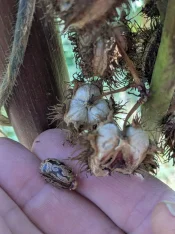
Ok, I'm going through some CRS right now. I thought Castor beans were the beans that are Poisonous. And, those beans do not even look like the ones I've picked that are small 5/16 diameter round beans that will supposedly kill you if you eat one. Am I off somewhere on another planet? .............. Nibs(see, I don't even know who I am) ............ supposed to be Nubs
- Thread Starter Thread Starter
- #2,631
The castor bean is what the poison ricin is derived from. A side note though is castor beans are also processed for castor oil which is used for topical ointments, but also historically as a laxative.
The toxin is not oil soluble, so pressing the beans results in no toxins in the oil. To be sure the oil is safe, it is also filtered and heat treated which destroys any of the toxic protein that may have been in the oil.
Although the bean is toxic, the seed coat is so hard and impervious that simply swallowing one will do nothing. Usually, doctors recommend just letting it pass and not worrying about it.
There is no antidote for ricin, treatment is supportive care.
These are ornamental varieties of castor bean, and I don't know if castor grown for oil differs significantly in size or appearance of the bean/plant. Could be different varieties of castor you are remembering, or maybe another plant with toxic seeds.
Last edited:

Do your beans look like these? Abrus precatoriusOk, I'm going through some CRS right now. I thought Castor beans were the beans that are Poisonous. And, those beans do not even look like the ones I've picked that are small 5/16 diameter round beans that will supposedly kill you if you eat one. Am I off somewhere on another planet? .............. Nibs(see, I don't even know who I am) ............ supposed to be Nubs

- Thread Starter Thread Starter
- #2,633
@Nubsnstubs
I found this site that list common landscape plants that are poisonous in AZ. Looking through the list, maybe Mexican Bird of Paradise? It has pods that look similar to peas and has brown angular to round seeds that are about the size you mentioned.
 azpoison.com
I found this site that list common landscape plants that are poisonous in AZ. Looking through the list, maybe Mexican Bird of Paradise? It has pods that look similar to peas and has brown angular to round seeds that are about the size you mentioned.
Poisonous Plants

I've been harvesting my heirloom dried beans. Our extremely dry late summer has been good for the beans. Too much rain in the late summer and fall can make it hard to get them dry. I probably have at least another bucket left in the garden but that section is not quite as ripe so I will leave them for another week or so. They usually shell out 4-5 pounds/ pail. I'm hoping for 15 pounds. I didn't weigh the seed that I planted but probably a little over a half pound.
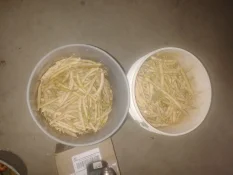
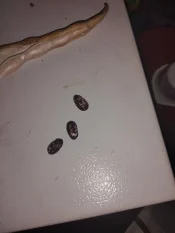
Half pound of seed to get 15 lbs of beans. Not bad.
They usually have 10-12 pods on each plant with 3 or 4 beans in a pod. Germination is usually close to 100⁰/⁰. The biggest factor is the weather too much rain in the late summer and they blight or the beans start sprouting in the pods before the are dry enough to harvest. If I get a bumper crop every 3 or 4 years I'm doing good. Last year was average 2 years ago was terrible. I always save extra for seed in case of a total failure.Half pound of seed to get 15 lbs of beans. Not bad.
Picked about a 100 stone peaches today, blanched and peeled half. Little buggers, lot of work for little pay out. However, I was gettin them before the bears, at least some. Looks to be about 200 on the tree. Heaviest year ever. Here is one of the heavier fruiting branches.
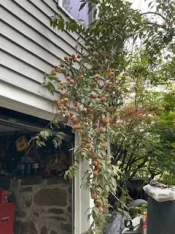
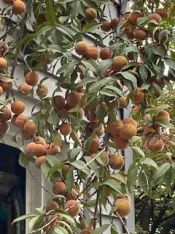
Last edited:
Mark, these look about the size, shape and color, but I don't remember seeing any black like shown on these seeds. I'm gonna try and remember where I saw them and get a few . I thought it was funny they were grown in the landscape of a medical center where there were a lot of kids. Fortunately, no one ever got sick from them that I know of. There are 5 locations here in Tucson that was my maintenance responsibility, but I don't remember exactly which center it was that had them. ........... NubsDo your beans look like these? Abrus precatorius
View attachment 278853

? Pyracantha (firethorn) berries are not considered highly poisonous but can cause mild gastrointestinal upsetMark, these look about the size, shape and color, but I don't remember seeing any black like shown on these seeds. I'm gonna try and remember where I saw them and get a few . I thought it was funny they were grown in the landscape of a medical center where there were a lot of kids. Fortunately, no one ever got sick from them that I know of. There are 5 locations here in Tucson that was my maintenance responsibility, but I don't remember exactly which center it was that had them. ........... Nubs
Do you know what firethorn wood looks like?? Pyracantha (firethorn) berries are not considered highly poisonous but can cause mild gastrointestinal upset