Stabilising with resin is an option for pieces as small as box parts.Lisa ( @sugarlady1980 ), something else that should be mentioned here I guess is that my boxes are relatively small, 8x8x4 might be the largest I've made, so most of my wood is around 1/2 inch thick or less. The boxes I make are fairly easy to hide mistakes and little variances in the wood. A little judicial sanding, glue with sawdust in it, etc. can hide a lot of issues. Mike ( @Mike1950 ) makes those gorgeous larger size boxes and starts with slightly thicker pieces, especially to make those coved sides. Larger boxes such as cigar humidors and larger music boxes would have a bigger potential for the wood to move as it ages, etc. In those situations, I think the wood you use needs to be dry, as stable as you can get it, and square and true.

You are using an out of date browser. It may not display this or other websites correctly.
You should upgrade or use an alternative browser.
You should upgrade or use an alternative browser.
Can crazy wood be used for box lids?
- Thread starter sugarlady1980
- Start date

I think no matter on size you should allow for movement.Lisa ( @sugarlady1980 ), something else that should be mentioned here I guess is that my boxes are relatively small, 8x8x4 might be the largest I've made, so most of my wood is around 1/2 inch thick or less. The boxes I make are fairly easy to hide mistakes and little variances in the wood. A little judicial sanding, glue with sawdust in it, etc. can hide a lot of issues. Mike ( @Mike1950 ) makes those gorgeous larger size boxes and starts with slightly thicker pieces, especially to make those coved sides. Larger boxes such as cigar humidors and larger music boxes would have a bigger potential for the wood to move as it ages, etc. In those situations, I think the wood you use needs to be dry, as stable as you can get it, and square and true.
I use plywood bottom. Loose fit and I glue about an inch or so. Just to keep it from moving. Top panel is same, it sets in hidden groove. Just a inch or so of glue there. I have made almost 100 of these. Only one lid went bonkers on me, that is know of. It moves with the seasons.

In my opinion it adds weight and a lot of costs. Resin adds traits to wood but boxes do not really require stabbed wood.Stabilising with resin is an option for pieces as small as box parts.
Yeah true. I'm just putting the idea out there. I should have added it's disadvantages. I haven't made many boxes so yeah.In my opinion it adds weight and a lot of costs. Resin adds traits to wood but boxes do not really require stabbed wood.
- Thread Starter Thread Starter
- #25
One more fast question on wood strength and movement... If I made a box from wormy maple with a framed figured walnut panel, would a wormy maple frame be strong enough to contain the walnut panel?
- Thread Starter Thread Starter
- #26
Those are some good lookin boxes!I think no matter on size you should allow for movement.
I use plywood bottom. Loose fit and I glue about an inch or so. Just to keep it from moving. Top panel is same, it sets in hidden groove. Just a inch or so of glue there. I have made almost 100 of these. Only one lid went bonkers on me, that is know of. It moves with the seasons.
View attachment 284476
Without at least picture of worry wood there is no way to answer this.One more fast question on wood strength and movement... If I made a box from wormy maple with a framed figured walnut panel, would a wormy maple frame be strong enough to contain the walnut panel?
Size of framed figure panel, straightness of grain in maple, thickness of maple, all come into play when answering this question. However, given the correct dimensions, the answer will be yes. Also involved is the planned finished thickness of the figured walnut panel .One more fast question on wood strength and movement... If I made a box from wormy maple with a framed figured walnut panel, would a wormy maple frame be strong enough to contain the walnut panel?
- Thread Starter Thread Starter
- #29
I am hoping to have a 1/4-3/8" 5x10 panel of the figured walnut. Its pretty bowed so I'm assuming it will end up on the thinner side. The wormy maple is 1" flat-sawn (I think). There is a small portion of straight looking grain on the left board at the bottom, but it doesn't look like a lot...maybe 1" wide x 30" long. I reckon I can go back to the lumber guy and see if he has any quarter-sawn, or boards with quarter-sawn sections.
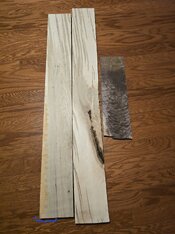
The center board has a good bit of fairly straight grain at the top. The center of that board will be more likely to have warping issues. The left board isn't too bad, but only the top of it has the wormy figure .

I think those pieces will work just fine. With the walnut panel being approx 5x10 inches, I'm guessing you'll want the maple frame to be around an inch wide? You should have plenty of maple for that. If you are going to make continuous grain on the maple, mark the face and keep track of which piece matches up with the next one. For the panel, you have several options - you could cut rabbets in the top inside edge of the maple and set the walnut into the rabbet so it extends up above the frame. You could cut the rabbets the same depth as your walnut so the frame face and walnut face will be flush. You can cut the rabbets on the inside bottom edge of the frame, insert the walnut and then either bevel or round off the maple frame so it flows down to the walnut. And you can cut dados into the inside edge of the frame, and set the walnut into the dados - again allowing the walnut to either be flush or slightly lower than the top of your frame.
The other thing I suggest is figuring out how you want to hinge the box. This is important because it will impact the dimensions. If you want to have the lid sit flush inside the top edge of the box, you'll need to use hidden pins. If you plan to use standard box hinge and allow the lid to sit on top of the box you'll need to make the thickness of your box sides wide enough to support the hinge screws. If you plan to use little barrel hinges, the same thing applies, you'll need to make the box sides and thickness of your lid frame wide enough to allow drilling the holes for the barrel hinges. You can also not use any hinges and simply cut a rabbet in the bottom edge of the frame that matches the top dimensions of your box sides. The lid then just nestles onto the box like this - like the lid on a cook pot.
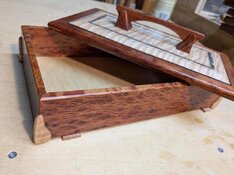
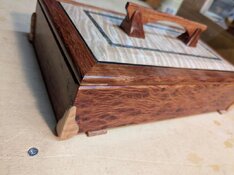
The other thing I suggest is figuring out how you want to hinge the box. This is important because it will impact the dimensions. If you want to have the lid sit flush inside the top edge of the box, you'll need to use hidden pins. If you plan to use standard box hinge and allow the lid to sit on top of the box you'll need to make the thickness of your box sides wide enough to support the hinge screws. If you plan to use little barrel hinges, the same thing applies, you'll need to make the box sides and thickness of your lid frame wide enough to allow drilling the holes for the barrel hinges. You can also not use any hinges and simply cut a rabbet in the bottom edge of the frame that matches the top dimensions of your box sides. The lid then just nestles onto the box like this - like the lid on a cook pot.
Last edited:
Found the edge I cut off with the name on it. It says louro faiaLouro Preto?
- Thread Starter Thread Starter
- #33
No hinges for me (yet). I am going to try a drop-in lid.
So I have my box cut out and sanded. I made a crosscut/bevel sled and the parts came out better than what I thought they would. I was all excited to start gluing it, but I read that mitered cornerns need keys for strength. How necessary are the miter keys? I really dont want to build another jig. The box is 5 x 5 x 10
So I have my box cut out and sanded. I made a crosscut/bevel sled and the parts came out better than what I thought they would. I was all excited to start gluing it, but I read that mitered cornerns need keys for strength. How necessary are the miter keys? I really dont want to build another jig. The box is 5 x 5 x 10
Keys can be cut in after the box is glued up. There is a jig, but it is fairly simple. You just need a 45 degree surface to ride the box across the table saw blade. @DLJeffs and @Mike1950 have some examples posted as I recall.No hinges for me (yet). I am going to try a drop-in lid.
So I have my box cut out and sanded. I made a crosscut/bevel sled and the parts came out better than what I thought they would. I was all excited to start gluing it, but I read that mitered cornerns need keys for strength. How necessary are the miter keys? I really dont want to build another jig. The box is 5 x 5 x 10
My experience- if.... your miters are good no keys are needed. if your miters are bad- keys-splines will not solve the problem. In class room- Build the box ? I show spline jig. I will post pics of splineless jointsNo hinges for me (yet). I am going to try a drop-in lid.
So I have my box cut out and sanded. I made a crosscut/bevel sled and the parts came out better than what I thought they would. I was all excited to start gluing it, but I read that mitered cornerns need keys for strength. How necessary are the miter keys? I really dont want to build another jig. The box is 5 x 5 x 10
- Thread Starter Thread Starter
- #36
Booo. Well theres one made out of 2x4's in my doug stowe and david freedman books so I will give that a try. I think I may have a .5 - 1 degree error in my cross cut sled, so I am looking to avoid making another for now. Then again, the error isn't consistent so it might be the stop block I made...
I have never used splines in any of my boxes. Mitered corners or not
- Thread Starter Thread Starter
- #38
I had hoped for my next jig build to be for box joints. I have one of those dovetail jigs for a router, but even with youtube videos it was above my head.My experience- if.... your miters are good no keys are needed. if your miters are bad- keys-splines will not solve the problem. In class room- Build the box ? I show spline jig. I will post pics of splineless joints
If I remember right you will be using walnut for the box sides? Very cool you got your miters cut and you like the way the box fits together, you have the hard part done. The miter glue joints are essentially end grain, so sometimes there is concern the glue doesn't penetrate as well and the joint isn't very strong. I think with walnut you'll be fine as Mike said, provided you get plenty of wood to wood contact in the miters. I did have a picture frame come apart because I didn't use splines, I think it pretty hard wood, used cut offs from a hard wood floor, cumara or something like that.
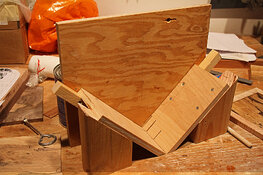
You can make a fancy spline jig that saddles over the fence on your table saw and is wide enough to fully support the box, etc like this...
But lately I've been using a very simple jig like this....
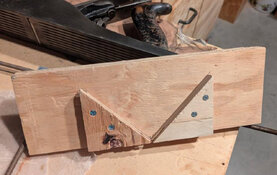
It's just a piece of 3/4" ply wood with two 45 degree triangles glued precisely so they make a 90 degree saddle for your box or picture frame to set in. You don't even have to use triangle, just two small pieces of wood, the important part is making them meet at 90 degrees and not tilted to one side or the other. The back of the 3/4" ply runs along the fence on your table saw. Slide your fence away from the blade so you have room to set your box in place, set the jig against the fence and set your box in the jig, and raise your saw blade to the desired depth so you cut about 2/3 the way through your miter joint. Lock the blade. Make marks on one corner where you want to install splines, usually equally spaced but you can get creative here. Set your box in the jig and adjust your fence so the blade will cut on your first mark and lock the fence in place. Slide the jig/box away from the blade, start the saw, and making sure the corner of your box is snugged tightly into the 90 degree jig, slide the jig/box along your fence and make your first spline kerf. Rotate the box a quarter turn and repeat to make all four kerfs at that location. Turn off the saw, readjust the fence to align the blade on your second mark and repeat.
Here's a photo with a picture frame in place in the jig. Just envision a box instead of the frame.
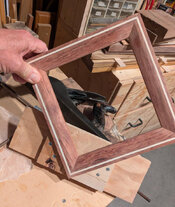
The only important part is to make sure the corner of your box is snugged into the V of the jig and the plywood is held tight against the fence..
You can make a fancy spline jig that saddles over the fence on your table saw and is wide enough to fully support the box, etc like this...
But lately I've been using a very simple jig like this....
It's just a piece of 3/4" ply wood with two 45 degree triangles glued precisely so they make a 90 degree saddle for your box or picture frame to set in. You don't even have to use triangle, just two small pieces of wood, the important part is making them meet at 90 degrees and not tilted to one side or the other. The back of the 3/4" ply runs along the fence on your table saw. Slide your fence away from the blade so you have room to set your box in place, set the jig against the fence and set your box in the jig, and raise your saw blade to the desired depth so you cut about 2/3 the way through your miter joint. Lock the blade. Make marks on one corner where you want to install splines, usually equally spaced but you can get creative here. Set your box in the jig and adjust your fence so the blade will cut on your first mark and lock the fence in place. Slide the jig/box away from the blade, start the saw, and making sure the corner of your box is snugged tightly into the 90 degree jig, slide the jig/box along your fence and make your first spline kerf. Rotate the box a quarter turn and repeat to make all four kerfs at that location. Turn off the saw, readjust the fence to align the blade on your second mark and repeat.
Here's a photo with a picture frame in place in the jig. Just envision a box instead of the frame.
The only important part is to make sure the corner of your box is snugged into the V of the jig and the plywood is held tight against the fence..
Last edited:
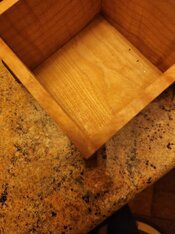
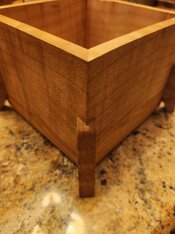
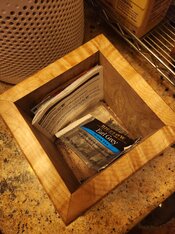
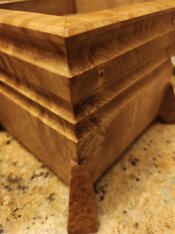
These are also in classroom. Called tea boxes. One is 1/2" other 1/4 " thins. Leg does add strength. But I know of none failing. Small boxes are difficult to get perfect miters but doable. I think first batch i made 16 all different.
But splines from what I have read are more decorative than structural.
But splines from what I have read are more decorative than structural.
