Crack, twist, warp prevention Methods u r useing that work 4 u

hobbit-hut

Don't leave home without it.
Full Member
Messages
1,562
Reaction score
800
Location
sarasota fl
First name
lowell
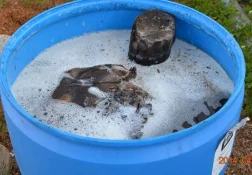
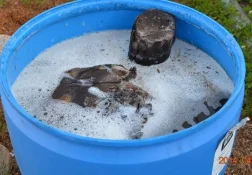
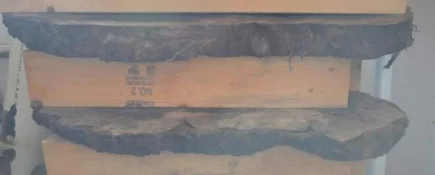
Cliff has a new thread on his freezer method and that information should go to his thread. My purpose of starting this thread is to promote the discussion on what others are doing that has been successful to dry wood and keep it from warping, cracking, twisting and control movement in general. And to that end show what I'm currently doing. I'm just using information picked up off the net that I read and tweaking it to suit my circumstances. I put a gallon of Dawn dishwashing liquid into a drum with a 1/4 tab of swimming pool chlorine ( to prevent mold ). The thing I do different is the time I let it set in the drum. Rather than several days I use several months. The burl is so water logged that it don't float when I take it out. One advantage to me is that really I can deal with it when I find the time and not have to worry about it. I rinsed the burl then let it soak in clean water in a drum for several more weeks. I let it air dry for a couple of weeks then cut it and let it air dry in the shop on my planner table. Turning it over every few days and most of it is straight. Really only two pieces that are not. I plan on boiling those two pieces and seeing if that makes a difference. I'll try to put more information with the photos. One thing you won't see is a toe shot. Hobbits are very sensitive about that. But should it ever happen and you are the first to point it out to me. Then I would have to give up some very ugly wood.
soapdrumDIW 001.webp

soapdrumDIW 003.webp

Latest batch I took out today. Will let it dry some before I cut it
soapdrumDIW 002.webp
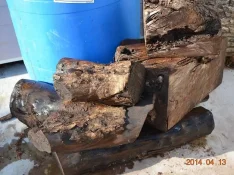
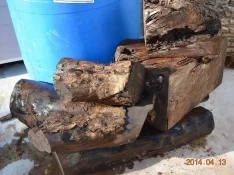
Walnut slabs air drying.

soapdrumDIW 001.webp

soapdrumDIW 003.webp
 
  • Thread Starter Thread Starter
  • #2
Walnut I cut from a slab drying on my plainer bed. WALNUTBURL 001.webp

WALNUTBURL 002.webp

WALNUTBURL 006.webp

WALNUTBURL 003.webp
As you can see they are all fairly straight and flat.
 
I tired the dawn early in my wood habit and it didn't work for me but I only let it stay in 3 days. Boiling however does definitely speed up the process.

Nice walnut. It's gonna rust your bed though.
 
  • Thread Starter Thread Starter
  • #4
I tired the dawn early in my wood habit and it didn't work for me but I only let it stay in 3 days. Boiling however does definitely speed up the process.

Nice walnut. It's gonna rust your bed though.
The bed is granite, but you can't see that very well.
 
Well excuuuuuse me Howard Hughes!


:rofl:
 
I am drying only olive which is very difficult to dry without cracking or warping. So far i have minimized cracking. I just wrap it in and seal it in brown grocery bag and put it for half a year in dry dark place. Later i put it behind my stove.
 
  • Thread Starter Thread Starter
  • #7
I am drying only olive which is very difficult to dry without cracking or warping. So far i have minimized cracking. I just wrap it in and seal it in brown grocery bag and put it for half a year in dry dark place. Later i put it behind my stove.
Interesting, I have some Olive I need to dry also. I might try that with a few pieces.
 
I've packed pieces into shavings in a cardboard box or brown paper bag to try to control the drying, usually works pretty well although once in a while I do have something split. I also use the good old standby Anchorseal and let sit in the back of the shop for 6-8 months.
 
  • Thread Starter Thread Starter
  • #9
I've packed pieces into shavings in a cardboard box or brown paper bag to try to control the drying, usually works pretty well although once in a while I do have something split. I also use the good old standby Anchorseal and let sit in the back of the shop for 6-8 months.
You bring up an interesting point I have been wanting to ask a question about. What do the guys that stabilize wood do when the wood is Anchorsealed ? Wax and water are the enemy of stabilization.
 
You bring up an interesting point I have been wanting to ask a question about. What do the guys that stabilize wood do when the wood is Anchorsealed ? Wax and water are the enemy of stabilization.
Sand it off or leave the piece a little thick when u start out and shave it off with table saw before it goes into the chamber .
 
Not saying this is the way to go but I have boiled olivewood with some good results- well with the wood it was good-now the wife- well lets just say boiling wood on her stove is probably not in my future. Sure made the house smell good though!!!! Dean jordan probably has used it as much as anyone- this thread is a good read http://www.woodbarter.com/threads/boiling-steaming-wood.3708/
 
  • Thread Starter Thread Starter
  • #12
Thanks Mike that's a very helpful thread. I'm in the planning stage of my set up for cooking the wood and that has some good ideas.
 
I may have to give boiling a whirl here today, Customer just dropped off a funky small log and wants some pens out of it in the near future, That saves me 6 months of drying.....
 
  • Thread Starter Thread Starter
  • #15
I cut into the crotch and the small limbs that were taken out of the drum ( see 2nd photo above ) and left outside to air dry. We did have one day of good rain a few days later. The way the wood cuts on the band saw is different than a green log. With a green log the BS cuts long ribbons and that is not the case when I cut this. It is more granular like you would expect from dry wood. There is something different that I can't define. It's just different the way it looks and feels. I'll try to post a photo of the shavings later today.
 
The "soapy soak" method was first published by accomplished wood turner from Hawaii, Ron Kent. It was maybe ten years ago, and his article is still up on his web site; http://www.ronkent.com/techniques.php however, the benefit of this method has been, to my knowledge, somewhat dispelled.

Boiling, steaming, or other controlled heat regimes (kiln drying) degrades the lignin sheath that protects the cell walls allowing bound water to be released along with the free water. This speeds up the drying process, and helps to reduce gross shrinkage disparity and thus reduces the stresses that cause cracking.

Another turner wrote about adding a half cup of fabric softener to his barrel at the end of the boil and while the water was cooling. I've done this too, but I haven't a clue as to whether it made a difference or not.
 
  • Thread Starter Thread Starter
  • #17
I remember reading what Leif O. Thorvaldson had to say in his article. I certainly clame nothing original and state once again. " I'm just using information picked up off the net that I read and tweaking it to suit my circumstances. " Having just read the link kindly provided by Mike Jones. The only difference is the amount of time I let it soak and the fact that I'm not rough turning the piece then letting it soak in a repeated process. And I use Dawn liquid dish soap and some swimming pool clorine. I think the description provided by Ron King puts into words, that I couldn't, exactly what I'm experiencing as to how the character of the wood is transformed. It makes me wonder who, what , where, how, the benefit of this method has been dispelled ? I feel it has valuable clear benefits to me and it's cheep to do is one of them. Anyone can take a piece of green wood and experiment with this and see for themselves and decide if it's worth doing. I am going to continue to do this and have several more drums of wood in the soak. I'll post some more photos of the small logs I just cut that was in with the crotch later. This wood is just air drying and not checking, cracking, warping and seems to dry rather quickly. Thanks for every ones attention who are interested.
 
Last edited:
The Walnut Burl blank you sent me home with seems very unique. It seems extra light and planes pretty nicely the balde seems to slip along like the surficant became part of the wood. I just planed it to see the grain but I do remember it worked strangely. Not in a bad way. I have very little experience with burl though.
 
  • Thread Starter Thread Starter
  • #19
The Walnut Burl blank you sent me home with seems very unique. It seems extra light and planes pretty nicely the balde seems to slip along like the surficant became part of the wood. I just planed it to see the grain but I do remember it worked strangely. Not in a bad way. I have very little experience with burl though.
Yeah, I noticed when I cut the Walnut and the IRW the same thing. To cut this crotch on the band saw is somewhat risky with a green blank. CROTCHIRW 007.webp I was prepared to let the saw eat it if something went wrong but it was quite the opposite experience.
 
It makes me wonder who, what , where, how, the benefit of this method has been dispelled ?

Lowell. I hope that my post was not taken as dismissing what you are experimenting with.....I did not mean it to do that. There was a group that put the "soap soak" to some rather extensive controlled tests, and I will try to find that article for you.

Carry on...
 
Back
Top