• New Woodbarter Hats Are Available!!! Scroll down on the main page to the Member Activities & Site Support, Then click on Wood Barter SCHWAG and go to the topics on hats by Woodtickgreg to order your hat. There's only a limited quanity, so don't wait to get yours.

Help with guitar wood IDing

omoz

Member
Full Member
Messages
19
Reaction score
2
Location
Norway
First name
Oystein
Hi all, apologies if this is entirely the wrong forum for this, but I figured there might be some expert opinions to gather here.

I have aqcuired an old acoustic guitar from the 60s, and have very little info on the wood used, apart from the top being spruce.

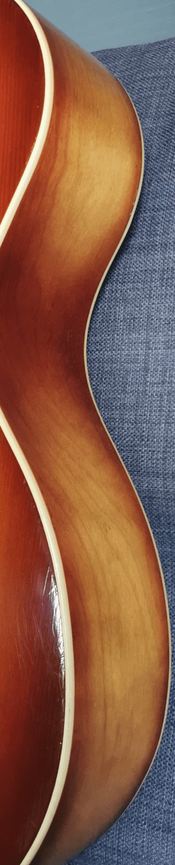
The back and sides are presumably from the same species, as this is common, but I am not sure which species. The guitar is painted, but the grain is visible. From a chip in the paint I can tell that the wood appears white/light gray in color. The unpainted inside of the guitar is a bit darker, presumably from aging.

I know that the builder sometimes used American maple, walnut, as well as various Japanese woods, but to me it looks like it could also be birch, or perhaps something else entirely? Interested to hear any opinions.

Also attaching a picture of the fretboard, since I have never seen a grain quite like it. I assume it is rosewood, as this would again be common, but I know Pau Ferro was used at some point as well.

Not critical to ID these woods for any purpose other than my curiosity, but grateful for any insight!
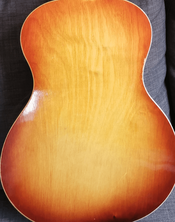

back.png

fretboard.png

inside.png

side.png
 

Arn213

craM de la craM # RipJack City!
Full Member
Messages
4,686
Reaction score
9,460
Location
Knickerbocker, NY
First name
Arn
You need to disclose the brand and the interior label- it is blocked out. Need front of headstock shot and back of the headstock- that will tell you the brand and maker. The back of the headstock should give you a serial number, where it is made and if not, you will find all of this in the interior label. It does have a burst finish. Yes, the fretboard is genuine rosewood and you probably want to know if it it the “holy grail” of all rosewoods?

Can you post more photo’s with general shots and close ups- there are missing pieces in the puzzle to figure out what this is. Need some interior photo’s as well as that will give you a clue of what wood it might be (the back and the sides) because it is not stained or bursted. Import guitars or lower version production guitars will have veneered back and sides over some generic wood.

Just not enough photographic information and it would help identify it with more information. Typical companies will use specific woods basically based on tried and true formulas.

By the way, this needs addressing if you want to get your guitar closer to optimal playability- the saddle or the nut spacing is not equally spaced. You can tell by the spacing on your strings on the fretboard.....see how close the d string is to the dot inlay and how far away the g string to the dot inlay? Same thing is going on with both e strings as one is about to fall off the board and the other is closer into the middle.
 
Last edited:

omoz

Member
Full Member
Messages
19
Reaction score
2
Location
Norway
First name
Oystein
  • Thread Starter Thread Starter
  • #3
Hi, thanks for the reply!

The guitar was made by a Norwegian luthier in the 60s, so not a well known brand, and no headstock markings. There is little information available on the luthier and his methods, and I have found no more than what I put in the initial post as far as his typical wood choices go. I heard he got some contacts through the Hagström factory for importing woods when he did not source it locally.

I would be extremely surprised if the back and sides were veneered, but will try to get some more pics up.
 

phinds

Founding Member
Founding Member
In Memoriam
Messages
11,076
Reaction score
22,282
Location
Cortland, NY
First name
Paul
The fretboard is Brazilian rosewood. The grain pattern near the bottom is one that as far as I know is only found on Brazilian rosewood.

I've seen better similarities than the best pic I could find off-hand but here it is
1621392662940.png
 

DLJeffs

Member
Full Member
Messages
6,771
Reaction score
17,189
Location
central Oregon
First name
Doug
The inside usually is not painted or finished so you might get better grain and color pics through the sound hole.
 

Arn213

craM de la craM # RipJack City!
Full Member
Messages
4,686
Reaction score
9,460
Location
Knickerbocker, NY
First name
Arn
The fretboard is Brazilian rosewood. The grain pattern near the bottom is one that as far as I know is only found on Brazilian rosewood.
I eluded to that in the first paragraph and last sentence- “the holy grail”. Brazilian rosewood is referred to that in the guitar industry. One of the key terms he states that this guitars was “made in the 1960’s”. But, when in the 1960’s was this guitar built because Brazil put an export ban on Brazilian rosewood in 1968- this affected the whole guitar industry and this is a known fact so companies and small luthiers switched to India East Indian rosewood or some other genuine rosewood in manufacturing guitars. I am on the fence whether this fretboard is Brazilian rosewood/dalbergia nigra which was commonly used back then. The finished guitar fretboard has too pronounced surface grain lines and they are too crisp and the gauge on them are on the thicker side. The grain pattern is more “landscape” and has traces of “spider webbing” at the end- I posted a clear definition and example on this on several threads here and I posted examples of my own stock with “spiderwebbing and landscape” grain pattern. Need to see the entire fretboard and need to see more photo’s. You can also remove the nut and take a photo of the end grain of the rosewood. In my opinion this fretboard has visual elements an possibly of another Brazilian rosewood- which is “Amazon rosewood”, dalbergia spruceana. Amazon rosewood is however denser and has a fluorescence feature. I am basing that based on thickness of the grain. Cocobolo and Amazon rosewood shares the same grain thickness elements.

Spider webbing and landscape pattern is “not” only found on Brazilian rosewood- it exist on other species predominantly in Ziricote (non rosewood), Madagascar rosewood and Cocobolo.

Here is exhibit “A” photo for reference purpose of 3 Brazilian rosewood fretboards with “landscape and spider webbing” grain pattern. Take note of the grain gauge:

61EA52B7-7DA1-4748-B66B-658C22840C7A.jpeg
 
Last edited:

Arn213

craM de la craM # RipJack City!
Full Member
Messages
4,686
Reaction score
9,460
Location
Knickerbocker, NY
First name
Arn
The inside usually is not painted or finished so you might get better grain and color pics through the sound hole.
I mentioned about taking interior photo’s as well. Some actually paint the interior, usually with shellac. but it is generally not advisable for repair purposes.

I don’t think the backs and sides are veneer because they are flat sawn cut- but you can check that by pulling out the strap pin at the lower bout. But I can be wrong about that because no one in their right mind will use a one piece flat sawn back that is 16” wide because it will tend to cup and distort. Companies will tend to put say a mahogany core and they would put a veneer on the outside of the guitar and the inside of the guitar (you would see a lot of this treatment in the 60’s of lower tier guitars). The lower budget guitars would tend to have the nicer veneer applied at the exterior and the veneer at the interior is not from the same flitch as the outside- that is one way you know that it is a veneer application as the color and grain will not mirror each other. The higher budget guitar would do better as they will use the same flitch for the outside and inside veneer- they tend to be book-matched. So, this application can fool people thinking this guitar is solid rosewood because the grain and color on the veneer mirrors the exterior and interior.

There are a lot of Brazilian rosewood veneered guitars that were made and some people who sells guitars will “pitch” a sale that the guitar is solid rosewood. This happens a lot with Brazilian rosewood veneered guitars- a large amount were imports (Japan). Do your due diligence if you don’t want to get fooled and spend a great deal of $$$$- only find out later that the guitar is only veneer out of Brazilian rosewood.
 
Last edited:

omoz

Member
Full Member
Messages
19
Reaction score
2
Location
Norway
First name
Oystein
  • Thread Starter Thread Starter
  • #9
Thanks all for the replies! I did not spend much $$ on this at all, as these are not considered very collectible, but still interesting to investigate more.

Hmmmm, I wonder if it's the same Norwegian wood The Beatles sang of...:ponder:
Hm, the seller did have a yellow submarine parked in the driveway.. :ponder:

But, when in the 1960’s was this guitar built because Brazil put an export ban on Brazilian rosewood in 1968
The guitar was likely made in 1964, and no later than early '66.

It is currently being shipped to me across the country, so no interior photos yet, but here are a few more that could be helpful. The chip in the paint near the binding is on the back side of the guitar.

chip.jpg

fretboard1.png

fretboard3.jpg

guitar1.png
 

phinds

Founding Member
Founding Member
In Memoriam
Messages
11,076
Reaction score
22,282
Location
Cortland, NY
First name
Paul
I eluded to that
You might want to look up "elude" in a dictionary.
Spider webbing and landscape pattern is “not” only found on Brazilian rosewood- it exist on other species predominantly in Ziricote (non rosewood), Madagascar rosewood and Cocobolo.
Since there is zero possibility that this is ziricote I didn't even consider it. I SHOULD have said "among rosewoods and similar appearing woods", but you're right about the others though. My bad.
 

Arn213

craM de la craM # RipJack City!
Full Member
Messages
4,686
Reaction score
9,460
Location
Knickerbocker, NY
First name
Arn
It is a lovely guitar. The bottom bridge material is definitely Brazilian rosewood. The fretboard with the additional photo’s helps and looking more like Braz. rose- jury though is still out till you get the guitar in your hands with additional photo’s. The fretboard is stunning and striking.

The builder was ahead of his time- typical traditional guitars, the ball ends of the string enters a slot at the bridge and a pin is pushed in to keep the string in place. The luthier who build this used a “top loader” where the string enters at the rear of the bridge. That detail application has come back in fashion.
 

Arn213

craM de la craM # RipJack City!
Full Member
Messages
4,686
Reaction score
9,460
Location
Knickerbocker, NY
First name
Arn
You might want to look up "elude" in a dictionary.

Since there is zero possibility that this is ziricote I didn't even consider it. I SHOULD have said "among rosewoods and similar appearing woods", but you're right about the others though. My bad.
I knew what you meant Paul and no need to apologize- I just added ziricote (hence why I stated non rosewood) because that is the most prolific species that has typical examples of spider webbing and landscape grain pattern. Those pattern actually only occur mostly on quarter cut to quarter to rift sawn cut. It doesn’t really show up for flat sawn material.

I’ll post the Brazilian rosewoods (dalbergia nigra) that I have and going to show you a comparison between the cousin, Brazilian “Amazon” rosewood (dalbergia spruceana)- they look similar that it could be hard to tell between the two of them unless you did a test. Granted the Amazon “rosewood” probably is the benchmark piece that I have not seen that quality and color for this species in the open market.

To those looking into the market for true Brazilian rosewood, buyer beware based on what I mentioned above., do due diligence and caveat emptor.
 
Last edited:

Arn213

craM de la craM # RipJack City!
Full Member
Messages
4,686
Reaction score
9,460
Location
Knickerbocker, NY
First name
Arn
@omoz - that is not chip out on the laquer finish at the waist line area. That is flaking and honest wear from being used over time. They most likely used nitrocellulose lacquer back then- you can see some crazing at areas of the guitar.

Let me bring this up and I hope it is a photo distortion. But, your string action is very, very high. I don’t know if you have incredible “Superman” strength to put that great of an effort chording and fretting as the distance between the top of the fretwire and the underside of the strings are far apart. You might be able to tweak some of that with a truss rod adjustment and hopefully you can- otherwise the worst case scenario is the guitar needs a “neck reset”.
 

omoz

Member
Full Member
Messages
19
Reaction score
2
Location
Norway
First name
Oystein
  • Thread Starter Thread Starter
  • #14
@Arn213 Yes, I'm sure the guitar will be a bit off playability-wise, although the seller assured me that the action was fairly low, and that this was just a weird photo angle. I can live with high action, especially for the price, but will try to tweak a bit once I get it in hand. I will also experiment with different string gauges, or even set it up for nashville tuning. I'm sure I'll find a way to use it!

Appreciate the input on the fretboard & bridge wood!
 

Arn213

craM de la craM # RipJack City!
Full Member
Messages
4,686
Reaction score
9,460
Location
Knickerbocker, NY
First name
Arn
@omoz this photo is what I find peculiar- that is the interior label of the guitar that will usually give you the builders name, what model it is, serial number, date it was completed and the materials used. But, see it is “blocked out”.

It gets weirder- there are no interior bracing and the grain does not match the grain make up/orientation as the exterior back. You can see the cathedral grain inside the box and the running north.

BEAEF779-6FE4-43B1-84F5-DAF03525DA06.png
 

Arn213

craM de la craM # RipJack City!
Full Member
Messages
4,686
Reaction score
9,460
Location
Knickerbocker, NY
First name
Arn
PSA to those members here who is planning to purchase an acoustic or classical guitar sight unseen. Always ask for a photo of the guitar viewed from it’s side walls at 180 degrees. You want 2 close up photo’s at this specific points. One area is where the neck meets the body- it needs to be zoomed in so you can see the “action” so it will give you an idea if it is low or it is high. The second area is between the edge of the fretboard to the end of the bridge- you are looking to see if there is a “sag” between the front edge of the bridge and the end of the rosette edge. If you see a dip, convex in nature that means the top has dropped and suffered from humidity issues- naturally it should be about 180 degrees aligned with the surface plane. That usually occurs due to humidity or not properly being humidified. Can it be fixed- yes, it can and they sell a tool for that which is installed in the inside and connects to the lower bout end pin and requires drilling holes at the bridge. What it does is “Jack” the top up to it’s natural condition- yes it works like a car Jack.
 

omoz

Member
Full Member
Messages
19
Reaction score
2
Location
Norway
First name
Oystein
  • Thread Starter Thread Starter
  • #17
@Arn213 Great points, and good tips for buyers! Attaching a photo that shows a bit more of that, but we'll see for sure when the guitar shows up. I would not generally recommend anyone to buy instruments like this sight unseen unless you can return it - which I can in this case.

As for the "blocking out" of the label, that was my doing, since it also had some personal info on it. Apologies for not making that clear. The label had the builder's name, a warranty statement, and a serial number. No dates, but the serial numbers were sequential, which dates the guitar to the period mentioned. No mentions of materials or other info, but I was able to find some old newspaper articles on the builder in Norwegian, and some info on his typical wood choices, as mentioned in the first post.

The builder was a woodworker, and not trained as a luthier, although he did local guitar repairs for some time before starting to build himself. He started building in the mid-late 1940s, so the designs would have had some time for refinement by the time this guitar was built.

There is some bracing right above the area of the pic you quoted. I can get better pics of that once the guitar is here. Not sure if the builder mirrored other common bracings from guitars at the time, or if he was of the more adventurous kind.

I suppose the grain not matching the back would be an indicator that it might be a veneer, or at least a multi-ply construction of some sort? I guess we will find out more once it is here. Excited to get my hands on this and investigate further!

action.jpg
 

Arn213

craM de la craM # RipJack City!
Full Member
Messages
4,686
Reaction score
9,460
Location
Knickerbocker, NY
First name
Arn
I suppose the grain not matching the back would be an indicator that it might be a veneer, or at least a multi-ply construction of some sort?
It appears that way and no luthier in there right mind would use a one piece back that is flat sawn cut because you are asking for warranty troubles because of the span and cut- 16” wide that is. There is a possibility that the middle core veneer is plywood and then a thin veneer applied to the front and back- see my post #8 for reference. This can be determined per my previous post by removing the strap pin at the lower bout- it will give you a section of the side walls. This application here with the plywood will make it more sound and dimensionally stable. The other way a veneer is used in the front and back with the center core solid wood- that could be anywhere from maple, mahogany, etc. By the way, plywood cores has been used throughout guitar building history- it is present and very much alive mostly in arch-top building till this day. Well, it is also exist on lower tier acoustic. Yes, I know they have pickups and that is a key microphone to enhance the sound.
 
Last edited:

DLJeffs

Member
Full Member
Messages
6,771
Reaction score
17,189
Location
central Oregon
First name
Doug
PSA to those members here who is planning to purchase an acoustic or classical guitar sight unseen. Always ask for a photo of the guitar viewed from it’s side walls at 180 degrees. You want 2 close up photo’s at this specific points. One area is where the neck meets the body- it needs to be zoomed in so you can see the “action” so it will give you an idea if it is low or it is high. The second area is between the edge of the fretboard to the end of the bridge- you are looking to see if there is a “sag” between the front edge of the bridge and the end of the rosette edge. If you see a dip, convex in nature that means the top has dropped and suffered from humidity issues- naturally it should be about 180 degrees aligned with the surface plane. That usually occurs due to humidity or not properly being humidified. Can it be fixed- yes, it can and they sell a tool for that which is installed in the inside and connects to the lower bout end pin and requires drilling holes at the bridge. What it does is “Jack” the top up to it’s natural condition- yes it works like a car Jack.
Couldn't you also ask for a photo with a metal straight edge laid lengthwise along the top. That would give you an indication of the arch top and daylight any sagging or top issues. To my eye the sides and back look like mahogany, stained and laquered.
 

Arn213

craM de la craM # RipJack City!
Full Member
Messages
4,686
Reaction score
9,460
Location
Knickerbocker, NY
First name
Arn
Couldn't you also ask for a photo with a metal straight edge laid lengthwise along the top. That would give you an indication of the arch top and daylight any sagging or top issues. To my eye the sides and back look like mahogany, stained and laquered.
Yes, you can, but not a lot of people (musicians or guitar vendors; not if they have a repair shop in house) have that handy and what you actually need is a notch one (to clear the fret wire) and that has to span from the fretboard halve towards to the bridge. That would not be convenient most of the time for most people to have that tool and you can get a read out just from sighting it with a photo- you will know if it is high or there is that dip at that area. Before you make any drastic repair- the truss rod is your friend to adjust the relief.

If for example I was buying a guitar with said condition- I would and walk away from the deal because the guitar did not have a stable and healthy life from not properly being humidified. Their headache becomes yours and sometimes the cost to fix it does not pay because the guitar value might be worth less. That is too much of a headache to resuscitate the guitar back to optimal playing conditions AND if it is highly collectible, the repair will cost you a pretty penny and greatly affect the resale value- thanks, but no thanks as there are plenty of guitars available for sale.

Oh and not everyone has a hydrometer *hygrometer (*revised and updated- good catch Cody @gman2431) is the problem. You own a couple of guitars, it would be smart to invest on one. There are interior cases with humidified control section and they do sell control humid paks, etc. to put inside your guitar case. Rule is if you are not playing your guitar- leave it in the case.

One of the greatest rule to myself is never ever buy a steel string guitar sight unseen. You have to be physical be there to diagnose any possible problems. An electric guitar you can get away with and it is more forgiving, but that is the reverse with the acoustic.
 
Last edited:
Top