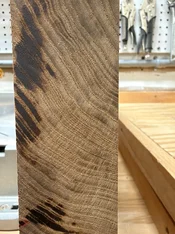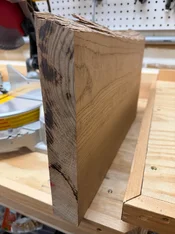
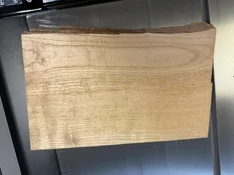
Is this Honey Locust?

Iheartwood

Member
Full Member
Messages
25
Reaction score
50
Location
Eastern PA
First name
Ryan
Hello all-

I purchased this from a small, one-man mill nearby in Bucks County, Pennsylvania. I was told it was honey locust and that the sawyer "never sees figured honey locust". Since I had never seen any honey locust, I bought it. Any input would be appreciated. Thanks! IMG_2061.webp
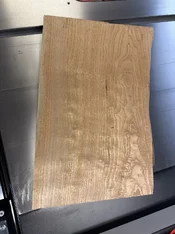
IMG_2062 2.webp IMG_2063.webp IMG_2064.webp
 
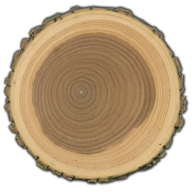
Images taken from Hobbithouse

Honey locust, see the banding of pores and the little rays in the end grain? We need to see your end grain cleaned up some more (sanded) to look for these things.
1791367650816.webp

Here is Butternut. See how it lacks that pore banding and the rays are so small you don't see them.

1791367737076.webp

Here is a Chinaberry sample.

1791367886324.webp 1791368270909.webp

Paul did not think Japanese Scholar tree was worth putting on the site. So here is a photo from the Inside Wood web site.

1791368162550.webp

A blacklight will help tell these apart.
 
Last edited:
  • Thread Starter Thread Starter
  • #3
Here are a few images after some sanding and with a bit more zoom. I don't have a black light readily available, sounds like it may be worth it to pick one up. IMG_2065.webp

IMG_2066.webp
 
Here are a few images after some sanding and with a bit more zoom. I don't have a black light readily available, sounds like it may be worth it to pick one up.View attachment 294207

View attachment 294208
These look great. Butternut is now out as a choice. Chinaberry does not have zig-zag banding like your wood. A blacklight can determine for sure if it is in or out. Chinaberry lacks reaction.
 
  • Thread Starter Thread Starter
  • #5
Well, I just purchased the finest blacklight flashlight that $10 can buy off of amazon. Will post back when it comes in this weekend.
 
I'm not the expert here, but that zigzag pattern looks ulmiform to me. Any chance that this is a species of elm?


EDIT: Clearly today I am not the expert in reading prior posts carefully, either. Looks like honey locust can have ulmiform latewood, as the images show. I think I have too much blood in my coffeestream today.
 
Last edited:
  • Thread Starter Thread Starter
  • #8
UV test seems to be negative. I tested it beside known Kentucky coffeetree, and the coffeetree fluoresces strongly while this board shows essentially none. Hmm
 
I'm not the expert here, but that zigzag pattern looks ulmiform to me. Any chance that this is a species of elm?


EDIT: Clearly today I am not the expert in reading prior posts carefully, either. Looks like honey locust can have ulmiform latewood, as the images show. I think I have too much blood in my coffeestream today.
Yes, there is a chance of being an elm, however, I am not aware of any elms that show such chatoyance without a finish applied. We have yet to see any weights per board foot or cubic foot. These items can help as well.

UV test seems to be negative. I tested it beside known Kentucky coffeetree, and the coffeetree fluoresces strongly while this board shows essentially none. Hmm
Well, Scholartree often emits a blue to purple reactivity. However, not sure what wavelengths your light is, as there are a range of UV that can trigger reaction in different woods.
 
Last edited:
There are a few Phellodendron species that could also be involved. Here is an Inside Wood picture.
Thumbnail of Phellodendron amurense 25x_04.tif
xs
lens: 2.5
Raimund Aichbauer
Inst: IWCS
Thumbnail of Phellodendron amurense 25x_02.tif
xs
lens: 2.5
Raimund Aichbauer
Inst: IWCS
 
  • Thread Starter Thread Starter
  • #12
My money was also on Sassafras. It relatively light-weight for size. I’ll have to get a weight and post back. Glad I didn’t use this for something like chair legs, thinking it was honey locust.
 
My money was also on Sassafras. It relatively light-weight for size. I’ll have to get a weight and post back. Glad I didn’t use this for something like chair legs, thinking it was honey locust.
I don't know how much chatoyance sassafras has. It seems pretty dull when unfinished, but i also haven't ever finished any before. I think it's supposed to smell like root beer when cut too, so that could be a good indicator.
 
I met up with @Iheartwood today and we traded some wood, including a big piece of this stuff. I also brought IWCS samples of everything i had that was kinda similar looking, including black locust, honey locust, sassafras, sumac, Kentucky coffeetree, and maybe 1 other I'm forgetting. It didn't match any of the samples i brought. I was thinking maybe chestnut but didn't have any with me to compare.

Now that I'm home, it's definitely not chestnut. Chestnut isn't very chatoyant, and the end grain is off like Mark said. The closest match to long grain and chatoyance from my collection is red elm. My elm has the end grain sealed though, so i can't compare end grain until later. But i did see the zigzag pattern that's characteristic of elm in the end grain of Ryan's piece. That's definitely the closest guess i have until i can look into it further.

Here's a red elm spindle blank next to the slab i traded for.

20261013_164048.webp
 
Back
Top