Sunlight aging

chatometry

Member
Full Member
Messages
786
Reaction score
1,437
Location
Italy
First name
Paolo
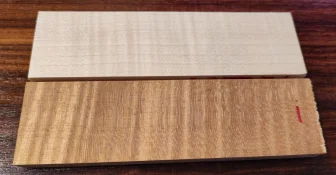
I'm asking you a wild guess: how long would it take to get this "aging" effect on maple?

IMG_20211109_105024.webp

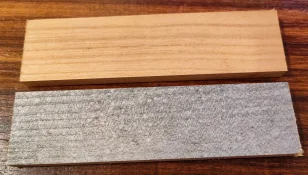
And what about even getting to "gray" on cherry?

IMG_20211109_105104.webp

Can this process be accelerated or carried out artificially?

Paolo
 
Last edited:
I don't know about the maple but getting the grey aging of wood takes quite some time. I think I have seen that it can be achieved using steel wool and vinegar but I don't know how effective it is
 
There are ways, one of which (steel wool and vinegar, just mentioned) works mainly on wood containing tannins.
Also available , is ammonia treatment. There are many hundreds of sites with information on this phenomenon. Some of which even have a little truth.
There are also several research papers on this, which I would trust a bit more.
 
Last edited:
Baking the maple can achieve that coloring in a few hours. As for the cherry, looks weathered, not aged.
 
Baking the maple can achieve that coloring in a few hours. As for the cherry, looks weathered, not aged.
what he said (very small).jpg

and I don't think any amount of UV will get maple that dark unless it starts off almost that dark (red maple for example). I have a light-colored maple dining room table that has been exposed to considerable indirect UV for over 30 years and it's not a whole lot darker than it was when it started out (somewhat like your light-colored piece). Certainly nowhere near the dark color you're showing.
 
Last edited:
  • Thread Starter Thread Starter
  • #6
Those two pieces are from the same board. You make me think that it's not sunlight exposure, but some sort of finish used by the seller to highlight the chatoyance.
I will need to check other boards...
 
You have to specify the species of maple because western big leaf is creamier and color. You can expose that to natural sunlight and it will get yellowish in color with direct sunlight. What you have I think is not big leaf variety as it is too white in color. Appears to be silver maple.

I have boards turn that color, but it took years to get it to developed that “violin amber” color and patina (let me see if I can locate it).

Mark and Paul is correct you can get that color hue on maple with the baked/roasted/torrefication treatment- but that particularly maple will not have that “freshness” if that sample piece was treated that way. Baked/roasted/torrefied maple will have the tendency to look “dry” and “dull” compare to air dried or kiln dried maple.

You mentioned that he used a finish? A shellac amber will get you that tint or an amber guitar finish (vintage clear) it is a typical clear tinted finish (yellow) applied so the maple doesn’t look sterile and looks aged/yellowed.

Here is a sample below (not mine) to show you the tinted versus clear on maple:

FD070E3A-327D-4D52-9567-C05251463770.jpeg
 
Last edited:
Those two pieces are from the same board. You make me think that it's not sunlight exposure, but some sort of finish used by the seller to highlight the chatoyance.
I will need to check other boards...
This area suggests that the dark color is only on the surface
1636470961503.webp
 
  • Thread Starter Thread Starter
  • #9
The pieces are from the same board, just from two different sides. So definitely the color is only on the surface.

I don't know the species, but I would think it is acer pseudoplatanus or acer campestre based on what I commonly see here.

This is a veneer leftover board from a veneer company. These are usually low value and almost thrown away by the company. So it is very unlikely that this is a finished surface, also because it is the "bad" side of the board, with the veneer machine clamping marks. I can't exclude it, though.

I will have to look at other boards from the same company...
 
You have to specify the species of maple because western big leaf is creamier and color. You can expose that to natural sunlight and it will get yellowish in color with direct sunlight. What you have I think is not big leaf variety as it is too white in color. Appears to be silver maple.

I have boards turn that color, but it took years to get it to developed that “violin amber” color and patina (let me see if I can locate it).

Mark and Paul is correct you can get that color hue on maple with the baked/roasted/torrefication treatment- but that particularly maple will not have that “freshness” if that sample piece was treated that way. Baked/roasted/torrefied maple will have the tendency to look “dry” and “dull” compare to air dried or kiln dried maple.

You mentioned that he used a finish? A shellac amber will get you that tint or an amber guitar finish (vintage clear) it is a typical clear tinted finish (yellow) applied so the maple doesn’t look sterile and looks aged/yellowed.

Here is a sample below (not mine) to show you the tinted versus clear on maple:

View attachment 218221

Big leaf can be lots of colors.

Screenshot_20211106-171910_Messenger.webp

Screenshot_20211106-171853_Messenger.webp
 
You are correct Mike- I wasn’t referring to burls but the typical sapwood western bigleaf in non figured types (plain sawn) and the ones with flame figuring. My favorite bigleaf are the spalted ones in flame and burl form- well non figured as well as I like the “fall color” patches.
 
You are correct Mike- I wasn’t referring to burls but the typical sapwood western bigleaf in non figured types (plain sawn) and the ones with flame figuring. My favorite bigleaf are the spalted ones in flame and burl form- well non figured as well as I like the “fall color” patches.
nah- that is just what the GEEtar guys like- the white stuff so they can dye it purple. Big leaf-non burl can be as red as cherry.
 
nah- that is just what the GEEtar guys like- the white stuff so they can dye it purple. Big leaf-non burl can be as red as cherry.
Yeah, majority of builders do (the purist) but not me. I tend to like color on mine as well because I like the warmer tones and the natural work of Mother Nature. I like the myriad color patches on the flame and burls where it has analogous colors that range from yellows all the way to the red spectrum with browns, grays and black lines thrown in between. Those IMHO makes more of an interesting looking guitar tops- decoratively speaking.
 
I'm asking you a wild guess: how long would it take to get this "aging" effect on maple?

View attachment 218218

And what about even getting to "gray" on cherry?

View attachment 218219

Can this process be accelerated or carried out artificially?

Paolo
The cherry looks to be about 6 months to a year out in the weather. Sunlight is not solely responsible for this, I doubt. There may have been a bit of wind and rain involved.
 
  • Thread Starter Thread Starter
  • #15
So gray is not just light, but weather too.

I read something about using tanning lamps to age wood. Has anybody here tried it?
As usual, I am not willing to make anything nicer; I am just looking for a way to age samples in a reasonable amount of time so that I can measure their chatoyance before and after aging.
Yes, older tanning lamps have high UV output and do work.
 
So gray is not just light, but weather too.

I read something about using tanning lamps to age wood. Has anybody here tried it?
As usual, I am not willing to make anything nicer; I am just looking for a way to age samples in a reasonable amount of time so that I can measure their chatoyance before and after aging.
Cherry, and some other woods, will respond to a UV sunlamp but I don't know how quickly. With some woods color change is due to oxidization as much as UV but cherry is not one of them.

EDIT: I should add that I although I don't know how long it would take for a UV lamp to show significant color enrichment in cherry, I DO know that it will happen considerably more quickly for cherry than for most other woods. Some woods, osage orange for example, take longer than most for the color change to occur. Some, redheart for example, take less time than most other woods. Cherry is particularly susceptible to UV.
 
Last edited:
  • Thread Starter Thread Starter
  • #18
Thank you Mark and Paul
I guess I will have to make some tests...

Which ones are you thinking about when you mention oxidization?
 
I once did a test with a piece of freshly sanded cherry under some regular florescent lights. Put a piece of tape on the cherry and placed it under the lights. After 12 hours you can see small differences. Put a piece of tape on cherry in full sunlight for a day and you'll be amazed how much the color changes.
 
  • Thread Starter Thread Starter
  • #20
So cherry is a "quick changer"...
I will try! Thank you!
 
Back
Top