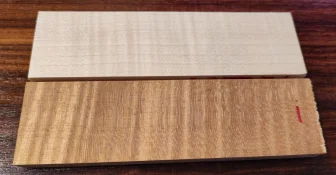
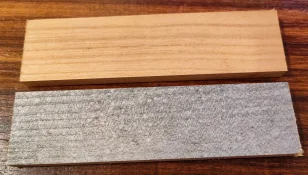
Baking the maple can achieve that coloring in a few hours. As for the cherry, looks weathered, not aged.
Big leaf can be lots of colors.You have to specify the species of maple because western big leaf is creamier and color. You can expose that to natural sunlight and it will get yellowish in color with direct sunlight. What you have I think is not big leaf variety as it is too white in color. Appears to be silver maple.
I have boards turn that color, but it took years to get it to developed that “violin amber” color and patina (let me see if I can locate it).
Mark and Paul is correct you can get that color hue on maple with the baked/roasted/torrefication treatment- but that particularly maple will not have that “freshness” if that sample piece was treated that way. Baked/roasted/torrefied maple will have the tendency to look “dry” and “dull” compare to air dried or kiln dried maple.
You mentioned that he used a finish? A shellac amber will get you that tint or an amber guitar finish (vintage clear) it is a typical clear tinted finish (yellow) applied so the maple doesn’t look sterile and looks aged/yellowed.
Here is a sample below (not mine) to show you the tinted versus clear on maple:
View attachment 218221
You are correct Mike- I wasn’t referring to burls but the typical sapwood western bigleaf in non figured types (plain sawn) and the ones with flame figuring. My favorite bigleaf are the spalted ones in flame and burl form- well non figured as well as I like the “fall color” patches.
nah- that is just what the GEEtar guys like- the white stuff so they can dye it purple. Big leaf-non burl can be as red as cherry.You are correct Mike- I wasn’t referring to burls but the typical sapwood western bigleaf in non figured types (plain sawn) and the ones with flame figuring. My favorite bigleaf are the spalted ones in flame and burl form- well non figured as well as I like the “fall color” patches.
Yeah, majority of builders do (the purist) but not me. I tend to like color on mine as well because I like the warmer tones and the natural work of Mother Nature. I like the myriad color patches on the flame and burls where it has analogous colors that range from yellows all the way to the red spectrum with browns, grays and black lines thrown in between. Those IMHO makes more of an interesting looking guitar tops- decoratively speaking.nah- that is just what the GEEtar guys like- the white stuff so they can dye it purple. Big leaf-non burl can be as red as cherry.
The cherry looks to be about 6 months to a year out in the weather. Sunlight is not solely responsible for this, I doubt. There may have been a bit of wind and rain involved.I'm asking you a wild guess: how long would it take to get this "aging" effect on maple?
View attachment 218218
And what about even getting to "gray" on cherry?
View attachment 218219
Can this process be accelerated or carried out artificially?
Paolo
Yes, older tanning lamps have high UV output and do work.So gray is not just light, but weather too.
I read something about using tanning lamps to age wood. Has anybody here tried it?
As usual, I am not willing to make anything nicer; I am just looking for a way to age samples in a reasonable amount of time so that I can measure their chatoyance before and after aging.
Cherry, and some other woods, will respond to a UV sunlamp but I don't know how quickly. With some woods color change is due to oxidization as much as UV but cherry is not one of them.So gray is not just light, but weather too.
I read something about using tanning lamps to age wood. Has anybody here tried it?
As usual, I am not willing to make anything nicer; I am just looking for a way to age samples in a reasonable amount of time so that I can measure their chatoyance before and after aging.