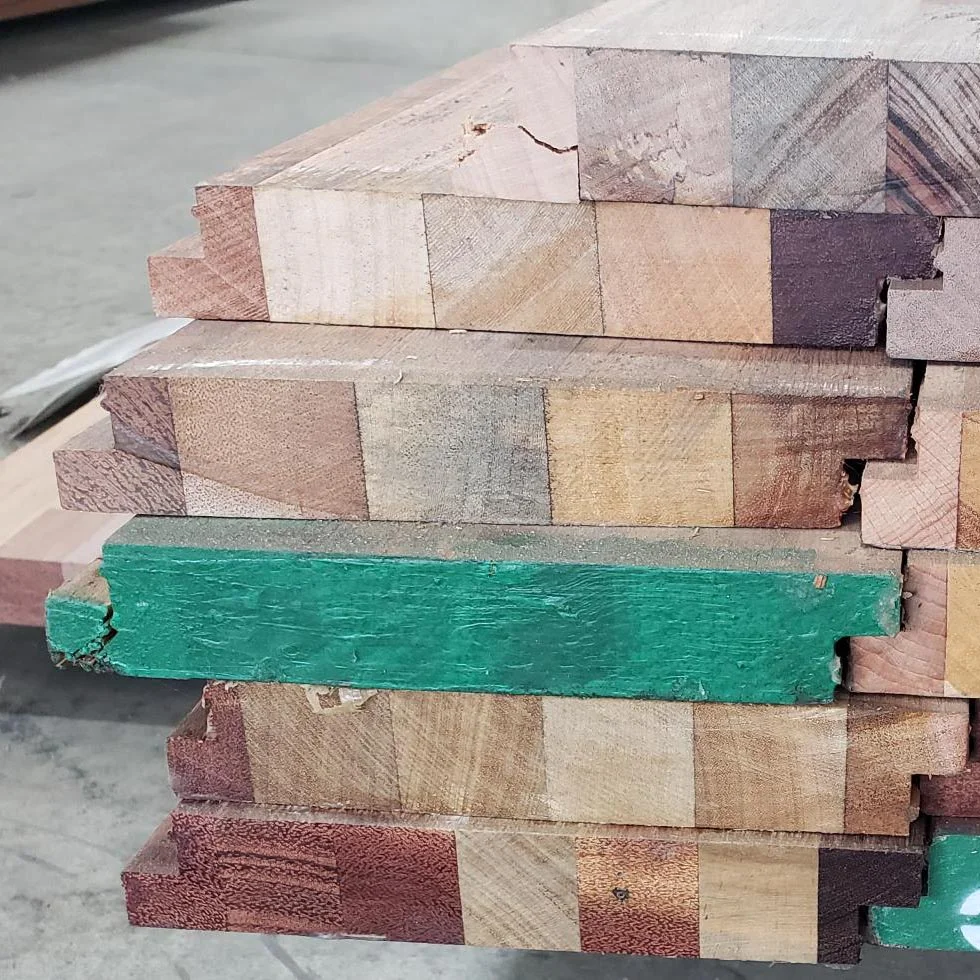
What free wood did you find today?

the stuff i have gotten is like this, but is 11 inches wide ship lap and up to about 48 foot long

Yeh, that's the stuff he has been getting - but not nearly that good looking. He pinches two pennies together thinner than just about anyone I know. A few years ago, when we had to repair a couple of overhead door openings (drivers didn't do a good job of backing in), he had some that was more gluelam. Three layers - top being something that was real wear resistant. They were glued together such that the fancy profiling of the edges did not have to happen - they interlock like the old tongue and groove gluelam rood deck used on churches and stuff.
 
No, they are not the same thing (close, but no cigar)

Laminated Veneer Lumber (LVL) and Glued Laminated Timber (Glulam) are similar in that they are both engineered wood products made by bonding together layers of wood. However, they are not the exact same thing.

LVL is typically made by layering veneers of wood together with adhesives to create a strong and versatile structural material. It is commonly used in beams, headers, and rimboards in construction.

Glulam, on the other hand, is made by bonding together solid sawn lumber pieces to create large structural members. Glulam beams are often used in heavy timber construction and architectural applications due to their strength and aesthetic appeal.

So, while both LVL and Glulam are engineered wood products that provide strength and stability, they are manufactured using slightly different processes and are used for different applications in construction.
Still referred to as glue lams in the trade...maybe not in the architect offices, but in the field by those that use them from Maryland to Maine. Not sure about other places. The names may have changed over the years. In the 1980's, LVL's were OSB rips, glued into a dado (either squared or V'ed) of solid stock, often long 2"x 2" or 2"x 3" material. They are often used for floor joist or ceiling rafters. They fail massively with any fire damage unlike traditional lumber. The trade is always changing.
 
Got to pick up a few of the pieces of a cedar elm that was taken down. There’s quite a lot left and I’m considering taking my trailer over there next week to help this fella get rid of some more of it…
61CCF659-7730-42EE-A6BA-0AC867E6CEB1.webp
36914C12-5866-4729-9F6D-8FAB596E2613.webp 30BC3EE8-8861-4891-9925-FB95456403BE.webp
 
I can definitely bring you a few pieces to try from what I did get! If I get a chance to go back, any particular orientation or sections you’d want to try in particular?
I am not particular, as I can cut to size. Thanks! Chuck
 
Does a cedar elm smell like a cedar?
Not really… when it’s green like this it actually doesn’t have a great smell. It’s not bad, but it’s pretty different from the oak and cedar/juniper varieties that we cut a lot of around here.
Once it’s dried, it doesn’t have much of a smell in my experience.

I'm not certain about this, but I’ve heard a couple explanations for the name “cedar elm” growing up here. One is that the color variation you see in the wood can be similar to cedar, the other is that because these elms grow in the same area(s) here that cedar trees are prevalent, they just get nicknamed.

To add to the confusion/story.., a lot of ash juniper (very invasive pest of a tree) grows here and chokes out the natural oak prairie and oak motts. People call these bushy ash juniper trees “cedar” because their foliage and smell are similar. The ash juniper is VERY invasive, and can drink incredible amounts of water, causing natural springs running to the surface from the aquifer and other seasonal water flows to dry up.

Cedar elms also have a very sprawling root system that can wreak havoc on plumbing, and they seek water aggressively. This may be another reason they got named “cedar elm.”

All this about why it’s named cedar elm is just my assumption, I don’t have it on authority, but it all kind of makes sense to me based on the rest of what I know … haha

 
Last edited:
You speak the truth Obi Wan. Junipers out here are the same and they've been allowed to become so populated it'd be nearly impossible to get rid of them.
To add to the confusion/story.., a lot of ash juniper (very invasive pest of a tree) grows here and chokes out the natural oak prairie and oak motts. People call these bushy ash juniper trees “cedar” because their foliage and smell are similar. The ash juniper is VERY invasive, and can drink incredible amounts of water, causing natural springs running to the surface from the aquifer and other seasonal water flows to dry up.
 
Not really… when it’s green like this it actually doesn’t have a great smell. It’s not bad, but it’s pretty different from the oak and cedar/juniper varieties that we cut a lot of around here.
Once it’s dried, it doesn’t have much of a smell in my experience.

I'm not certain about this, but I’ve heard a couple explanations for the name “cedar elm” growing up here. One is that the color variation you see in the wood can be similar to cedar, the other is that because these elms grow in the same area(s) here that cedar trees are prevalent, they just get nicknamed.

To add to the confusion/story.., a lot of ash juniper (very invasive pest of a tree) grows here and chokes out the natural oak prairie and oak motts. People call these bushy ash juniper trees “cedar” because their foliage and smell are similar. The ash juniper is VERY invasive, and can drink incredible amounts of water, causing natural springs running to the surface from the aquifer and other seasonal water flows to dry up.

Cedar elms also have a very sprawling root system that can wreak havoc on plumbing, and they seek water aggressively. This may be another reason they got named “cedar elm.”

All this about why it’s named cedar elm is just my assumption, I don’t have it on authority, but it all kind of makes sense to me based on the rest of what I know … haha
it is listed as an evergreen, with yellowing of leaves in winter but not dropping as in deciduous trees
 
it is listed as an evergreen, with yellowing of leaves in winter but not dropping as in deciduous trees
then again on another site it's listed as deciduous
internet says
Called Cedar Elm because of the rough, cedar scale-like texture of the leaves and because it is often found in the western part of its range with Ashe Juniper (Juniperus ashei), which is locally called "cedar." The Latin species name means "thick leaf."
 
Last edited:
It is completely deciduous here in Texas. Also called fall elm as seeds drop in fall. Tough hard wood - makes for great mallet heads. Turns ok. Jim
 
Turner moving from Maine to Puerto Rico so helped him out. Cherry, maple and wht oak. Has lots more but I’m picky and just took the best.

IMG_7453.webp
 
I cut up several Cedar Elms after the big storm this spring. It didn't smell terrible but I completely understand why the Elm tree got the name Piss Elm.
 
Back
Top