Is it native here?? You mentioned Australia. .............. Jerry (in Tucson)Jerry, I believe it is shoestring acacia, or River Cooba, as they call it in Australia, I have never worked with catsclaw Acacia so I dont know how they compare. I will have a finish on it by tomorrow, so I will show some pics then...

You are using an out of date browser. It may not display this or other websites correctly.
You should upgrade or use an alternative browser.
You should upgrade or use an alternative browser.
What did you do in your shop today?
- Thread starter woodtickgreg
- Start date

huisache is sweet acaciaNope, not huisache, definitely Acacia...
looks nothing like the shoestring acacia growing here in las vegasJerry, I believe it is shoestring acacia, or River Cooba, as they call it in Australia, I have never worked with catsclaw Acacia so I dont know how they compare. I will have a finish on it by tomorrow, so I will show some pics then...
the red and white bands are definitely sweet acacia also called huisache

Jerry, I believe it is shoestring acacia, or River Cooba, as they call it in Australia, I have never worked with catsclaw Acacia so I dont know how they compare. I will have a finish on it by tomorrow, so I will show some pics then...
lol this is your response to my huisache sweet acacia post from 5 yrs ago
[IMG alt="barry richardson"]https://data.woodbarter.com/avatars/m/0/673.jpg?1476284282[/IMG]
Global Moderator
Full Member
Messages10,237Reaction score16,647LocationBuckeye AZFirst nameBarry
Yup, sweet acacia, its very prone to cracking as it dries...
https://www.facebook.com/barryrichardsonwooddesign
[IMG alt="barry richardson"]https://data.woodbarter.com/avatars/m/0/673.jpg?1476284282[/IMG]
barry richardson
Moderator
Staff memberGlobal Moderator
Full Member
Messages10,237Reaction score16,647LocationBuckeye AZFirst nameBarry
Yup, sweet acacia, its very prone to cracking as it dries...
https://www.facebook.com/barryrichardsonwooddesign
Last edited:

Today in my shop I took an amazing nap.

I've done that a few times....my safe place!!Today in my shop I took an amazing nap.

Shoestring Acacia is originally from Australia, but like eucalyptus and many others, it has been introduced years ago to the southwest and CaliforniaIs it native here?? You mentioned Australia. .............. Jerry (in Tucson)
Im pretty familiar with sweet acacia, I have 3 of the trees on my property, and have worked with it a lot, here is some sweet acacia I turned a while back;looks nothing like the shoestring acacia growing here in las vegas
the red and white bands are definitely sweet acacia also called huisache

maybe we will just have to agree to disagree lol
i've seen a number of the shoestring and willow acacia stumps/cut off at ground level, none of which included the light and dark contrasting bands that are visible in your prior posted root ball, certainly possible caused by adverse growing conditions, just not familiar to meIm pretty familiar with sweet acacia, I have 3 of the trees on my property, and have worked with it a lot, here is some sweet acacia I turned a while back;
View attachment 252682
maybe we will just have to agree to disagree lol

About 25 years ago, I was in Indonesia working on building a power plant on the east end of Java. It was a short drive and then ferry to Bali, so I took a couple days off to check it out. I toured thru various craft villages, but the woodworkers really got my attention…and that’s 10 years before I got my first lathe. I ended up getting about a dozen carved pieces, including a teak coffee table and a pair of rhinos, this one the smallest about 15 pounds or so. The larger one over 25 lbs. Storage left these water mark drip lines so I decided to see what I could do to clean them up. 0000 steel wool followed by Ren wax looks good so far…will take a little time but worth it!
Oh, as to the wood??? I think the guy told me ebony…I’m not sure but it is heavy and dense. No, I’m not gonna put in the tub to see if it sinks!
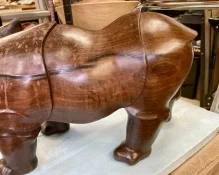
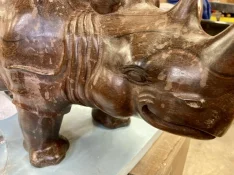
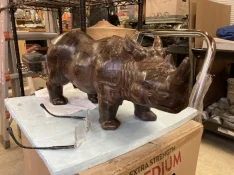
Oh, as to the wood??? I think the guy told me ebony…I’m not sure but it is heavy and dense. No, I’m not gonna put in the tub to see if it sinks!

Very cool. I saw carvings like that in Indonesia too, solid wood and heavy. I had no way to get one home and didn't want to pay the shipping. Plus I was worried about the statue drying out and cracking. Some smaller ones had done exactly that. Your's still look great.
Thanks Doug. The company paid for some belongings to be sent home based on duration there. That year I was away for about a year. It was a well packed crate, about 3x4x5…maybe bigger. Zero damage to the dozen or so pieces. Will have to get pic of elephant, it’s supposed to be ebony, it is very black and dense but could be the finish. Every bit of 40 lbs.Very cool. I saw carvings like that in Indonesia too, solid wood and heavy. I had no way to get one home and didn't want to pay the shipping. Plus I was worried about the statue drying out and cracking. Some smaller ones had done exactly that. Your's still look great.
Last edited:
I don't think they used stains much from what I saw. There was some movement to using carving tools like Dremels and grinders and stuff, versus the old hand tool methods. I bet your elephant is ebony.
Perhaps so. The interesting thing was how families would often make the same piece, differentiated by skill level and subsequent quality of details and finish.I don't think they used stains much from what I saw. There was some movement to using carving tools like Dremels and grinders and stuff, versus the old hand tool methods. I bet your elephant is ebony.
Here’s the elephant, 21” high and 24” long. Not one crack that I can see.

Pic?Perhaps so. The interesting thing was how families would often make the same piece, differentiated by skill level and subsequent quality of details and finish.
Here’s the elephant, 21” high and 24” long. Not one crack that I can see.
Oops…Pic?
 , and I suspect the non-USA version would be ivory…these are some light whitish wood.

Last edited:
Nice looking elephant. And I noticed the same thing - the designs were mostly the same no matter who's shop you went into. It was the same in Papua New Guinea. Although in PNG, one of their favorite designs was a wooden penis, and they carved them in all different sizes. Most shops had entire shelves full of them. Never did find anyone to explain the fascination with that design.
I used to know a few people i could ask about that, but i was younger and single then!!